

Under existing law, the Public Utilities Commission has regulatory authority over public utilities, including telephone corporations. Existing law establishes, among other funds related to telecommunications, the California Advanced Services Fund (CASF) in the State Treasury. Existing law requires the commission to develop, implement, and administer the CASF to encourage the deployment of high-quality advanced communications services to all Californians that will promote economic growth, job creation, and the substantial social benefits of advanced information and communications technologies. Existing law requires the commission to approve infrastructure projects supported by expenditures from the fund that provide last-mile broadband access to households that are unserved by an existing facilities-based broadband provider. This bill would establish the Rural Broadband and Emergency Infrastructure Grant Act of 2020 to ensure that all California fairgrounds are equipped with adequate broadband and telecommunications infrastructure to support local, regional, and state emergency and disaster response personnel and systems. The bill would, upon appropriation, require the Department of Technology, Department of Food and Agriculture, Public Utilities Commission, California Broadband Council, and Office of Emergency Services to jointly develop the Rural Broadband and Emergency Infrastructure Grant Program to provide each California fairground with grant moneys to support broadband and telecommunications infrastructure deployment.
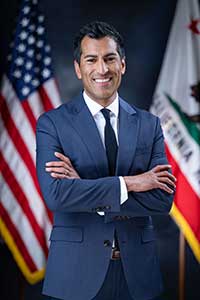
Asm. Robert Rivas
Sponsored bills
This measure would designate the week of February 24, 2020, to March 1, 2020, as Eating Disorders Awareness Week.
Existing law establishes a statewide system of public elementary and secondary education under which local educational agencies throughout the state provide instruction and other services to pupils in kindergarten and grades 1 to 12, inclusive. Existing law establishes the State Department of Education, under the administration of the Superintendent of Public Instruction, and assigns to that department numerous duties and responsibilities with respect to the funding and governance of this system. The California State Lottery Act of 1984, an initiative measure approved by the voters at the November 6, 1984, statewide general election, authorizes a California State Lottery and provides for its operation and administration by the California State Lottery Commission and the Director of the California State Lottery, with certain limitations. The act requires all revenues from the imposition of the lottery after accrual of all obligations for prizes and expenses to be deposited in the California State Lottery Education Fund. The act continuously appropriates the moneys in the fund for the benefit of public education, as specified. Following the end of each fiscal year, existing law requires the commission to calculate and report to the Controller and the Legislature the amount of total net revenues allocated to the benefit of public education from that fund. This bill would require the department, commencing on or before October 1, 2021, and on or before October 1 of each year thereafter, to submit a report of the total amount of lottery funds allocated to public elementary and secondary schools in the school year ending the preceding July 1. The bill would require the report to specify the amount received by each school and to describe how each school expended these funds. The bill would require the report to be submitted to the Governor and to the respective chairpersons of the Committees on Budget and Education of the Assembly and the Senate. This bill would amend the California State Lottery Act to specify that revenues of the California State Lottery are to be allocated so as to ensure that the relationship between increases in the net revenue of the California State Lottery and increases in funding allocated to public education is directly proportional. This bill would declare that its provisions further the purposes of the California State Lottery Act.
Existing law prohibits a person from selling or otherwise furnishing tobacco products, as defined, to a person under 21 years of age. Existing law, the Stop Tobacco Access to Kids Enforcement (STAKE) Act, provides for enforcement of that prohibition by the Attorney General. This bill would require the Attorney General to establish and maintain on the Attorney General's internet website a list of tobacco product brand styles that lack a characterizing flavor, as defined. The bill would authorize the Attorney General to require a manufacturer or importer of tobacco products to submit a list of all brand stages of tobacco products they manufacturer or import to the Attorney General. The bill would authorize manufacturers and importers of tobacco products to submit to the Attorney General a list of all brand styles, as defined, of tobacco products that they manufacture or import for sale or distribution in or into California that lack a characterizing flavor. The bill would require a manufacturer or importer that submits a product pursuant to these provisions to, under penalty of perjury, describe each brand style and state that it lacks a characterizing flavor. By expanding the scope of the crime of perjury, this bill would create a state-mandated local program. The bill would require the Attorney General to determine whether each brand style has a characterizing flavor, as specified. The bill would require any manufacturer or importer that submits a product in this way to, among other things, consent to the jurisdiction of the California courts for the purpose of enforcing these provisions and to appoint an agent for service of process, as specified. The bill would authorize the Attorney General to recover reasonable attorney's fees, investigative costs, and other related costs, against an entity that makes a clearly frivolous submission to the Attorney General for inclusion on the list. The bill would require moneys recovered by the Attorney General in an action pursuant to these provisions to be deposited in the Public Rights Law Enforcement Special Fund, as specified. The California Constitution requires the state to reimburse local agencies and school districts for certain costs mandated by the state. Statutory provisions establish procedures for making that reimbursement. This bill would provide that no reimbursement is required by this act for a specified reason. This bill would declare that it is to take effect immediately as an urgency statute.
The California Coastal Act of 1976 requires any person undertaking development in the coastal zone to obtain a coastal development permit issued by the California Coastal Commission for a project, as defined, in accordance with prescribed procedures. This bill would require the commission, on or before July 1, 2021, to adopt regulations to expedite the process of reviewing and acting upon applications for coastal development permits for projects that either include affordable housing units or in which 100% of the units will be affordable to households making 80% or below the median income.
This measure would declare March 5, 2020, as Family Justice Center Day in California and would recognize the lifesaving and hope-giving work of the California Family Justice Center Network and its member Family Justice Centers as they work with rape crisis centers, domestic violence shelters, human trafficking agencies, prosecutors' offices, law enforcement agencies, and other professionals and community-based organizations to ensure that adult and child survivors of trauma can access all of their services in one setting.
This measure would recognize March 7, 2020, as California Arbor Day, and would urge California residents to observe the day with appropriate tree-planting activities and programs.
(1) Existing law, the Brady-Jared Teen Driver Safety Act of 1997, establishes a provisional licensing program and generally requires that a driver's license issued to a person at least 16 years of age but under 18 years of age be issued pursuant to that provisional licensing program. Existing law requires a person to hold an instruction permit for not less than 6 months prior to applying for a provisional license. During the first 12 months after issuance of a provisional license, existing law prohibits the licensee from driving between the hours of 11 p.m. and 5 a.m. and transporting passengers who are under 20 years of age, as specified. Existing law provides limited exceptions to these restrictions under which a licensee is authorized to drive under specified circumstances. A violation of these provisions is punishable as an infraction. This bill would, commencing July 1, 2022, expand the scope of the provisional licensing program by expanding the applicable age range for the program to persons at least 16 years of age, but under 21 years of age. The restrictions on provisional licensees described above would apply during the first 6 months after issuance of a provisional license to a licensee who is 18, 19, or 20 years of age, subject to specified exemptions. The bill would, commencing July 1, 2022, require a person at least 18 years of age, but under 21 years of age, to hold an instruction permit for at least 60 days before applying for a provisional license. By expanding the scope of the provisional licensing program, the violation of which constitutes an infraction, the bill would impose a state-mandated local program. The bill would, commencing July 1, 2022, make other technical and conforming changes. The bill would also include specified findings and declarations. (2) Existing law generally authorizes the Department of Motor Vehicles, for good cause, to issue an instruction permit to any physically and mentally qualified person who applies to the department for an instruction permit and who meets any one of 5 specified requirements, including that the person is 17 years and 6 months of age or older. The bill would, commencing July 1, 2022, raise the age for the above requirement to 20 years and 6 months. Existing law provides that a person, while having in the person's immediate possession a valid permit issued pursuant to the above provisions, may operate a motor vehicle, other than a motorcycle or a motorized bicycle, when accompanied by, and under the immediate supervision of, a California-licensed driver with a valid license of the appropriate class, 18 years of age or over whose driving privilege is not on probation, as specified. A violation of this provision is punishable as an infraction. The bill would, commencing July 1, 2022, for purposes of supervising a person issued a valid permit as described above, raise the required age of the California-licensed driver to 21 years of age. By changing the definition of an existing infraction, the bill would impose a state-mandated local program. (3) Existing law prohibits a person from owning or operating a driving school or giving driving instruction for compensation without a license issued by the Department of Motor Vehicles. The bill would require an owner or operator of a driving school or an independent driving instructor, as a condition of obtaining a new license or renewed license from the department on and after July 1, 2022, to offer and accept installment payments, as specified, for the compensation to provide the instruction required by the Brady-Jared Teen Driver Safety Act of 1997. The bill would also authorize the Department of Motor Vehicles, on or after January 1, 2021, to charge a driving school, as specified, a fee not to exceed $1 for each driver education or driver training certificate of completion furnished by the department and issued to a person who has demonstrated satisfactory completion of a certified driver education and driver training course, in order to recover the department's reasonable costs in administering the provisional licensing program, including covering the department's costs in implementing the program. The bill would prohibit a driving school from charging an applicant a fee for a certificate of completion that exceeds the fee the department charges the school. (4) The California Constitution requires the state to reimburse local agencies and school districts for certain costs mandated by the state. Statutory provisions establish procedures for making that reimbursement. The bill would provide that no reimbursement is required by this act for a specified reason.