This measure would declare April 28, 2022, as Take Our Daughters and Sons to Work Day, and would recognize the goals of introducing our daughters and sons to the workplace and commend all participants of Take Our Daughters And Sons To Work Day.
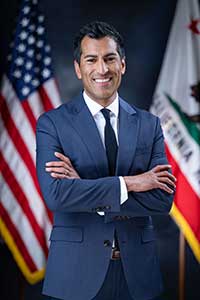
Asm. Robert Rivas
Sponsored bills
This measure would designate the week of May 1, 2022, through May 7, 2022, as Compost Awareness Week.
The Control, Regulate and Tax Adult Use of Marijuana Act (AUMA) , an initiative measure approved as Proposition 64 at the November 8, 2016, statewide general election, authorizes a person who obtains a state license under AUMA to engage in commercial adult-use cannabis activity pursuant to that license and applicable local ordinances. The Medicinal and Adult-Use Cannabis Regulation and Safety Act (MAUCRSA) , among other things, consolidates the licensure and regulation of commercial medicinal and adult-use cannabis activities and requires the Department of Cannabis Control to administer its provisions. Under MAUCRSA, the Department of Cannabis Control has sole authority to license and regulate commercial cannabis activity, which MAUCRSA defines to include, among other activities, the sale of cannabis and cannabis products. This bill would require the department to issue temporary event cultivator retail licenses that authorize the license holder to sell cannabis or cannabis products, containing cannabis cultivated by that licensee, at specified state temporary events licensed under the act. The bill would authorize a licensee who holds a valid state cultivation license and a valid license, permit, or other authorization for cannabis cultivation issued by a local jurisdiction, and who cultivates no more than one acre of cannabis, as provided, or is an equity applicant or licensee, as defined, to apply for a temporary event cultivator retail license. The bill would require a temporary event cultivator retail licensee to comply with all requirements imposed on cannabis retailers selling cannabis or cannabis products at a state temporary event, unless otherwise specified. The bill would specify that a temporary event cultivator retail license is valid only for the specific state temporary event for which it was issued, and would limit the number of temporary event cultivator retail licenses issued to each licensee to 8 per calendar year. AUMA authorizes the Legislature to amend its provisions with a 23 vote of both houses to further its purposes and intent. This bill would state that the bill furthers the purposes and intent of AUMA.
Existing law establishes the California Community Colleges, under the administration of the Board of Governors of the California Community Colleges, as one of the segments of public postsecondary education in this state. The board of governors appoints the Chancellor of the California Community Colleges as the chief executive officer of the segment. Existing law establishes the California Online Community College, under the administration of the board of governors, for purposes of creating an organized system of accessible, flexible, and high-quality online content, courses, and programs focused on providing industry-valued credentials compatible with the vocational and educational needs of Californians who are not currently accessing higher education. This bill would make the California Online Community College Act inoperative on January 1, 2024. On or before January 1, 2024, the bill would appropriate the California Online Community College's funding for specified purposes at the California Community Colleges, as provided.
This measure would proclaim, in perpetuity, the month of April as California Wines: Down to Earth Month, to celebrate the sustainable leadership of California wineries and winegrape growers throughout the month of April.
Existing law, referred to as the Medical Injury Compensation Reform Act of 1975 (MICRA) , prohibits an attorney from contracting for or collecting a contingency fee for representing any person seeking damages in connection with an action for injury or damage against a health care provider based upon alleged professional negligence in excess of specified limits. This bill would recast those provisions and base the amount of contingency fee that may be contracted for upon whether recovery is pursuant to settlement agreement and release of all claims executed before a civil complaint or demand for arbitration is filed, or pursuant to settlement, arbitration, or judgment after a civil complaint or demand for arbitration is filed, as specified. The bill would add and revise definitions for these purposes. Existing law provides that in any action against a health care provider based upon professional negligence, the injured plaintiff is entitled to recover noneconomic losses to compensate for pain, suffering, inconvenience, physical impairment, disfigurement, and other nonpecuniary damage. Existing law limits the amount of damages for noneconomic losses in an action for injury against a health care provider based on professional negligence to $250,000. This bill would remove the $250,000 limit on noneconomic damages and expand the recast provisions to include an action for injury against a health care institution, as defined. The bill would increase the applicable limitation based upon whether the action for injury involved wrongful death. The bill would specify that these limitations would increase by $40,000 each January 1st for 10 years and beginning on January 1, 2034, the applicable limitations on noneconomic damages for personal injury and for wrongful death would be adjusted for inflation on January 1st of each year by 2%. Existing law specifies that in any action for injury or damages against a provider of health care services, a superior court shall, at the request of either party, enter a judgment ordering that money damages or its equivalent for future damages of the judgment creditor be paid in whole or in part by periodic payments rather than by a lump-sum payment if the award equals or exceeds $50,000. This bill would increase the minimum amount of the judgment required to request periodic payments to $250,000. Existing law makes statements, writings, or benevolent gestures expressing sympathy or a general sense of benevolence relating to the pain, suffering, or death of a person involved in an accident and made to that person, or to the family of that person, inadmissible as evidence of an admission of liability in a civil action. This bill would specify that statements, writings, or benevolent gestures expressing sympathy, regret, a general sense of benevolence, or suggesting, reflecting, or accepting fault relating to the pain, suffering, or death of a person, or to an adverse patient safety event or unexpected health care outcome, as specified, shall be confidential, privileged, protected, not subject to subpoena, discovery, or disclosure, and shall not be used or admitted into evidence in any civil, administrative, regulatory, licensing, or disciplinary board, agency, or body action or proceeding, and shall not be used or admitted in relation to any sanction, penalty, or other liability, as evidence of an admission of liability or for any other purpose.

Existing law establishes the Division of Occupational Safety and Health, known as Cal-OSHA, in the Department of Industrial Relations. Existing law prohibits a person from acting as a farm labor contractor without a license issued by the Labor Commissioner, and requires a licensed farm labor contractor to comply with various employment laws and practices, including providing training in sexual harassment in the language understood by the agricultural employee. This bill would require Cal-OSHA to establish and administer a program to commence July 1, 2023, except as specified, by contracting with community-based organizations to provide prescribed outreach services to farmworkers in indigenous languages. The bill would require the contracted community-based organizations to conduct initial outreach within 3 months of implementation of the program. The bill would require Cal-OSHA to provide a liaison in each of its regions to work directly with community-based organizations to answer questions and respond to complaints that arise from indigenous language speakers. The bill would also require Cal-OSHA to provide technical support for community-based organizations to interpret regulations adopted pursuant to the bill and to help develop outreach materials that are culturally appropriate for farmworkers who speak indigenous languages. The bill would require Cal-OSHA, on and after January 1, 2023, to track and post on its internet website prescribed information relating to the program. The bill would require Cal-OSHA, on or before December 31, 2028, to submit a report to the Legislature evaluating the implementation of the program, including aspects of the outreach that were successful or could be improved, among other things.
Under existing law, the State Water Resources Control Board and the 9 California regional water quality control boards regulate water quality and prescribe waste discharge requirements in accordance with the federal national pollutant discharge elimination system (NPDES) permit program established by the federal Clean Water Act and the Porter-Cologne Water Quality Control Act. Existing law requires each regional board to formulate and adopt water quality control plans for all areas within the region, as provided. Existing law authorizes the imposition of civil penalties for violations of certain waste discharge requirements and requires that penalties imposed pursuant to these provisions be deposited into the Waste Discharge Permit Fund, to be expended by the state board, upon appropriation by the Legislature, for specified purposes related to water quality. For violations of certain other waste discharge requirements, including the violation of a waste discharge requirement effluent limitation, existing law imposes specified civil penalties, the proceeds of which are deposited into the continuously appropriated State Water Pollution Cleanup and Abatement Account, which is established in the State Water Quality Control Fund. This bill would create within the Waste Discharge Permit Fund the Waterway Recovery Account, the Citizen Monitoring Account, the Community Capacity Building Account, and the Stormwater Innovation Account, and, subject to future legislation, would annually transfer from the annual proceeds of the State Water Pollution Cleanup and Abatement Account, subject to a future legislative act, the following amounts: 30% to the Waterway Recovery Account; 5% to the Citizen Monitoring Account, but in no instance less than $250,000; 10% to the Community Capacity Building Account, but in no instance less than $500,000; and 5% to the Stormwater Innovation Account. The bill would require moneys in the Waterway Recovery Account to be distributed by the state board, upon appropriation by the Legislature, to each regional board on a pro rata basis to expend on specified purposes, including, among others, restoration projects that improve water quality. The bill would provide that moneys in each of the other 3 accounts created by the bill are available for the state board to expend, upon appropriation by the Legislature, for the following purposes: for the Citizen Monitoring Account, to fund a specified state board program to increase water quality monitoring or to establish a priority water-contact recreation site monitoring program; for the Community Capacity Building Account, to create and fund a community capacity program to increase disadvantaged and tribal community participation in state board outreach and regulatory processes; and for the Stormwater Innovation Account, for specified activities relating to stormwater best management practices.
Existing law, the California Emergency Services Act, establishes the Office of Emergency Services within the Governor's office under the supervision of the Director of Emergency Services and makes the office responsible for the state's emergency and disaster response services for natural, technological, or man-made disasters and emergencies. Existing law sets forth various provisions on fairgrounds owned or operated by a district agricultural association, the California Exposition and State Fair, county fairs, and citrus fruit fairs. This bill would, upon an appropriation by the Legislature for this purpose, require the Office of Emergency Services to establish a grant program on or before January 1, 2024, to provide fairs with grant funding for purposes of building and upgrading broadband communication infrastructure on fairgrounds. The bill would require the office to establish standards to determine how fairs receive grant funding based on the fairgrounds' need for broadband capabilities in order to service an emergency response operation. In regard to the standards, the bill would require that fairs eligible for funding meet certain criteria, including being capable of providing publicly available broadband access to the fair's broadband network throughout the year. The bill also would authorize the office to prioritize the order of grant disbursements based on specified criteria, including the frequency in which fairgrounds are used as an emergency staging area, evacuation center, community resilience center, or other relevant emergency response site. The bill would require the office to consult with the Department of Technology and the Department of Food and Agriculture to coordinate the statewide deployment of broadband communication infrastructure on fairgrounds. For purposes of the grant program, the bill would define "fair" to mean a district agricultural association, the California Exposition and State Fair, a county fair, or a citrus fruit fair.
Existing law requires the Department of Resources Recycling and Recovery to establish a farm and ranch solid waste cleanup and abatement grant program for the purposes of cleaning up and abating the effects of illegally disposed solid waste. The program makes grants available to public entities and Native American tribes for these purposes. Existing law also creates the Farm and Ranch Solid Waste Cleanup and Abatement Account in the General Fund for expenditure by the department, upon appropriation by the Legislature in the annual Budget Act, for purposes of the program. Existing law prohibits the sum of all funds transferred into the account from other funds or accounts from exceeding $1,000,000 annually. This bill would require the department to establish a pilot program, until January 1, 2028, that would make grants available to public entities and Native American tribes on behalf of applicants who are farmers and ranchers and for the purposes of the farm and ranch solid waste cleanup and abatement grant program, as described. The bill, until January 1, 2028, would make the $1,000,000 annual maximum amount of funds that may be transferred into the account inoperative and would prohibit moneys contributed to the farm and ranch solid waste cleanup and abatement grant program from specified sources from collectively exceeding $1,000,000 annually. The bill would require that any amount over $1,000,000 that is transferred into the account on an annual basis be available for the purposes of the pilot program, upon appropriation by the Legislature. The bill would authorize the department to provide for the deposit into the account of philanthropic and federal funding for the purposes of the pilot program, as provided.