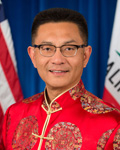
Photo of Kansen Chu
D California House · District 25

Rep. Kansen Chu

Compare
Total votes
23,696
all sessions
Attendance
96%
825 missed
Higher than 76% of chamber peers
With party
99%
of cast votes
Higher than 75% of chamber peers
Bipartisan score
0%
crosses aisle rarely
Lower than 77% of chamber peers
Sponsored
1,534
bills & resolutions
Near the chamber average
Committees
0
assignments
1,534 bills and resolutions

Sponsored bills

Total
1,534
Primary
206
Co-sponsor
1,328
This page
1,534
matching current filters
Co-sponsor ACA 14
Failed · California House · Co-sponsor
A resolution to propose to the people of the State of California an amendment to the Constitution of the State, by adding Section 9.5 to Article IX thereof, relating to the University of California.

Existing provisions of the California Constitution establish the University of California as a public trust under the administration of the Regents of the University of California. The California Constitution grants to the regents all the powers necessary or convenient for the effective administration of this public trust. Pursuant to the California Constitution, there are 7 ex officio members of the regents and 18 appointive members appointed by the Governor and approved by the Senate, a majority of the membership concurring. This measure would enact the University of California Equal Employment Opportunity Standards Act, which would, effective January 1, 2021, except as specified, require the regents to ensure that all contract workers, as defined, who are paid to perform support services for students, faculty, patients, or the general public at any campus, dining hall, medical center, clinic, research facility, laboratory, or other university location, are at all times subject to and afforded the same equal employment opportunity standards, as defined, as university employees performing similar services. The measure would authorize the regents, or any campus or other entity of the University of California, to contract for, or otherwise arrange to use, contract labor, as defined, to perform support services only under specified conditions, only if authorized to do so by statute, and only to the extent necessary to address one or more of prescribed needs. The measure would authorize the Legislature to enact statutes to further the purposes of, and to aid the enforcement of, this measure.

Failed Sep 1, 2020 1 co-sponsor
Co-sponsor ACR 115
Passed · California House · Co-sponsor
Relative to gun-related businesses.

This measure would urge each bank with which the State of California has a business relationship to evaluate its commercial relationship with gun manufacturers and to consider the repercussions of that relationship, and urge all banks to discuss their lending practices with their shareholders and to adopt lending practices that mirror the people of California's values of protecting citizens before profit.

Passed Sep 1, 2020 1 co-sponsor
Co-sponsor SB 793
Signed into law · California Senate · Co-sponsor
Flavored tobacco products.

Existing law, the Stop Tobacco Access to Kids Enforcement (STAKE) Act, prohibits a person from selling or otherwise furnishing tobacco products, as defined, to a person under 21 years of age. Existing law also prohibits the use of tobacco products in county offices of education, on charter school or school district property, or near a playground or youth sports event, as specified. This bill would prohibit a tobacco retailer, or any of the tobacco retailer's agents or employees, from selling, offering for sale, or possessing with the intent to sell or offer for sale, a flavored tobacco product or a tobacco product flavor enhancer, as those terms are defined, except as specified. The bill would make a violation of this prohibition an infraction punishable by a fine of $250 for each violation. The bill would state the intent of the Legislature that these provisions do not preempt or prohibit the adoption and implementation of local ordinances that impose greater restrictions on the access to tobacco products than the restrictions imposed by the bill, as specified. The bill would state that its provisions are severable. By creating a new crime, the bill would impose a state-mandated local program. The California Constitution requires the state to reimburse local agencies and school districts for certain costs mandated by the state. Statutory provisions establish procedures for making that reimbursement. This bill would provide that no reimbursement is required by this act for a specified reason.

Signed into law Aug 28, 2020 1 co-sponsor
Primary AB 1107
Passed · California House · Lead sponsor
Proclaimed state emergencies: proclamations, materials, and announcements: translation.

Existing law, the California Emergency Services Act, authorizes the Governor to proclaim a state of emergency when specified conditions of disaster or extreme peril to the safety of persons and property exist, and to exercise certain powers in response to that emergency. Existing law defines the term "state of emergency" to mean the duly proclaimed existence of conditions of disaster or of extreme peril to the safety of persons and property within the state caused by, among other things, fire, storm, riot, epidemic, or cyberterrorism. Existing law requires the State Department of Health Care Services to require managed care plans providing Medi-Cal services to provide language assistance services to limited-English-proficient (LEP) beneficiaries. Existing law requires the department to determine, at least every 3 years, or more often as specified, when an LEP population meets the requirement for translation services by using a numeric threshold, including a population group of at least 3,000 or 5% of the beneficiary population, whichever is fewer, mandatory managed care Medi-Cal beneficiaries, residing in the service area, who indicate their primary language as other than English. This bill would require all proclamations, materials, and announcements made by the Governor or issued by a state agency related to a duly proclaimed state of emergency to be made available statewide in all the threshold languages spoken by LEP speakers. The bill would define the term "threshold languages spoken by limited-English-proficient speakers" to mean all Medi-Cal threshold languages spoken by any threshold population group, without limitation to county-specific thresholds, that are determined by the State Department of Health Care Services pursuant to the above-described language assistance services provisions.

Passed Aug 20, 2020 0 co-sponsors
Co-sponsor AB 125
Passed · California House · Co-sponsor
Early childhood education: reimbursement rates.

(1) The Child Care and Development Services Act establishes a system of childcare and development services for children up to 13 years of age. Existing law requires the Superintendent of Public Instruction to implement a plan that establishes reasonable standards and assigned reimbursement rates, which vary with the length of the program year and the hours of service. Existing law requires the reimbursement system to be submitted to the Joint Legislative Budget Committee. This bill would require the Superintendent to implement a reimbursement system plan that establishes reasonable standards and assigned reimbursement rates that would vary with additional factors, including a quality adjustment factor to address the cost of staffing ratios, as provided. The bill would require the reimbursement system plan, including methodology, standards, county rate targets as provided, and the total statewide funding amount necessary to reach annual rate targets for all agencies to be annually submitted to the Joint Legislative Budget Committee, on or before November 10. The bill would require the plan to include a formula for annually adjusting reimbursement rates, as provided. The bill would require the department, by July 1, 2020, and annually thereafter, as provided, to establish a reimbursement rate target for each contracting agency that meets specific quality standards based on specified elements, including quality adjustment factors for the age range of children proposed to be served by the contracting agency, as a multiplier, which the bill would also require the department to establish. (2) Existing law establishes adjustment factors for a provider agency's reported child days of enrollment in order to reflect the additional expense of serving specified children, including an adjustment factor for infants and toddlers who are 0 to 36 months and are served in a child daycare center or family childcare home, as provided. This bill would, as of July 1, 2020, delete the above adjustment factors and would make conforming changes. (3) Existing law requires reimbursement rates to be adjusted by specified adjustment factors for childcare and development programs and, for childcare and development providers serving children for less than 4 hours per day, requires the reimbursement factor to be 55% of the standard reimbursement rate. This bill would instead require the above-described reimbursement factor to be 50% of the standard reimbursement rate. (4) The bill would make its operation contingent on the enactment of SB 174 of the 2019–20 Regular Session on or before January 1, 2020.


Passed Aug 20, 2020 1 co-sponsor
Primary AB 2538
Passed · California House · Lead sponsor
Athlete agents: minor athletes: health and safety.

Existing law, the Miller-Ayala Athlete Agents Act, regulates various activities of an athlete agent in representing student athletes and professional athletes, including contact with athletes, contract negotiations, and required disclosures. The act authorizes an athlete agent to offer or provide money or any other thing of benefit or value to a student athlete, if it is authorized by, and is in compliance with, an official written policy of the elementary or secondary school, college, university, or other educational institution of the student athlete and the terms of the contract comply with the bylaws of the National Collegiate Athletic Association. Under existing law, an athlete agent or athlete agent's representative or employee who violates any provision of the act is guilty of a misdemeanor, punishable by a fine of not more than $50,000, or imprisonment in a county jail not exceeding one year, or both fine and imprisonment. This bill would prohibit an athlete agent from sending or causing to be sent, a minor who is an athlete to any location that would be hazardous or detrimental to the health, safety, morals, or education of the minor, as specified. The bill would prohibit an athlete agent from entering any contract on behalf of an athlete who is a minor that requires the minor to appear at any event or establishment where alcoholic beverages or other intoxicating substances are sold to be consumed on the premises or where they are served, except as specified. By expanding the scope of a crime, the bill would impose a state-mandated local program. The California Constitution requires the state to reimburse local agencies and school districts for certain costs mandated by the state. Statutory provisions establish procedures for making that reimbursement. This bill would provide that no reimbursement is required by this act for a specified reason.

Passed Aug 20, 2020 0 co-sponsors
Co-sponsor AB 123
Passed · California House · Co-sponsor
Early childhood education: childcare and development programs.

(1) The Child Care and Development Services Act, administered by the State Department of Education, requires the Superintendent of Public Instruction to administer childcare and development programs that offer a full range of services to eligible children from infancy to 13 years of age, inclusive. The act requires that families meet specified requirements to be eligible for federal- and state-subsidized childcare and development services. This bill would extend eligibility to a family in which a member of that family has been certified as fully eligible to receive CalFresh or Medi-Cal benefits. The bill would require a parent to provide documentation of current enrollment in CalFresh or Medi-Cal, unless the contractor providing childcare and development services has, and elects to use, other means of obtaining verification of that enrollment. The bill would authorize a family to submit a self-certification of income that is signed by the parent for the purpose of prioritizing enrollment and calculating family fees. (2) Existing law requires the department to arrange intraagency adjustments between California state preschool contracts and general childcare contracts for the same agency and funding allocation, and to establish timelines for intraagency contract fund transfers. This bill would additionally require the department to allow and arrange for interagency adjustments between those contracts for the same agency or different agencies and the same funding allocation, and to establish timelines for those interagency contract fund transfers. (3) Existing law requires the Superintendent to implement a plan establishing assigned reimbursement rates, per unit of average daily enrollment, to be paid by the state to provider agencies for the provision of childcare and development services. Existing law provides for an adjustment factor to be applied to units of average daily enrollment if a provider agency serves children who meet specified criteria. Existing law sets the adjustment factor based on the age of the child served, among other criteria. This bill would require those adjustment factors to continue to apply irrespective of whether a child is served in a commingled classroom that serves children from 0 to 12 years of age. The bill, during the 2020–21 fiscal year, would authorize a contractor providing childcare and development services under the act to provide those services to children from 0 to 12 years of age in classrooms with children of varying ages. (4) Existing law requires the Superintendent to establish a fee schedule for families using preschool and childcare and development services, as specified, and requires family fees to be assessed at initial enrollment and reassessed at the update of certification or recertification. Existing law encourages child development contractors to develop and maintain a reserve within the child development fund in the county treasury, derived from earned but unexpended funds. Existing law authorizes reserve funds to be expended for specified purposes. Existing law requires that 10% of specified reserve funds to be used solely for the purpose of professional development for California state preschool program instructional staff. This bill would authorize a contractor to waive family fees for families who are enrolled but who receive services only through distance learning. The bill would provide that the cost of waiving family fees under the above-described provision is an allowable use of contract funds received for providing childcare and development services, and would authorize a contractor to use reserve funds to cover the costs of a waiver. The bill would also delete the requirement that 10% of the specified reserve funds be used for that professional development purpose.

Passed Aug 20, 2020 1 co-sponsor
Co-sponsor AB 2088
In committee · California House · Co-sponsor
Wealth tax.

Existing law imposes taxes upon income and real property, as well as taxes upon certain transactions and excise taxes. This bill would impose an annual tax at a rate of 0.4% of a resident of this state's worldwide net worth in excess of $30,000,000, or in excess of $15,000,000 in the case of a married taxpayer filing separately. The bill would describe worldwide net worth with reference to specific federal provisions and would provide that worldwide net worth does not include specific assets, including directly held real property or liabilities related to directly held real property. The bill would also authorize the Franchise Tax Board to adopt regulations to carry out these provisions, including regulations regarding the valuation of certain assets that are not publicly traded. Existing law requires the Franchise Tax Board to administer the Personal Income Tax Law. This bill would require the Franchise Tax Board to amend or create returns with regard to the Wealth Tax. This bill would include a change in state statute that would result in a taxpayer paying a higher tax within the meaning of Section 3 of Article XIIIA of the California Constitution, and thus would require for passage the approval of 23 of the membership of each house of the Legislature. This bill would take effect immediately as a tax levy.

In committee Aug 17, 2020 1 co-sponsor
Showing 11 to 20 of 1,534 bills