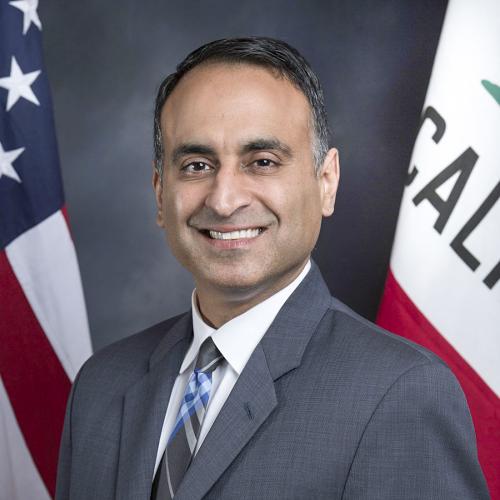
This measure would designate the month of November 2020 to be California's Sikh American Awareness and Appreciation Month. The measure would recognize and acknowledge the significant contributions made by Californians of Sikh heritage to our state and seeks to afford all Californians the opportunity to better understand, recognize, and appreciate the rich history and shared principles of Sikh Americans. The measure would condemn all hate crimes and bias incidents against Sikh Americans and encourage all Sikhs to practice their faith freely and fearlessly.
Asm. Ash Kalra
Sponsored bills
This measure would recognize June 21, 2020, as the 2020 International Day of Yoga in California.
Existing law establishes various environmental and economic policies. This bill would enact the California COVID-19 Recovery Deal. The bill would make a series of legislative findings and declarations pertaining to the coronavirus (COVID-19) pandemic and various economic, environmental, and social conditions in the state. The bill would state the intent of the Legislature that the state adopt a policy framework with principles and goals committed to accomplish specified economic, environmental, and social objectives and priorities as part of the state's COVID-19 recovery spending. The bill would state that the Legislature establishes various spending rules for the COVID-19 recovery, including adopting spending measures that prohibit businesses, organizations, or agencies from accepting public funds for any long-term projects that prolong the emission of greenhouses gases or lead to the expansion of fossil fuel projects and ensuring that recovery spending includes specific measures for California populations and communities most negatively impacted by COVID-19.
Existing law authorizes the use of a digital signature in any written communication with a public entity, as defined, in which a signature is required or used. Under existing law, if a public entity elects to use a digital signature, that digital signature has the same force and effect as the use of a manual signature if it embodies all of specified attributes, including being unique to the person using it and conforming to regulations adopted by the Secretary of State. Existing law requires the Secretary of State to have adopted the initial regulations for these provisions no later than January 1, 1997, including seeking the advice of public and private entities in developing these regulations and holding at least one public hearing to receive comments before adopting the regulations. This bill would delete the above-described language requiring the adoption of the initial regulations, as prescribed. The bill would instead require digital signatures to conform to regulations adopted by the Secretary of State pursuant to specified procedures. The bill would further require the Secretary of State to adopt emergency regulations to provide appropriate and timely guidance to public entities and the public generally regarding the signature requirements and to make the regulatory changes needed to update these provisions no later than March 1, 2022, in accordance with the Administrative Procedure Act. The bill would make the emergency regulations adopted pursuant to these provisions effective only until nonemergency, final regulations are adopted and become effective through the regular rulemaking process.
(1) Under existing law, the Public Utilities Commission has regulatory authority over public utilities, including electrical corporations. The Public Utilities Act requires the commission to review and accept, modify, or reject a procurement plan for each electrical corporation in accordance with specified requirements and objectives. The act requires the commission to adopt appropriate procedures to ensure the confidentiality of any market sensitive information submitted in an electrical corporation's proposed procurement plan or resulting from or related to the electrical corporation's approved procurement plan. This bill would require the procedures adopted by the commission to ensure that all information that is reasonably necessary to verify the accuracy of any cost an electrical corporation seeks to recover in rates and charges assessed on bundled or unbundled ratepayers is available without unreasonable restriction to a person participating in commission proceedings in which an electrical corporation seeks approval to recover those costs. The bill would require the commission to ensure that this information is provided for inspection to other load-serving entities in those proceedings, as specified. (2) Existing law requires a public utility to furnish reports and other information as the commission may require. This bill would require the commission to require an electrical or gas corporation to annually submit a report to the commission that identifies the electrical or gas corporation's equipment that is past its useful life and natural gas and diesel backup generation, and that provides related maintenance and safety information, as specified. The bill would require the commission to make those reports available to the public, except as provided. (3) Under existing law, a violation of the Public Utilities Act or any order, decision, rule, direction, demand, or requirement of the commission is a crime. Because the provisions of this bill would be a part of the act and a violation of its provisions or a related order or decision of the commission would be a crime, the bill would impose a state-mandated local program. (4) Existing constitutional provisions require that a statute that limits the right of access to the meetings of public bodies or the writings of public officials and agencies be adopted with findings demonstrating the interest protected by the limitation and the need for protecting that interest. This bill would make legislative findings to that effect. (5) The California Constitution requires the state to reimburse local agencies and school districts for certain costs mandated by the state. Statutory provisions establish procedures for making that reimbursement. This bill would provide that no reimbursement is required by this act for a specified reason.
Existing law requires a city, county, or city and county to administratively approve an application to install an electric vehicle charging station through the issuance of a building permit or similar nondiscretionary permit subject to a limited review by the building official of that city, county, or city and county. Existing law allows the building official to require the applicant to apply for a use permit if the official finds that the station could have a specific adverse impact upon the public health or safety and prohibits the city, county, or city and county from denying the application for a use permit to install an electric vehicle charging station unless it makes written findings that the proposed installation would have a specific adverse impact upon the public health or safety, and there is no feasible method to satisfactorily mitigate or avoid the specific adverse impact. Existing law requires every city, county, and city and county to create an expedited, streamlined permitting process for electric vehicle charging stations and to adopt a checklist pursuant to which an applicant that satisfies the information requirements shall be deemed complete and therefore eligible for expedited review. This bill would require an application to install an electric vehicle charging station to be deemed complete if, 5 business days after the application was submitted, the building official of the city, county, or city and county has not deemed the application complete, as specified, and if the building official has not issued a one-written correction notice, as specified. The bill would require an application to install an electric vehicle charging station to be deemed approved if 15 business days after the application was deemed complete certain conditions are met, including that the building official of the city, county, or city and county has not approved the application, as specified, and the building official has not made findings that the proposed installation could have an adverse impact, as described above, and required the applicant to apply for a use permit. This bill would declare that it is to take effect immediately as an urgency statute.
Existing law, the California Art Preservation Act (CAPA) , prohibits certain acts relating to the physical alteration or destruction of fine art, defined as an original painting, sculpture, or drawing, or an original work of art in glass, of recognized quality, other than a work prepared under contract for commercial use by its purchaser, including the intentional defacing, mutilating, altering, or destruction of a work of fine art except by an artist who owns and possesses a work of fine art that the artist has created. Existing law requires a trier of fact regarding the question of whether a work of art is of recognized quality to rely on the opinions of artists, art dealers, collectors of fine art, curators of art museums, and other persons involved with the creation or marketing of fine art. This bill would require a trier of fact to additionally rely on the visibility of the work, community recognition awards attributable to the work, and recognition and awards received by the artist of the work. CAPA provides that if a work of fine art cannot be removed from a building without substantial physical defacement, mutilation, alteration, or destruction of the work, the rights and duties described above, unless expressly reserved by an instrument in writing signed by the owner of the building, containing a legal description of the property and properly recorded, shall be deemed waived. The law also provides that if a work of fine art can be removed from a building without substantial harm to the fine art, and in the course of or after removal, the owner intends to cause or allow the fine art to suffer physical defacement, mutilation, alteration, or destruction, the rights and duties described above apply unless the owner of the building has provided, or diligently attempted to provide, written notice to the artist or the artist's heir, beneficiary, devisee, or personal representative, and the notified parties have failed to remove the work or pay for its removal within 90 days. CAPA contains a similar provision in the case of a work of fine art that can be removed from a building scheduled for demolition without substantial physical defacement, mutilation, alteration, or destruction of the work, and the owner of the building has notified the owner of the work of fine art of the scheduled demolition or the owner of the building is the owner of the work of fine art, and the owner of the work of fine art elects not to remove the work of fine art. This bill would additionally include an interested community and a city art commission in the list of required recipients of the written notice described above and would authorize a court to extend the 90-day period within which a noticed party is required to act to remove the art from the building. CAPA authorizes an organization, defined as a public or private not-for-profit entity or association, in existence at least three years at the time an action is filed under that law, a major purpose of which is to stage, display, or otherwise present works of art to the public or to promote the interests of the arts or artists, to commence an action for injunctive relief to preserve or restore the integrity of a work of fine art from those acts, subject to certain conditions related to whether a work can be safely removed from a building, which are similar those described above. This bill would expand the definition of organization to include an entity in existence for at least one year, a major purpose of which is to preserve the cultural or historical integrity of the community.

Existing law makes it unlawful to produce, process, sell, offer to sell, or possess olive oil that indicates on its label "California Olive Oil," or uses similar words, to suggest that California is the source of the oil, unless 100% of that oil is derived from olives grown in California. This bill would make it unlawful and subject to imprisonment, fine, or both, as specified, to make any false representation in a brand name, label, advertising matter, packaging material, letterhead, invoice, tag, sign, business card, or other oral, written, or printed matter that an olive oil is produced entirely from olives grown within California, including using the terms "California olive oil," "California olives," or substantially similar representations. This bill would apply a similar prohibition on representations that an olive oil was produced from olives from a specific region of California unless at least 85% of the olive oil, by weight, was produced from olives grown in that specific region. This bill would authorize the Department of Food and Agriculture to seize olive oil labeled in violation of these prohibitions and to dispose of the olive oil. By creating a new crime, this bill would impose a state-mandated local program. The California Constitution requires the state to reimburse local agencies and school districts for certain costs mandated by the state. Statutory provisions establish procedures for making that reimbursement. This bill would provide that no reimbursement is required by this act for a specified reason.
The California Endangered Species Act requires the Fish and Game Commission to establish a list of endangered species and a list of threatened species and to add or remove species from either list if it finds, upon the receipt of sufficient scientific information, as specified, and based solely upon the best available scientific information, that the action is warranted. The commission has listed certain species of dudleya as threatened or endangered under the act. This bill would make it unlawful to uproot, remove, harvest, or cut dudleya, as defined, from land owned by the state or a local government or from property not their own without written permission from the landowner in their immediate possession, except as provided, and would make it unlawful to sell, offer for sale, possess with intent to sell, transport for sale, export for sale, or purchase dudleya uprooted, removed, harvested, or cut in violation of that provision. The bill would require a violation of those provisions, or any rule, regulation, or order adopted pursuant to those provisions, to be a misdemeanor punishable by a specified fine, imprisonment in a county jail for not more than a year, or both the fine and imprisonment. By creating a new crime, the bill would impose a state-mandated local program. Upon conviction or other entry of judgment for a violation of these provisions, the bill would require any seized dudleya to be forfeited to the Department of Fish and Wildlife, and would authorize the court to impose, in addition to, and separate from, any criminal penalty the cost of replanting any dudleya forfeited to the department. The bill would require the prosecution of an offense punishable under these provisions to be commenced within 3 years after commission of the offense. The California Constitution requires the state to reimburse local agencies and school districts for certain costs mandated by the state. Statutory provisions establish procedures for making that reimbursement. This bill would provide that no reimbursement is required by this act for a specified reason.