

Passed Feb 4, 2021
1 co-sponsor
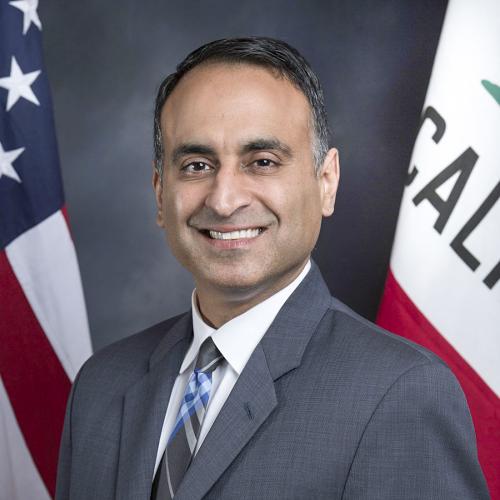
Asm. Ash Kalra
Total votes
23,729
all sessions
Attendance
97%
547 missed
Higher than 75% of chamber peers
With party
99%
of cast votes
Near the chamber average
Bipartisan score
0%
crosses aisle rarely
Near the chamber average
Sponsored
2,377
bills & resolutions
Higher than 97% of chamber peers
Committees
12
assignments
2,377 bills and resolutions
Sponsored bills
Total
2,377
Primary
290
Co-sponsor
2,087
This page
2,377
matching current filters
Passed Feb 1, 2021
1 co-sponsor
Passed Jan 25, 2021
1 co-sponsor
Relative to Reverend Dr. Martin Luther King, Jr.
This measure would, among other things, honor the late civil rights pioneer and icon Reverend Dr. Martin Luther King, Jr. and commemorate Dr. Martin Luther King, Jr. Day.
Passed Jan 19, 2021
1 co-sponsor
Passed Jan 15, 2021
1 co-sponsor
Passed Jan 11, 2021
1 co-sponsor
Pupil instruction: high school graduation requirements: ethnic studies.
(1) Existing law requires a pupil to complete designated coursework while in grades 9 to 12, inclusive, in order to receive a diploma of graduation from high school. These graduation requirements include, among others, the completion of 3 years of courses in English and 3 years of courses in social studies, including one-year courses in United States history and geography and world history, culture, and geography, a one-semester course in American government and civics, and a one-semester course in economics. Existing law requires the Instructional Quality Commission to develop, and the State Board of Education to adopt, modify, or revise, a model curriculum in ethnic studies. Existing law also encourages each school district and charter school that maintains any of grades 9 to 12, inclusive, and that does not otherwise offer a standards-based ethnic studies curriculum to offer, beginning in the school year following the adoption of the model curriculum, a course of study in ethnic studies based on the model curriculum. This bill would add the completion of a one-semester course in ethnic studies, meeting specified requirements, to the high school graduation requirements commencing with pupils graduating in the 2029–30 school year, including for pupils enrolled in a charter school. The bill would expressly authorize local educational agencies, including charter schools, to require a full-year course in ethnic studies at their discretion. The bill would require local educational agencies, including charter schools, to offer an ethnic studies course commencing with the 2025–26 school year, as specified. The bill would authorize, subject to the course offerings of a local educational agency, including a charter school, a pupil to satisfy the ethnic studies course requirement by completing either (A) a course based on the model curriculum in ethnic studies developed by the commission, (B) an existing ethnic studies course, (C) an ethnic studies course taught as part of a course that has been approved as meeting the A-G requirements of the University of California and the California State University, except as specified, or (D) a locally developed ethnic studies course approved by the governing board of the school district or the governing body of the charter school. The bill would require a pupil who completes a course described above to also accrue credit for coursework in the subject that the course is offered, including, if applicable, credit towards satisfying a course required for a diploma of graduation from high school. The amendments made by the bill, as described above, would become operative only upon an appropriation of funds by the Legislature for purposes of the amendments in the annual Budget Act or another statute. Because the bill would add new duties to local educational agencies, it would constitute a state-mandated local program. (2) The California Constitution requires the state to reimburse local agencies and school districts for certain costs mandated by the state. Statutory provisions establish procedures for making that reimbursement. This bill would provide that, if the Commission on State Mandates determines that the bill contains costs mandated by the state, reimbursement for those costs shall be made pursuant to the statutory provisions noted above.
Vetoed Sep 30, 2020
1 co-sponsor
Criminal procedure: discrimination.
Existing law generally prescribes the procedure for the prosecution of persons arrested for committing a crime, including pleadings, bail, pretrial proceedings, trial, judgment, sentencing, and appeals. Existing law allows a person who is unlawfully imprisoned or restrained of their liberty to prosecute a writ of habeas corpus to inquire into the cause of their imprisonment or restraint. Existing law allows a writ of habeas corpus to be prosecuted for, among other things, relief based on the use of false evidence that is substantially material or probative to the issue of guilt or punishment that was introduced at trial. This bill would prohibit the state from seeking a criminal conviction or sentence on the basis of race, ethnicity, or national origin, as specified. The bill would allow a writ of habeas corpus to be prosecuted on the basis of that prohibition, and would require the defendant to appear at the evidentiary hearing by video unless their presence in court is needed. The bill would permit a defendant to file a motion requesting disclosure of all evidence relevant to a potential violation of that prohibition that is in the possession or control of the prosecutor and would require a court, upon a showing of good cause, to order those records to be released. The bill would authorize a court that finds a violation of that prohibition to impose a remedy specified in the bill. The bill would apply its provisions to adjudications and dispositions in the juvenile delinquency system. The bill would apply its provisions only prospectively to cases in which judgment has not been entered prior to January 1, 2021. Existing law creates an explicit right for a person no longer imprisoned or restrained to file a motion to vacate a conviction or sentence based on a prejudicial error damaging to the moving party's ability to meaningfully understand, defend against, or knowingly accept the actual or potential adverse immigration consequences of a plea of guilty or nolo contendere, or based on newly discovered evidence of actual innocence, as specified. This bill would additionally allow for a person no longer imprisoned or restrained to file a motion to vacate a conviction or sentence based on a conviction or sentence that was sought, obtained, or imposed on the basis of race, ethnicity, or national origin in violation of the bill's provisions. This bill would state that its provisions are severable.
Signed into law Sep 30, 2020
0 co-sponsors
Probation: length of terms.
Existing law authorizes courts that have jurisdiction in misdemeanor cases to suspend the sentence and make and enforce terms of probation in those cases, for a period not to exceed 3 years, except when the period of the maximum sentence imposed by law exceeds 3 years, in which case the terms of probation may be imposed for a longer period than 3 years, but not to exceed the time for which the person may be imprisoned. This bill would instead restrict the period of probation for a misdemeanor to no longer than one year, except as specified. Existing law authorizes the court, in the order granting probation, to suspend the imposition or execution of sentence and direct the suspension to continue for a period of time not exceeding the maximum term for which the person could be imprisoned, except as specified. This bill would instead authorize a court to impose a term of probation not longer than 2 years, except as specified.
Signed into law Sep 30, 2020
1 co-sponsor
Prisoners: California Reentry Commission.
Existing law requires the Department of Corrections and Rehabilitation to establish parole reentry and assessment programs for inmates in state prison, in order to assess the inmate prior to release and to assist with the inmate's reentry into the community while on parole. Existing law establishes the California Reentry and Enrichment Grant Program to provide grants to community-based programs that provide rehabilitative services to incarcerated individuals. This bill would, subject to an appropriation by the Legislature for these purposes, establish the California Reentry Commission within the department, to be cochaired by the Secretary of the Department of Corrections and Rehabilitation and a formerly incarcerated individual to be appointed to the commission by the Governor. The bill would specify the members of the commission and require the commission to meet once every 2 months. The bill would require the commission to prepare and develop a new health and safety agenda for those returning home from prison or jail, coordinate with the Department of Corrections and Rehabilitation and the Board of State and Community Corrections to develop a grant program to provide grants to reentry service providers, conduct a review of reentry barriers, review current state criminal justice policies, and report to the Legislature on the impact of COVID-19 on the reentry population, among other duties.
Vetoed Sep 30, 2020
1 co-sponsor
Ask Maddy
·
AI policy assistant
Ask Maddy about Ash Kalra
Scope: CA
Hi! I can help you understand Ash Kalra's legislative record. What would you like to know?
Try one of these
i
Maddy answers using official bill text and legislative records. Always verify before sharing.
Sources cited inline