

The Political Reform Act of 1974 prohibits a foreign government or foreign principal from making any contribution, expenditure, or independent expenditure in connection with the qualification or support of, or opposition to, a state or local ballot measure or an election for a state or local office. The act prohibits a person or committee from soliciting or accepting a contribution from a foreign government or foreign principal for the same purposes. The act makes a violation of these prohibitions a misdemeanor. This bill would expand these prohibitions to include contributions, expenditures, or independent expenditures made by a foreign-influenced business entity, as defined, in connection with an election or ballot measure. The bill would require a business entity that makes a contribution, expenditure, or independent expenditure to file with the filing officer and the applicable candidate or committee a statement of certification, signed by the entity's chief executive officer under penalty of perjury, avowing that the entity was not a foreign-influenced business entity on the date the contribution, expenditure, or independent expenditure was made. The bill would prohibit a person who receives funds from a business entity from using those funds for purposes of a contribution, expenditure, or independent expenditure in connection with a ballot measure or election unless the person receives a copy of the statement of certification from the business entity. By creating a new crime and expanding the scope of an existing crime, the bill would impose a state-mandated local program. The California Constitution requires the state to reimburse local agencies and school districts for certain costs mandated by the state. Statutory provisions establish procedures for making that reimbursement. This bill would provide that no reimbursement is required by this act for a specified reason. The Political Reform Act of 1974, an initiative measure, provides that the Legislature may amend the act to further the act's purposes upon a 23 vote of each house of the Legislature and compliance with specified procedural requirements. This bill would declare that it furthers the purposes of the act.
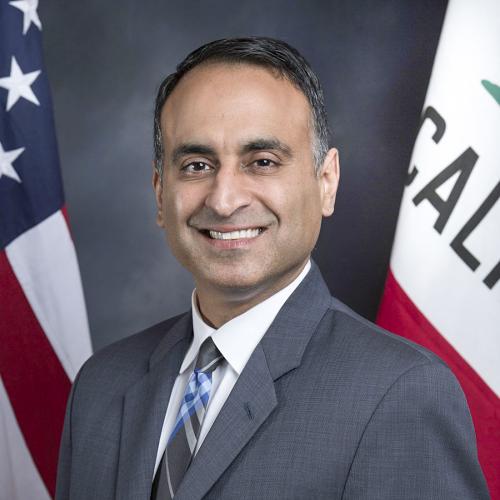
Asm. Ash Kalra
Sponsored bills
Existing law grants the Division of Occupational Safety and Health, which is within the Department of Industrial Relations, jurisdiction over all employment and places of employment, with the power necessary to enforce and administer all occupational health and safety laws and standards. The Occupational Safety and Health Standards Board, an independent entity within the department, has the exclusive authority to adopt occupational safety and health standards within the state. Existing law, the California Occupational Safety and Health Act of 1973, requires employers to comply with certain standards ensuring healthy and safe working conditions, as specified, and charges the division with enforcement of the act. Other existing law relating to occupational safety imposes special provisions on certain industries and charges the division with enforcement of these provisions. This bill would require a motion picture production employer to hire a qualified set safety supervisor for all motion picture productions to perform a risk assessment, as specified, to be completed prior to the first day of production on a feature, an episode of a series, or a program, and to be on set daily to ensure cast and crew are not engaged in or exposed to an environment or activity that puts workers' health and safety at risk. The bill would allow the use of a firearm and blank ammunition containing gunpowder or other explosive charge on motion picture productions only for specified purposes and under specified safety conditions. The bill would require a qualified armorer, property master, or designee handling a firearm in the course of the motion picture production to have a specified state permit, to have completed certain training in firearms, and to have a specified federal document for the possession and custody of the firearm. The bill would require an employer to document and report to certain entities any incident involving a firearm or blank ammunition that occurs during a film or television production, as prescribed. This bill would prohibit ammunition on film, television, and commercial sets, except in prescribed circumstances, subject to certain safety rules and laws. The bill would require an employer to ensure that any employee responsible for handling, or in proximity to, firearms on set completes a specific firearm training or equivalent training, as prescribed. The bill would require an employer to comply with the bill and all safety standards adopted by the standards board. The bill would establish exemptions from its provisions for specified registered security guards and peace officers when they are on the perimeter of a set where motion picture production is happening. This bill would require the division to enforce its provisions and, before July 1, 2023, to propose to the standards board, for its review and adoption on or before January 1, 2024, a standard that protects the health and safety of motion picture production employees with regard to the storage, handling, and use of firearms and blanks on set and for use of ammunition. The bill would require the division, in the development of the proposed safety standard, to consider and incorporate, to the extent feasible and consistent with the bill, the provisions of specified joint industry-labor safety bulletins. The bill would also require the division to consider certain other safety standards as it determines to be relevant. The bill would establish civil penalties for specified violations. The bill would define terms for its purposes.
Existing law requires each campus of the California Community Colleges and the California State University, and requests each campus of the University of California, to identify in the online version of the campus course schedule its courses that exclusively use digital course materials, as specified, and communicate to students that the course materials for these courses are free of charge and therefore not required to be purchased. This bill would require each campus of the California Community Colleges and the California State University, and request each campus of the University of California, to prominently display the estimated costs for each course of all required course materials, and fees directly related to those materials, for no less than 75% of the total number of courses on the online campus schedule. The bill would define, for purposes of this requirement, "course materials" to include digital or physical textbooks, devices such as calculators and remote attendance platforms, and software subscriptions. By imposing new duties on community college districts, this bill would impose a state-mandated local program. The California Constitution requires the state to reimburse local agencies and school districts for certain costs mandated by the state. Statutory provisions establish procedures for making that reimbursement. This bill would provide that, if the Commission on State Mandates determines that the bill contains costs mandated by the state, reimbursement for those costs shall be made pursuant to the statutory provisions noted above.
This measure would designate a specified portion of Interstate Highway Route 405 in the County of Los Angeles as the Officer Tommy Scott Memorial Highway. The measure would request that the Department of Transportation determine the cost of appropriate signs showing this special designation and, upon receiving donations from nonstate sources covering that cost, erect those signs.
This measure would declare March 13, 2022, to April 15, 2022, as Deaf History Month.
This measure would proclaim the month of April 2022 as Black April Memorial Month.
This measure would acknowledge the Muslim holy month of Ramadan and express the Legislature's respect to Muslims across California and throughout the world on this occasion.