This measure would recognize April 24, 2022, through April 30, 2022, as Crime Victims' Rights Week.
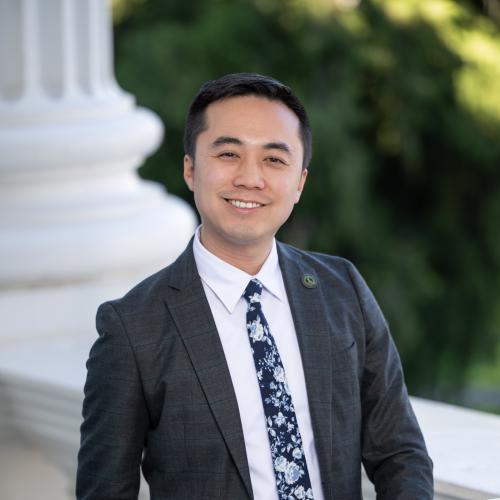
Asm. Alex Lee
Sponsored bills
Existing law authorizes the finder of fact in a criminal prosecution, to find the defendant guilty of an offense that is necessarily included in the charged offense. Case law requires the trial court to instruct the jury that it must find the defendant guilty of a necessarily included offense if there is substantial evidence that the defendant is guilty of the necessarily included offense. This bill would require the court, if requested by a defendant, to instruct the jury on a lesser offense, which is closely related to the offense charged, if the defendant has relied on a theory of defense consistent with a conviction for the lesser offense, the evidence of the lesser offense is relevant to and admitted for the purpose of establishing guilt of the charged offense, and a basis exists on which the jury could find the offense to be less than charged. The bill would also authorize the judge to find the defendant guilty of the lesser offense if there is no jury. The bill would state the intent of the Legislature to restore rights found by the California Supreme Court in People v. Geiger (1984) 35 Cal.3d 510.
Existing law, referred to as the Medical Injury Compensation Reform Act of 1975 (MICRA) , prohibits an attorney from contracting for or collecting a contingency fee for representing any person seeking damages in connection with an action for injury or damage against a health care provider based upon alleged professional negligence in excess of specified limits. This bill would recast those provisions and base the amount of contingency fee that may be contracted for upon whether recovery is pursuant to settlement agreement and release of all claims executed before a civil complaint or demand for arbitration is filed, or pursuant to settlement, arbitration, or judgment after a civil complaint or demand for arbitration is filed, as specified. The bill would add and revise definitions for these purposes. Existing law provides that in any action against a health care provider based upon professional negligence, the injured plaintiff is entitled to recover noneconomic losses to compensate for pain, suffering, inconvenience, physical impairment, disfigurement, and other nonpecuniary damage. Existing law limits the amount of damages for noneconomic losses in an action for injury against a health care provider based on professional negligence to $250,000. This bill would remove the $250,000 limit on noneconomic damages and expand the recast provisions to include an action for injury against a health care institution, as defined. The bill would increase the applicable limitation based upon whether the action for injury involved wrongful death. The bill would specify that these limitations would increase by $40,000 each January 1st for 10 years and beginning on January 1, 2034, the applicable limitations on noneconomic damages for personal injury and for wrongful death would be adjusted for inflation on January 1st of each year by 2%. Existing law specifies that in any action for injury or damages against a provider of health care services, a superior court shall, at the request of either party, enter a judgment ordering that money damages or its equivalent for future damages of the judgment creditor be paid in whole or in part by periodic payments rather than by a lump-sum payment if the award equals or exceeds $50,000. This bill would increase the minimum amount of the judgment required to request periodic payments to $250,000. Existing law makes statements, writings, or benevolent gestures expressing sympathy or a general sense of benevolence relating to the pain, suffering, or death of a person involved in an accident and made to that person, or to the family of that person, inadmissible as evidence of an admission of liability in a civil action. This bill would specify that statements, writings, or benevolent gestures expressing sympathy, regret, a general sense of benevolence, or suggesting, reflecting, or accepting fault relating to the pain, suffering, or death of a person, or to an adverse patient safety event or unexpected health care outcome, as specified, shall be confidential, privileged, protected, not subject to subpoena, discovery, or disclosure, and shall not be used or admitted into evidence in any civil, administrative, regulatory, licensing, or disciplinary board, agency, or body action or proceeding, and shall not be used or admitted in relation to any sanction, penalty, or other liability, as evidence of an admission of liability or for any other purpose.
Existing law requires the State Department of Public Health, through its Office of Health Equity, to perform strategic planning relating to gaps in health status and access to care among the state's diverse racial and ethnic communities, women, persons with disabilities, and the lesbian, gay, bisexual, transgender, queer, and questioning communities. Existing law requires the office to report to the Legislature on its activities on multicultural health. Existing law makes it unlawful to, by force or threat of force, willfully injure, intimidate, interfere with, oppress, or threaten any other person in whole or in part because of one or more of certain actual or perceived characteristics of the victim, as specified. Existing law also sets forth various criminal or civil penalties for different offenses involving certain forms of harassment. This bill would require the department to conduct research and a 5-year, statewide, public campaign to raise awareness and understanding of street harassment as a public health problem in the state with the purpose of preventing its occurrence. The bill would define "street harassment" as words, gestures, or actions directed at a specific person in a public place, as defined, without the consent of that person, based on the person's actual or perceived race, color, ethnic group identification, ancestry, national origin, religion, mental disability, physical disability, medical condition, genetic information, age, marital status, sex, gender, gender identity, gender expression, or sexual orientation, that the person experiences as intimidating, alarming, terrorizing, or threatening to their safety. The bill would make related legislative findings. The bill would require the department to conduct the research through surveys and focus groups, identifying subpopulations at disproportionate risk of experiencing street harassment. The bill would require the department to prepare 2 reports, proposing strategies and policies to prevent and respond to street harassment, as specified. The bill would require the department to submit the reports to the Legislature and the Governor, and to publish them on the department's internet website, no later than January 1, 2024, for the first report, and no later than June 30, 2027, for the 2nd report. The bill would require the department to commence the public campaign on January 1, 2023, conducting it online and in physical locations. The bill would require the department to, among other things, develop culturally relevant content, annually evaluate the effectiveness of the campaign, and prepare and publish on its internet website an annual report describing the campaign's activities, effectiveness, and gaps, as specified.

The Political Reform Act of 1974 prohibits a foreign government or foreign principal from making any contribution, expenditure, or independent expenditure in connection with the qualification or support of, or opposition to, a state or local ballot measure or an election for a state or local office. The act prohibits a person or committee from soliciting or accepting a contribution from a foreign government or foreign principal for the same purposes. The act makes a violation of these prohibitions a misdemeanor. This bill would expand these prohibitions to include contributions, expenditures, or independent expenditures made by a foreign-influenced business entity, as defined, in connection with an election or ballot measure. The bill would require a business entity that makes a contribution, expenditure, or independent expenditure to file with the filing officer and the applicable candidate or committee a statement of certification, signed by the entity's chief executive officer under penalty of perjury, avowing that the entity was not a foreign-influenced business entity on the date the contribution, expenditure, or independent expenditure was made. The bill would prohibit a person who receives funds from a business entity from using those funds for purposes of a contribution, expenditure, or independent expenditure in connection with a ballot measure or election unless the person receives a copy of the statement of certification from the business entity. By creating a new crime and expanding the scope of an existing crime, the bill would impose a state-mandated local program. The California Constitution requires the state to reimburse local agencies and school districts for certain costs mandated by the state. Statutory provisions establish procedures for making that reimbursement. This bill would provide that no reimbursement is required by this act for a specified reason. The Political Reform Act of 1974, an initiative measure, provides that the Legislature may amend the act to further the act's purposes upon a 23 vote of each house of the Legislature and compliance with specified procedural requirements. This bill would declare that it furthers the purposes of the act.
The Personal Income Tax Law and the Corporation Tax Law allow various credits against the taxes imposed by those laws. This bill, for taxable years beginning on or after January 1, 2023, and before January 1, 2028, would allow a credit against those taxes to a taxpayer that is transferred, and allocated, credits pursuant to the sale of a specified multifamily rental housing development to a qualified developer, that has received a credit reservation from the California Tax Credit Allocation Committee, in specified amounts. The bill would define a qualified developer for purposes of this bill, in part, as a specified entity that commits, at application to the committee and under penalty of perjury, to employing a tax credit reservation allowed by the bill in the acquisition of a qualified development. By expanding the crime of perjury, this bill would impose a state-mandated local program. The bill would require the credits to be reserved on a first-come-first-served basis. The bill would limit the aggregate amount of credit that may be allocated by the committee, as provided. The bill would also provide that the credit amount shall be $0 for each taxable year beginning on or after January 1, 2023, and before January 1, 2028, unless otherwise specified in a bill providing for appropriations related to the Budget Act. Existing law requires that any bill introduced on or after January 1, 2020, that would authorize certain tax expenditures, as defined, or tax exemptions contain, among other things, specific goals, purposes, and objectives that the tax expenditure or exemption will achieve, detailed performance indicators, and data collection requirements. This bill would include additional information required for any bill authorizing a new tax expenditure. The California Constitution requires the state to reimburse local agencies and school districts for certain costs mandated by the state. Statutory provisions establish procedures for making that reimbursement. This bill would provide that no reimbursement is required by this act for a specified reason. This bill would take effect immediately as a tax levy.
Under existing law, the Stop Tobacco Access to Kids Enforcement Act, an enforcing agency, as defined, may assess civil penalties against any person, firm, or corporation that sells, gives, or furnishes specified tobacco and cigarette related items, including cigarette papers, to a person who is under 21 years of age, except as specified. The existing civil penalties range from $400 to $600 for a first violation, up to $5,000 to $6,000 for a 5th violation within a 5-year period. Existing law prohibits the sale, distribution, or nonsale distribution of tobacco products directly or indirectly to any person under 21 years of age through the United States Postal Service or other public or private postal or package delivery service. Under existing law, a district attorney, city attorney, or the Attorney General may assess civil penalties against a violator of not less than $1,000 or more than $2,000 for the first violation and up to $10,000 for a 5th or subsequent violation within a 5-year period. Under existing law, every person, firm, or corporation that knowingly or under circumstances in which it has knowledge, or should otherwise have grounds for knowledge, sells, gives, or furnishes a cigarette, among other specified items, to another person who is under 21 years of age is, except as specified, subject to either a criminal action for a misdemeanor or to a civil action brought by a city attorney, a county counsel, or a district attorney, punishable by a fine of $200 for the first offense, $500 for the 2nd offense, and $1,000 for the 3rd offense. This bill would prohibit a person or entity from selling, giving, or furnishing to another person of any age in this state a single-use electronic cigarette, as defined, except as specified. The bill would prohibit that selling, giving, or furnishing, whether conducted directly or indirectly through an in-person transaction, or by means of any public or private method of shipment or delivery to an address in this state. This bill would authorize a city attorney, county counsel, or district attorney to assess a $500 civil fine against each person determined to have violated those prohibitions in a proceeding conducted pursuant to the procedures of the enforcing agency, as specified. This bill would make its provisions operative on January 1, 2024.
This measure would respectfully memorialize the President of the United States and the Congress of the United States to take action to restore honor to Bernard B. James, and to take the necessary actions to ensure the treatment of Bernard B. James is rectified by a full exoneration, including having the military record of Bernard B. James cleared of any court judgment and less-than-honorable discharge.