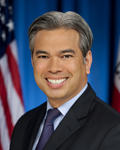
Photo of Rob Bonta
D California House · District 18

Rep. Rob Bonta

Compare
Total votes
21,307
all sessions
Attendance
98%
241 missed
Higher than 87% of chamber peers
With party
99%
of cast votes
Higher than 96% of chamber peers
Bipartisan score
0%
crosses aisle rarely
Lower than 97% of chamber peers
Sponsored
1,483
bills & resolutions
Higher than 95% of chamber peers
Committees
0
assignments
1,483 bills and resolutions

Sponsored bills

Total
1,483
Primary
217
Co-sponsor
1,266
This page
1,483
matching current filters
Co-sponsor ACR 155
Signed into law · California House · Co-sponsor
Relative to Black History Month.

This measure would recognize February 2020 as Black History Month, urge all citizens to join in celebrating the accomplishments of African Americans during Black History Month, encourage the people of California to recognize the many talents of African Americans and the achievements and contributions they make to their communities to create equity and equality for education, economics, and social justice, and recognize the significance in protecting citizens' right to vote and remedying racial discrimination in voting.

Signed into law Jun 17, 2020 1 co-sponsor
Co-sponsor ACA 25
Passed · California House · Co-sponsor
A resolution to propose to the people of the State of California an amendment to the Constitution of the State, by adding Section 21.5 to Article IV thereof, relating to the Legislature.

The California Constitution requires the Legislature to convene in regular session on specified dates and provides that a majority of the membership constitutes a quorum, although a lesser number may recess from day to day and compel the attendance of absent members. The California Constitution requires the proceedings of each house of the Legislature to be open and public and recognizes the right of the public to attend, record, and broadcast those proceedings. The California Constitution authorizes the Legislature to provide for the convening of the Legislature to meet the needs resulting from a war-caused or enemy-caused disaster in the state. This measure would permit Members to remotely attend and vote in a legislative proceeding, or to vote by proxy in a legislative proceeding if permitted by their house, during the pendency of a state of emergency declared by the Governor or the President of the United States, under specified conditions. The measure would provide, among other conditions, that a Member may remotely attend and vote, or vote by proxy as authorized, in a proceeding only if the state of emergency prevents the Member from safely attending the proceeding in person. The measure would also provide that a Member attending remotely would be included in the determination of a quorum. The measure would provide that if 15 or more of the Members of a house cannot attend a proceeding during a state of emergency because they are deceased, disabled, or missing, a quorum may be established by a majority of those Members able to attend. The measure would specify that the Legislature may provide by statute for temporarily filling the vacant offices of Members with pro tempore members in the event that 15 or more of the Members of a house are deceased, disabled, or missing during a state of emergency. The measure would require the Legislature by concurrent resolution, or each house by separate resolutions, 23 of the membership concurring, to adopt rules to implement this provision no later than the end of the biennial legislative session in which this measure takes effect, except as specified.

Passed Jun 15, 2020 1 co-sponsor
Co-sponsor AB 3256
In committee · California House · Co-sponsor
Economic Recovery, Wildfire Prevention, Safe Drinking Water, Drought Preparation, and Flood Protection Bond Act of 2020.

The California Drought, Water, Parks, Climate, Coastal Protection, and Outdoor Access For All Act of 2018, approved by the voters as Proposition 68 at the June 5, 2018, statewide direct primary election, authorizes the issuance of bonds in the amount of $4,000,000,000 pursuant to the State General Obligation Bond Law to finance a drought, water, parks, climate, coastal protection, and outdoor access for all program. This bill would enact the Economic Recovery, Wildfire Prevention, Safe Drinking Water, Drought Preparation, and Flood Protection Bond Act of 2020, which, if approved by the voters, would authorize the issuance of bonds in the amount of $6,980,000,000 pursuant to the State General Obligation Bond Law to finance projects for an economic recovery, wildfire prevention, safe drinking water, drought preparation, and flood protection program. This bill would provide for the submission of these provisions to the voters at the November 3, 2020, statewide general election. This bill would declare that it is to take effect immediately as an urgency statute.

In committee Jun 8, 2020 1 co-sponsor
Co-sponsor AB 2058
In committee · California House · Co-sponsor
Income taxes: credits: low-income housing.

(1) The Personal Income Tax Law and the Corporation Tax Law allow various credits against the taxes imposed by those laws. This bill, for taxable years beginning on or after January 1, 2021, and before January 1, 2026, would allow a credit against those taxes to a taxpayer that is transferred, and allocated, credits pursuant to the sale of a multifamily rental housing development or mobilehome park to a qualified developer, as defined, that has received a credit reservation from the California Tax Credit Allocation Committee, in specified amounts. The bill would require the credits to be reserved on a first-come-first-served basis. The bill would limit the aggregate amount of credit that may be allocated by the committee, as provided. The bill would also provide that the credit amount shall be $0 for each taxable year beginning on or after January 1, 2021, and before January 1, 2026, unless otherwise specified in a bill providing for appropriations related to the Budget Act. (2) Existing law requires any bill authorizing a new tax credit to contain, among other things, specific goals, purposes, and objectives that the tax credit will achieve, detailed performance indicators, and data collection requirements. This bill would include additional information required for any bill authorizing a new income tax credit. (3) This bill would take effect immediately as a tax levy.

In committee Jun 3, 2020 1 co-sponsor
Co-sponsor AB 3155
In committee · California House · Co-sponsor
Subdivision Map Act: streamlined approval process: subdivisions.

(1) The Planning and Zoning Law requires a city or county to adopt a general plan for land use development within its boundaries that includes, among other things, a housing element. Existing law provides for various incentives intended to facilitate and expedite the construction of affordable housing. Existing law, until January 1, 2026, authorizes a development proponent to submit an application for a multifamily housing development that is subject to a streamlined, ministerial approval process, as provided, and not subject to a conditional use permit, if the development satisfies specified objective planning standards including among others, that the development proponent commit to record a land use restriction or covenant providing that any lower or moderate-income housing units remain available at affordable housing costs or rent, as specified. This bill would exempt a project from the objective planning standard described above, if the project involves the subdivision of a parcel for 10 or fewer units and is not a part of a larger project involving more than 10 units, the project is not a public work, as defined, and the project satisfies the requirements of any applicable inclusionary housing ordinance of the local government, as specified. Existing law also includes as an objective planning standard for the streamlined, ministerial approval process that the development be subject to a requirement mandating a minimum percentage of below market rate housing, as specified. Under existing law, that requirement is satisfied if the locality's latest production report reflects that there were fewer units of housing issued building permits affordable to either very low income or low-income households by income category than were required for the regional housing needs assessment cycle for that reporting period, and the project seeking approval dedicates 50% of the total number of units to housing affordable to households making at or below 80% of the area median income. This bill additionally would condition satisfaction of that objective planning standard on such a project containing more than 10 units of housing. Under the bill, if a project contains 10 units of housing or less and is subject to an inclusionary housing ordinance when the project application is submitted, the project would satisfy the objective planning standard if the project satisfies the requirements of the inclusionary housing ordinance. Under the bill, if a project contains 10 units of housing or less and is not subject to any inclusionary housing ordinances, the project would satisfy the objective planning standard if the developer pays a fee of an unspecified amount to the local government. (2) The Subdivision Map Act vests the authority to regulate and control the design and improvement of subdivisions in the legislative body of a local agency and sets forth procedures governing the local agency's processing, approval, conditional approval or disapproval, and filing of tentative, final, and parcel maps, and the modification thereof. This bill would require a local agency to issue a building permit for a subdivision that consists of 10 or fewer lots and of which at least 75% of the perimeter adjoins parcels that are developed with urban uses, as specified, if the applicant for the permit has received a tentative map approval or parcel map approval and the applicant has submitted proof, to the satisfaction of the local agency, of a recorded covenant and agreement that states that the applicant and the successors and assignees agree that the building permit is issued on the condition that a certificate of occupancy for the building will not be issued unless the final map has been recorded, and that the total number of lots created by the subdivision will not exceed 10. The bill would require the local agency to issue the building permit based upon the approved tentative or parcel map and its conditions of approval. (3) By imposing requirements on local agencies relative to the subdivision of 10 or fewer lots, the bill would impose a state-mandated local program. The California Constitution requires the state to reimburse local agencies and school districts for certain costs mandated by the state. Statutory provisions establish procedures for making that reimbursement. This bill would provide that no reimbursement is required by this act for a specified reason.

In committee Jun 3, 2020 1 co-sponsor
Primary AB 3118
In committee · California House · Lead sponsor
Medically supportive food.

Existing law provides for the Medi-Cal program, which is administered by the State Department of Health Care Services, under which qualified low-income individuals receive health care services, including enteral nutrition products, pursuant to a schedule of benefits, and subject to utilization controls, such as prior authorization. The Medi-Cal program is, in part, governed and funded by federal Medicaid program provisions. Existing law, until January 1, 2021, or as otherwise specified, requires the department to establish a 3-year pilot program in specified counties, including the Counties of Alameda and Sonoma, to provide medically tailored meals, as defined, to Medi-Cal participants with specified health conditions, such as cancer and renal disease. This bill would require the department to establish, no earlier than January 1, 2021, a pilot program for a 3-year period in the County of Alameda to provide medically supportive food, such as healthy food vouchers or renewable food prescriptions, as a covered benefit for a Medi-Cal beneficiary who has a specified chronic health condition, including diabetes or heart disease, when utilizing evidence-based practices that demonstrate the prevention, reduction, or reversal of those specified diseases. The bill would authorize the department, in consultation with stakeholders, to establish utilization controls, including the limitation on the number of services, and to enter into contracts for purposes of implementing the pilot program. The bill would require the department to evaluate the pilot program upon its conclusion, to report to the Legislature on those findings, and to implement these provisions by various means, including provider bulletins, without taking regulatory action. The bill would condition the implementation of these provisions to the extent permitted by federal law, the availability of federal financial participation, and the department securing federal approval, and would repeal these provisions on January 1, 2026. This bill would make legislative findings and declarations as to the necessity of a special statute for the County of Alameda.


In committee Jun 3, 2020 0 co-sponsors
Co-sponsor ACR 182
Passed · California House · Co-sponsor
California Down Syndrome Awareness Week and Day.

This measure would proclaim March 15, 2020, to March 22, 2020, as California Down Syndrome Awareness Week and March 21, 2020, as California Down Syndrome Day, and would encourage all Californians to support and participate in related activities.

Passed May 26, 2020 1 co-sponsor
Primary ACA 10
In committee · California House · Lead sponsor
A resolution to propose to the people of the State of California an amendment to the Constitution of the State, by adding Article XXV thereto, relating to housing.

The California Constitution enumerates various personal rights, including the right to enjoy and defend life and liberty, acquiring, possessing, and protecting property, and pursuing and obtaining safety, happiness, and privacy. This measure would declare that the fundamental human right to housing exists in this state. The measure would declare that this right is exclusively enforceable by a public right of action. The measure would specify that it is the shared obligation of state and local jurisdictions to respect, protect, and fulfill this right through progressively implemented measures, consistent with available resources, within an aggressive but reasonable time frame.

In committee May 12, 2020 0 co-sponsors
Primary AB 1839
In committee · California House · Lead sponsor
Economic, environmental, and social recovery: California COVID-19 Recovery Deal.

Existing law establishes various environmental and economic policies. This bill would enact the California COVID-19 Recovery Deal. The bill would make a series of legislative findings and declarations pertaining to the coronavirus (COVID-19) pandemic and various economic, environmental, and social conditions in the state. The bill would state the intent of the Legislature that the state adopt a policy framework with principles and goals committed to accomplish specified economic, environmental, and social objectives and priorities as part of the state's COVID-19 recovery spending. The bill would state that the Legislature establishes various spending rules for the COVID-19 recovery, including adopting spending measures that prohibit businesses, organizations, or agencies from accepting public funds for any long-term projects that prolong the emission of greenhouses gases or lead to the expansion of fossil fuel projects and ensuring that recovery spending includes specific measures for California populations and communities most negatively impacted by COVID-19.

In committee May 11, 2020 0 co-sponsors
Showing 61 to 70 of 1,483 bills
Previous 1 6 7 8 149 Next