

The Charter Schools Act of 1992 authorizes the establishment and operation of charter schools. Existing law prescribes procedures for the closure of a charter school, as provided. Existing law authorizes the denial of charter petitions that do not include specified information on the procedures to be used if the charter school closes, including procedures to ensure a final audit of the charter school to determine the disposition of all assets and liabilities of the charter school, including plans for disposing of any net assets and for the maintenance and transfer of pupil records. Existing law establishes the California Longitudinal Pupil Achievement Data System (CALPADS) , which is maintained by the State Department of Education and consists of pupil data regarding demographics, program participation, enrollment, and statewide assessments. This bill would require, upon a charter school notifying its chartering authority of the closing of the charter school, the school district in which the charter school was geographically located to become the designated entity for the disposal of any remaining net assets, as defined, if there exists no designated entity for the disposal of any remaining net assets of the charter school, as provided. The bill would authorize school districts, on or after January 1, 2023, and chartering authorities that held net assets of a closed charter school before January 1, 2023, to spend or dispose of remaining net assets of a closed charter school in its discretion. The bill would apply these net asset disposal rules to the net assets of charter schools maintained by limited liability corporations managed by the governing body of the charter school. The bill would also require charter schools to update all pupil information in CALPADS and report the number of displaced pupils to the department before closing. To the extent that this bill imposes new duties on charter schools, the bill would impose a state-mandated local program. Existing law requires the California School Finance Authority to administer the Charter School Facility Grant Program, and provides that the grant program is intended to provide assistance with facilities rent and lease costs for pupils in charter schools. This bill would additionally require the California School Finance Authority to notify the applicable chartering authority and the school district in which the charter school was geographically located of a charter school's application for grant funding. The bill would, as applied to charter school facilities owned by related parties that are no longer occupied by the charter school, require owners of facilities that sell or lease the facility for any purpose other than of public, nonsectarian education within 10 years after receiving grant program funds to reimburse the Charter School Facility Grant Program Fund for all grant program funds received in the preceding 10 years except for grant program funds received before January 1, 2023, as provided. The bill would require the Charter School Finance Authority to deposit reimbursed grant program funds into funding round funds, as provided. The bill would authorize the California School Finance Authority to charge an application fee for grant applications submitted by a charter school to be used for charter school facilities owned by related parties, as provided. The California Constitution requires the state to reimburse local agencies and school districts for certain costs mandated by the state. Statutory provisions establish procedures for making that reimbursement. This bill would provide that, if the Commission on State Mandates determines that the bill contains costs mandated by the state, reimbursement for those costs shall be made pursuant to the statutory provisions noted above.
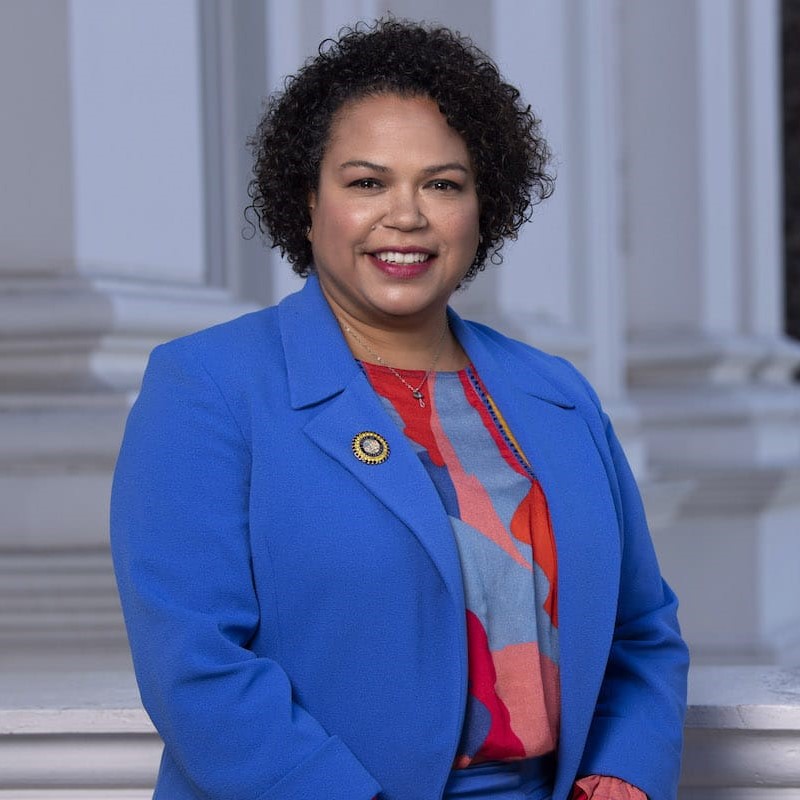
Asm. Mia Bonta
Sponsored bills
Existing law requires the adopted course of study for grades 1 to 6, inclusive, to include certain areas of study, including English, mathematics, social sciences, science, visual and performing arts, health, and physical education, as specified. Existing law requires the study of English to include knowledge of and appreciation for literature and the language, as well as the skills of speaking, reading, listening, spelling, handwriting, and composition. This bill would create the Family and Community Literacy: Supporting Literacy and Biliteracy in Schools, Families, and Communities Grant Program for the purpose of supporting the goal of all of California's pupils reading at grade level by third grade and engaging families at every stage of that process. The bill would require the department to award competitive grants from the California Family Literacy Innovation Project to local educational agencies, as provided. This bill would establish the California Family Literacy Innovation Project, under the administration of the department, in order to support community literacy and educational enrichment by supporting local educational agencies to engage families to improve literacy and biliteracy outcomes. The bill would require the department to award grants of up to $1,900,000 each to at least 25 local educational agencies that conduct a needs assessment and analysis, and design an evidence-based Family Literacy and Biliteracy Innovation Plan, as provided. The bill would require grant recipients to provide annual progress reports to the department, and would require the department to contract with an external evaluator to develop a final report and evaluate program effectiveness, as provided. This bill would make the implementation of its provisions contingent upon an appropriation by the Legislature in the annual Budget Act or another statute.
(1) Existing law establishes the California Clean Truck, Bus, and Off-Road Vehicle and Equipment Technology Program, which is administered by the State Air Resources Board, in conjunction with the State Energy Resources Conservation and Development Commission, to fund development, demonstration, precommercial pilot, and early commercial deployment of zero- and near-zero-emission truck, bus, and off-road vehicle and equipment technologies. This bill would expand the purposes of the program to include the funding of the development, demonstration, precommercial pilot, and early commercial deployment of zero- and near-zero-emission commercial harbor craft technologies. (2) Existing law establishes the Clean Transportation Program, administered by the State Energy Resources Conservation and Development Commission, to provide funding to certain entities to develop and deploy innovative technologies that transform California's fuel and vehicle types to help attain the state's climate change policies. Under existing law, the commission may only provide funding under the Clean Transportation Program to specified eligible programs and projects. This bill would expand the programs and projects that are eligible to receive funding under the Clean Transportation Program to include programs and projects that accelerate the commercialization of commercial harbor craft and alternative and renewable fuels and programs and projects to retrofit fleets of commercial harbor craft with technologies that create higher fuel efficiencies. (3) Existing law establishes the Air Quality Improvement Program, administered by the State Air Resources Board, for the purpose of funding air quality improvement projects relating to fuel and vehicle technologies, including, but not limited to, providing funding for research to determine and improve the air quality impacts of alternative transportation fuels and vehicles, vessels, and equipment technologies. Under existing law, the state board is limited to providing funding under the Air Quality Improvement Program to specified eligible programs. This bill would expand the programs that are eligible to receive funding under the Air Quality Improvement Program to include incentives for commercial harbor craft, including low- or zero-emission commercial harbor craft. (4) Existing establishes the Low Carbon Transit Operations Program, administered by the Department of Transportation, to provide operating and capital assistance for transit agencies to reduce greenhouse gas emissions and improve mobility. Existing law authorizes, among other things, capital or operating assistance for new or expanded waterborne transit as an eligible expenditure under the program. This bill would specifically provide that expenditures related to the purchase of zero-emission public transportation ferries are an eligible expenditure under the program if the expenditure would result in new or expanded waterborne transit.
(1) Existing law, the Planning and Zoning Law, sets forth various requirements relating to the development of property in local jurisdictions. This bill would require a qualified jurisdiction, as defined, to develop, by January 1, 2024, and execute a plan to collaborate with social equity investors, as described. The bill would also require a qualified jurisdiction to compile, by January 1, 2024, a list of properties meeting certain conditions in the prior 3 years and a list of properties that the qualified jurisdiction considers blighted properties, as defined. (2) This bill would make legislative findings and declarations as to the necessity of a special statute for the qualified jurisdictions. (3) By imposing additional duties on local officials, this bill would impose a state-mandated local program. The California Constitution requires the state to reimburse local agencies and school districts for certain costs mandated by the state. Statutory provisions establish procedures for making that reimbursement. This bill would provide that, if the Commission on State Mandates determines that the bill contains costs mandated by the state, reimbursement for those costs shall be made pursuant to the statutory provisions noted above.
Existing law establishes the Pathways to Success Grant Program with the goal of providing pupils in preschool, transitional kindergarten, kindergarten, and grades 1 to 12, inclusive, with dual language immersion programs, developmental bilingual programs for English learners, or early learning dual language learners programs, as those terms are defined. Existing law requires the State Department of Education to administer the program and award a minimum of 10 grants of up to $300,000 to school districts and consortia of school districts in partnership with other specified entities, and additional funding of up to $20,000 to an applicant proposing to establish a dual language immersion program or developmental bilingual program for English learners in a target language other than Spanish, as provided. Existing law makes the implementation of the program contingent upon an appropriation by the Legislature for its purposes in the annual Budget Act or another statute. This bill would revise and recast the Pathways to Success Grant Program. The bill would require the State Department of Education to instead award a minimum of 20 one-time grants of up to $750,000 per grant, as provided, and additional funding of up to $37,500 when awarding a grant to an applicant proposing to establish a dual language immersion program or developmental bilingual program for English learners in a target language other than Spanish, as provided. The bill would require the department to, among other things, determine grant award selection criteria and meet quarterly with grantees to share practices and resources and resolve implementation issues. The bill would require the department to hire a consultant to coordinate program activities and provide technical assistance to the department. The bill would require the department to contract for technical assistance and strategic planning services for grantees and would exempt those contracts from various state contracting requirements. The bill would require the department to submit to the appropriate policy and budget committees of the Legislature an annual progress report, a one-time report on or before June 30, 2025, and a one-time report on or before October 1, 2029, with specified information about the progress and outcomes of the grant program, as provided. This bill would additionally require grant applicants to include a description of how the proposed grant programs align to one or more goals included in the local educational agency's local control and accountability plan. The bill would additionally authorize grant funds to be used for attendance at the quarterly grant recipient meetings and for employment of a dual immersion teacher specialist to support program implementation, as provided.
Existing law establishes the Integrated Climate Adaptation and Resiliency Program, to be administered by the Office of Planning and Research, to coordinate regional and local efforts with state climate adaptation strategies to adapt to the impacts of climate change, as provided. Existing law requires the program to include working with and coordinating local and regional efforts for climate adaptation and resilience, including, but not limited to, developing tools and guidance, promoting and coordinating state agency support for local and regional efforts, and informing state-led programs to better reflect the goals, efforts, and challenges faced by local and regional entities pursuing adaptation, preparedness, and resilience. Existing law requires the office to coordinate with appropriate entities to establish a clearinghouse for climate adaptation information for use by state, regional, and local entities, as provided. This bill would require the office, on or before July 1, 2023, to establish within the program the Resilience Navigators Program to provide information and guidance to potential applicants for state programs that offer financial assistance, including grants or loans, to develop or implement plans, programs, or projects that seek to create, improve, or enhance resilience to climate change, including disasters associated with or amplified by climate change, including, but not limited to, wildfires and extreme heat. The bill would require the office to develop and maintain on its internet website or a related, state-administered internet website, and update annually, an interactive resource of all of these state programs, as specified, provide specified information and guidance to entities that are potential applicants for these programs, and conduct outreach to vulnerable communities, as defined, regarding available programs. This bill would require the Natural Resources Agency, on or before July 1, 2024, and in coordination with the Integrated Climate Adaptation and Resiliency Program and state entities represented in the California Climate Adaptation Strategy, to develop an interactive internet website that displays the state's climate adaptation strategy, including the strategy's priorities, goals, actions, metrics, timeframes, and lead agencies, as provided, and to develop coordinated, science-based approaches for measuring the performance and outcomes of state investments that support implementation of the state's climate adaptation strategy, as provided.
This measure would recognize that the Antelope Valley will henceforth be affectionately and acceptably referred to by the State of California as the Aerospace Valley.
This measure would proclaim the week of August 1, 2022, to August 7, 2022, inclusive, as California HPV Vaccine Week in order to increase awareness of the human papillomavirus (HPV) vaccine as a cancer prevention tool and to promote the vaccination of all adolescents who are 9 to 13 years of age, inclusive, throughout California. The measure would urge all health providers and community members to get California adolescents caught up on all routine vaccinations, especially the cancer-preventing HPV vaccine.
This measure would designate the month of October 2022 as California Hindu American Awareness and Appreciation Month. The measure would also recognize and acknowledge the significant contributions made by Californians of Hindu heritage to the state and seek to increase awareness and understanding of the Hindu American community.