Maddy summaryThis bill establishes April 27 as Harvey Milk Day to honor the first openly gay man elected to public office in a major U.S. city. The resolution recognizes Milk's legacy as a civil rights leader who fought against discrimination and advocated for LGBTQ+ visibility and unity among minority communities. It recounts key events in his life, including his assassination in 1978 and the subsequent legal proceedings against his killer. The measure serves as a commemorative acknowledgment of Milk's impact on California and national history rather than creating new laws or policies.
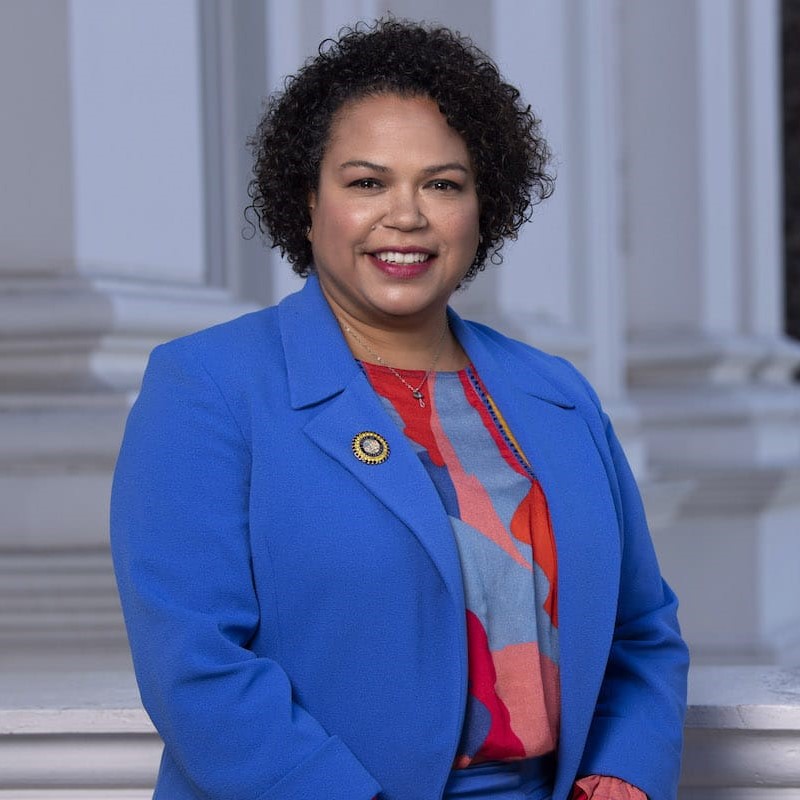
Asm. Mia Bonta
Sponsored bills
Existing law allows a person who was arrested or convicted of a nonviolent offense while they were a victim of human trafficking, intimate partner violence, or sexual violence, to petition the court, under penalty of perjury, for vacatur relief. Existing law requires, to receive that relief, that the crime for which the person was arrested or convicted was a nonviolent offense and that the person establish, by clear and convincing evidence, that the arrest or conviction was the direct result of being a victim of human trafficking, intimate partner violence, or sexual violence. Existing law authorizes the court to vacate the conviction if it concludes that the petitioner was a victim of one of those crimes at the time of the alleged commission of the offense, the arrest was a direct result of being a victim of that offense, and the vacatur is in the best interest of justice. This bill would allow that relief for a person arrested or convicted of any offense. The bill would also authorize relief for a person whose offense was related, rather than directly related, to being a victim of human trafficking, intimate partner violence, or sexual violence. The bill would remove the requirement that the court find that vacating the conviction is in the best interest of justice in order to vacate the arrest or conviction. Because this bill would authorize more petitions to be filed under penalty of perjury, by expanding the scope of the crime of perjury, this bill would impose a state-mandated local program. If a court issues an order for a person who was arrested or convicted of an offense while they were a victim of intimate partner violence or sexual violence, existing law requires the court to order the law enforcement agency having jurisdiction over the offense, the Department of Justice, and any law enforcement agency that arrested the petitioner or participated in the arrest of the petitioner to seal their records of the arrest and the court order to seal and destroy the records within 3 years from the date of the arrest, or within one year after the court order is granted, whichever occurs later, and thereafter to destroy their records of the arrest and the court order to seal and destroy those records. This bill would require the court to also order any law enforcement agency that has taken action or maintains records related to or because of the offense, including, but not limited to, departments of probation, rehabilitation, corrections, and parole, to seal and destroy their records. The bill would require those agencies to seal their records of arrest and the court order to seal and destroy the records within one year from the date of arrest, or within 90 days after the court order is granted, whichever occurs later. The bill would require the agencies to destroy these records within one year of the date of the court order. The bill would also require the Department of Justice to notify the petitioner and the petitioner's counsel that the department has complied with the order to seal the arrest records by the applicable deadline. The California Constitution requires the state to reimburse local agencies and school districts for certain costs mandated by the state. Statutory provisions establish procedures for making that reimbursement. This bill would provide that no reimbursement is required by this act for a specified reason.
Existing law requires the California Transportation Commission, under a program commonly known as the Trade Corridor Enhancement Program, to allocate, upon appropriation by the Legislature, revenues from a specified portion of the state excise tax on diesel fuel and certain federal funds to infrastructure projects located on or along specified transportation corridors. Under existing law, eligible projects under the program include, among others, highway improvements to more efficiently accommodate the movement of freight and environmental and community mitigation or efforts to reduce environmental impacts of freight movement. Under the program, existing law requires the commission to adopt a program of projects from projects nominated by the Department of Transportation and local agencies. In adopting the program of projects, existing law requires the commission to evaluate the total potential economic and noneconomic benefits of the program of projects to California's economy, environment, and public health, and to specifically assess localized impacts in disadvantaged communities. Existing law also requires the California Environmental Protection Agency to identify disadvantaged communities, and, pursuant to that requirement, the agency has developed a tool to identify those communities, commonly known as CalEnviroScreen. This bill would, commencing January 1, 2025, require the commission, the Department of Housing and Community Development, and the State Air Resources Board to create guidance for the programming of projects under the Trade Corridor Enhancement Program that expand the physical footprint of a highway in a community in the highest 10% of CalEnviroScreen communities. Commencing January 1, 2028, the bill would require this guidance to be incorporated into the programming cycle. The bill would require the applicant agency, as a condition of commission funding for design, right-of-way, and capital construction costs, to complete the applicable requirements of the California Environmental Quality Act and the federal National Environmental Policy Act of 1969 within 6 months of the commission adopting the program of projects. The bill would also require the commission to establish percentage targets for funds allocated under the program to be allocated to investments in zero-emission freight infrastructure, with an initial target of 15% of program funds awarded being awarded to investments in zero-emission freight infrastructure to be increased by 5% each cycle until it reaches 50%, as provided.
Existing law vests the Public Utilities Commission with regulatory authority over public utilities, including electrical corporations. Existing law authorizes the commission to adopt new, or expand existing, fixed charges, as defined, for the purpose of collecting a reasonable portion of the fixed costs of providing electrical service to residential customers. Under existing law, the commission may authorize fixed charges for any rate schedule applicable to a residential customer account. Existing law requires the commission, no later than July 1, 2024, to authorize a fixed charge for default residential rates. Existing law requires these fixed charges to be established on an income-graduated basis, with no fewer than 3 income thresholds, so that low-income ratepayers in each baseline territory would realize a lower average monthly bill without making any changes in usage. This bill would prohibit modifications to the amount of the income-graduated fixed charge from exceeding changes in inflation, as provided. The bill would make the provisions authorizing the income-graduated fixed charge inoperative on July 1, 2028. The bill, commencing July 1, 2028, would instead permit the commission to authorize fixed charges that, as of January 1, 2015, do not exceed $5 per residential customer account per month for low-income customers enrolled in the California Alternate Rates for Energy (CARE) program and that do not exceed $10 per residential customer account per month for customers not enrolled in the CARE program. The bill would authorize these maximum allowable fixed charges to be adjusted by no more than the annual percentage increase in the Consumer Price Index for the prior calendar year, beginning January 1, 2016. The bill would require the commission to adopt any modification to an existing fixed charge for the collection of a reasonable portion of the fixed costs of providing electrical service to residential customers in a stand-alone proceeding. The bill would prohibit a fixed charge from resulting in an increase to an electrical corporation's revenue requirement. The bill would require the commission, on or before July 1, 2027, but no sooner than 2 years after the adoption of the income-graduated fixed charge, to submit a public report to the relevant policy committees of both houses of the Legislature on the electrical corporations' implementation of the income-graduated fixed charge and other cost-saving options, as specified. Under existing law, a violation of the Public Utilities Act or any order, decision, rule, direction, demand, or requirement of the commission is a crime. Because the provisions of this bill would be a part of the act and therefore a violation of the bill's requirements or of a commission action implementing its requirements would be a crime, the bill would impose a state-mandated local program. The California Constitution requires the state to reimburse local agencies and school districts for certain costs mandated by the state. Statutory provisions establish procedures for making that reimbursement. This bill would provide that no reimbursement is required by this act for a specified reason.
Existing federal law, the Victims of Crime Act of 1984, creates the Crime Victims Fund and authorizes federal financial assistance to states for the purpose of supporting eligible crime victim assistance programs. Existing law creates various programs under the Office of Emergency Services related to crime prevention and education, including, among other things, programs concerning family violence prevention and domestic violence prevention. This bill would require the office to allocate funds, upon appropriation by the Legislature, to fill the gap in the federal Victims of Crime Act funding and to prioritize continuity and stability of crime victim services if the federal grant funding that is awarded to the office is 10% or more lower than the amount awarded in the prior year. The bill would require the office to regularly consult, collaborate with, and consider the recommendations regarding allocation of funding from the Victims of Crime Act Steering Committee.
Maddy summaryThis bill designates October 2024 as Menopause Awareness Month in California to highlight the health and societal impacts of menopause on women. It acknowledges that millions of women face symptoms that can affect their daily lives and work, noting that women of color are at higher risk for complications like premature menopause and heart disease. The resolution encourages the state to provide better health information and services to support women's well-being before, during, and after this transition. While the text outlines these goals, the bill itself is a formal recognition rather than a law that creates new funding or mandates specific programs.
Existing law establishes the Medi-Cal program, which is administered by the State Department of Health Care Services, under which qualified low-income individuals receive health care services. The Medi-Cal program is, in part, governed and funded by federal Medicaid program provisions. Existing law generally requires a county to redetermine a Medi-Cal beneficiary's eligibility to receive Medi-Cal benefits every 12 months and whenever the county receives information about changes in a beneficiary's circumstances that may affect their Medi-Cal eligibility. Existing law conditions implementation of the redetermination provisions on the availability of federal financial participation and receipt of any necessary federal approvals. Under existing law, if a county has facts clearly demonstrating that a Medi-Cal beneficiary cannot be eligible for Medi-Cal due to an event, such as death or change of state residency, Medi-Cal benefits are terminated without a redetermination. Existing law requires the department, subject to federal funding, to extend continuous eligibility to children 19 years of age or younger for a 12-month period, as specified. Under existing law, operative on January 1, 2025, or the date that the department certifies that certain conditions have been met, a child is continuously eligible for Medi-Cal up to 5 years of age. Under those provisions, a redetermination is prohibited during this time, unless certain circumstances apply, including, voluntary disenrollment, death, or change of state residency. This bill would require the department to seek federal approval to extend continuous eligibility to individuals over 19 years of age. Under the bill, subject to federal funding, and except as described above with regard to death, change of state residency, or other events, an individual would remain eligible from the date of a Medi-Cal eligibility determination until the end of a 12-month period, as specified. The bill would make various changes to the above-described redetermination procedures. The bill would, among other things, require the county, in the event of a loss of contact, to attempt communication with the intended recipient through all additionally available channels before completing a prompt redetermination. The bill would require the county to make another review of certain obtained information in an attempt to renew eligibility without needing a response from a beneficiary. The bill would require the county to complete a determination at renewal without requesting additional information or documentation if specified conditions are met, relating to, among other things, prior income verification and no contradictory information on file. When income is found not reasonably compatible from electronically available sources, the bill would require the county to first attempt to obtain a reasonable explanation through a verbal or written explanation, in an attempt to resolve a discrepancy between the beneficiary's self-attestation and information received through electronic data sources on required eligibility factors. For purposes of the income verification process only, when a renewal is received without a reasonable explanation or other income verification, the bill would require a county to accept self-attested information, as specified. Under the bill, for a beneficiary whose eligibility was discontinued due to failure to provide needed information and who submits to the county that information, as specified, the beneficiary would be entitled to a Medi-Cal eligibility determination for the 3 months immediately prior to the month in which the beneficiary provided the information, unless the beneficiary opts out. The bill would make conforming changes to related provisions. In the case of a redetermination due to a change in circumstances, each time a Medi-Cal beneficiary who is considered a member of a vulnerable or difficult-to-reach population, as defined, makes contact with the county, the bill would require the county to begin a new 12-month eligibility period if certain conditions are met. The bill would require the department to set a goal, in the form of a target rate of at least 50%, for successful ex parte renewals, and to post a related report. The bill would require counties to collect and submit to the department call-center data metrics. The bill would require the department to seek any necessary federal approvals to make permanent all temporary eligibility rules, not already described above, that were originally implemented for Medi-Cal renewals that were due between June 2023 and May 2024, inclusive, as part of the COVID-19 Unwinding Period. By creating new duties for counties relating to the redetermination of Medi-Cal eligibility, the bill would impose a state-mandated local program. The California Constitution requires the state to reimburse local agencies and school districts for certain costs mandated by the state. Statutory provisions establish procedures for making that reimbursement. This bill would provide that, if the Commission on State Mandates determines that the bill contains costs mandated by the state, reimbursement for those costs shall be made pursuant to the statutory provisions noted above.
Existing federal law, the federal Patient Protection and Affordable Care Act (PPACA) , requires each state to establish an American Health Benefit Exchange to facilitate the purchase of qualified health benefit plans by qualified individuals and qualified small employers. PPACA defines a "qualified health plan" as a plan that, among other requirements, provides an essential health benefits package. Existing state law creates the California Health Benefit Exchange, also known as Covered California, to facilitate the enrollment of qualified individuals and qualified small employers in qualified health plans as required under PPACA. Existing law, the Knox-Keene Health Care Service Plan Act of 1975 (Knox-Keene) , provides for the licensure and regulation of health care service plans by the Department of Managed Health Care. Existing law provides for the regulation of health insurers by the Department of Insurance. Existing law provides for the Medi-Cal program, which is administered by the State Department of Health Care Services, under which qualified low-income individuals receive health care services. The Medi-Cal program is, in part, governed and funded by federal Medicaid program provisions. This bill, the California Guaranteed Health Care for All Act, would create the California Guaranteed Health Care for All program, or CalCare, to provide comprehensive universal single-payer health care coverage and a health care cost control system for the benefit of all residents of the state. Under the bill, CalCare would be a health care service plan subject to Knox-Keene. The bill, among other things, would provide that CalCare cover a wide range of medical benefits and other services and would incorporate the health care benefits and standards of other existing federal and state provisions, including the federal Children's Health Insurance Program, Medi-Cal, ancillary health care or social services covered by regional centers for persons with developmental disabilities, Knox-Keene, and the federal Medicare Program. The bill would make specified persons eligible to enroll as CalCare members during the implementation period, and would provide for automatic enrollment. The bill would require the board to seek all necessary waivers, approvals, and agreements to allow various existing federal health care payments to be paid to CalCare, which would then assume responsibility for all benefits and services previously paid for with those funds. This bill would create the CalCare Board to govern CalCare, made up of 9 voting members with demonstrated and acknowledged expertise in health care, and appointed as provided, plus the Secretary of California Health and Human Services or their designee as a nonvoting, ex officio member. The bill would provide the board with all the powers and duties necessary to establish CalCare, including determining when individuals may start enrolling into CalCare, employing necessary staff, negotiating pricing for covered pharmaceuticals and medical supplies, establishing a prescription drug formulary, and negotiating and entering into necessary contracts. The bill would require the board, on or before July 1 of an unspecified year, to conduct and deliver a fiscal analysis to determine whether or not CalCare may be implemented and if revenue is more likely than not to pay for program costs, as specified. The bill would establish an Advisory Commission on Long-Term Services and Supports to advise the board on matters of policy related to long-term services and supports. The bill would require the board to convene a CalCare Public Advisory Committee to advise the board on all matters of policy for CalCare, an Advisory Committee on Public Employees' Retirement System Health Benefits to provide recommendations related to public employee retiree health benefits, and a CalCare Health Workforce Working Group to provide the board with input on issues related to health care workforce education, recruitment, and retention. The bill would establish an Office of Health Equity within CalCare and under the direction of the Director of the Department of Health Care Access and Information to ensure health equity under the program and other health programs of the California Health and Human Services Agency and to support the board through specified actions. This bill would provide for the participation of health care providers in CalCare, including the requirements of a participation agreement between a health care provider and the board, provide for payment for health care items and services, and specify program participation standards. The bill would prohibit a participating provider from discriminating against a person by, among other things, reducing or denying a person's benefits under CalCare because of a specified characteristic, status, or condition of the person. This bill would prohibit a participating provider from billing or entering into a private contract with an individual eligible for CalCare benefits regarding a covered benefit, but would authorize contracting for a health care item or service that is not a covered benefit if specified criteria are met. The bill would authorize health care providers to collectively negotiate fee-for-service rates of payment for health care items and services using a third-party representative, as provided. The bill would require the board to annually determine an institutional provider's global budget, to be used to cover operating expenses related to covered health care items and services for that fiscal year, and would authorize payments under the global budget. This bill would state the intent of the Legislature to enact legislation that would develop a revenue plan, taking into consideration anticipated federal revenue available for CalCare. The bill would create the CalCare Trust Fund in the State Treasury, as a continuously appropriated fund, consisting of any federal and state moneys received for the purposes of the act. The bill would specify uses for moneys in the CalCare budget, including special projects for which not-for-profit or governmental entities may apply. Because the bill would create a continuously appropriated fund, it would make an appropriation. This bill would prohibit specified provisions of this act from becoming operative until the Secretary of California Health and Human Services gives written notice to the Secretary of the Senate and the Chief Clerk of the Assembly that the CalCare Trust Fund has the revenues to fund the costs of implementing the act. The California Health and Human Services Agency would be required to publish a copy of the notice on its internet website. Existing constitutional provisions require that a statute that limits the right of access to the meetings of public bodies or the writings of public officials and agencies be adopted with findings demonstrating the interest protected by the limitation and the need for protecting that interest. This bill would make legislative findings to that effect.

Under existing law, human trafficking is a crime and law enforcement officers who are assigned field and investigative duties are required to complete minimum training pertaining to the handling of human trafficking complaints. Existing law generally provides support services for individuals who are survivors of human trafficking, including public social services and address confidentiality, as specified. Existing law authorizes the Department of Motor Vehicles to issue an identification card to an applicant who provides specified information to the department and pays a specified fee. Existing law provides assisted processes for persons being released from a federal or state prison or a state hospital to obtain an identification card. Existing law additionally waives the fee for senior citizens and indigent persons. This bill would require the department to develop an assisted and expedited process for survivors of human trafficking to obtain a new or replacement identification card. The bill would require the department to develop an application form that can be filled out by specified persons on behalf of the applicant. The bill would require the department to waive the fee for an applicant applying pursuant to this process. The bill would also require the California Victim Compensation Board to post specified information, including information about obtaining an identification card using this process, on its internet website.
Maddy summaryThis bill is a House Resolution that formally recognizes May 2024 as Asian and Pacific Islander American Heritage Month in California. It directly affects the state legislature and the broader public by establishing an official period to honor the history and contributions of Asian and Pacific Islander communities. The resolution highlights the diverse backgrounds of these populations, their significant roles in California's development, and their ongoing achievements in various fields. By adopting this measure, the Assembly commends these communities for their accomplishments and acknowledges the hardships they have faced throughout history.