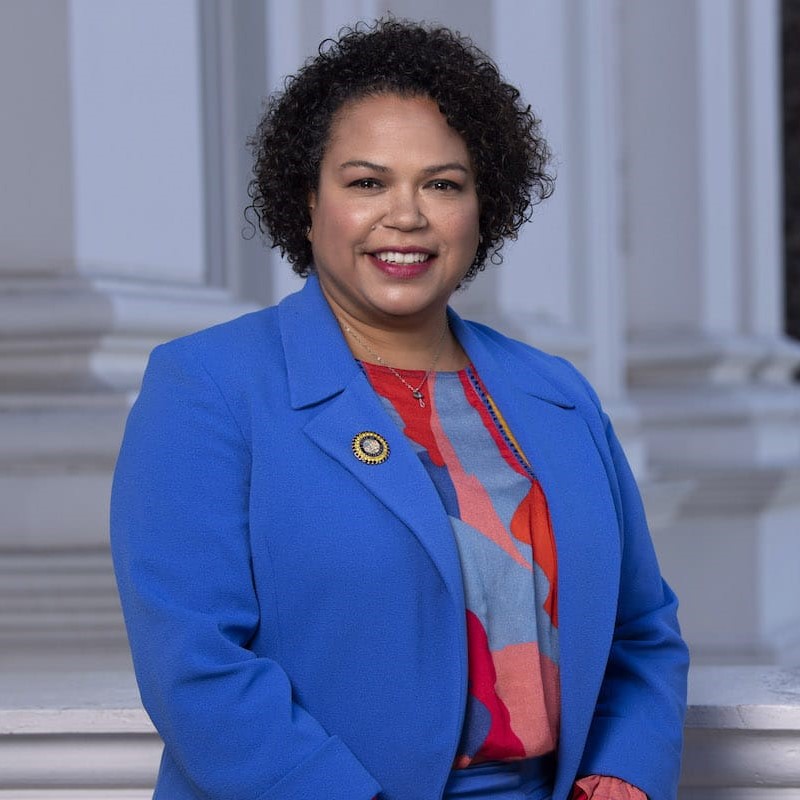
Photo of Mia Bonta
D California Assembly · District 18 On the 2026 ballot

Asm. Mia Bonta

Compare
Total votes
12,577
all sessions
Attendance
92%
902 missed
Near the chamber average
With party
99%
of cast votes
Near the chamber average
Bipartisan score
0%
crosses aisle rarely
Near the chamber average
Sponsored
1,139
bills & resolutions
Near the chamber average
Committees
14
assignments
1,139 bills and resolutions

Sponsored bills

Total
1,139
Primary
116
Co-sponsor
1,023
This page
1,139
matching current filters
Co-sponsor SCR 88
Signed into law · California Senate · Co-sponsor
Relative to California Wines: Down to Earth Month.

This measure would proclaim, in perpetuity, the month of April as California Wines: Down to Earth Month, to celebrate the sustainable leadership of California wineries and winegrape growers throughout the month of April.

Signed into law May 24, 2022 1 co-sponsor
Co-sponsor AB 35
Signed into law · California Assembly · Co-sponsor
Civil damages: medical malpractice.

Existing law, referred to as the Medical Injury Compensation Reform Act of 1975 (MICRA) , prohibits an attorney from contracting for or collecting a contingency fee for representing any person seeking damages in connection with an action for injury or damage against a health care provider based upon alleged professional negligence in excess of specified limits. This bill would recast those provisions and base the amount of contingency fee that may be contracted for upon whether recovery is pursuant to settlement agreement and release of all claims executed before a civil complaint or demand for arbitration is filed, or pursuant to settlement, arbitration, or judgment after a civil complaint or demand for arbitration is filed, as specified. The bill would add and revise definitions for these purposes. Existing law provides that in any action against a health care provider based upon professional negligence, the injured plaintiff is entitled to recover noneconomic losses to compensate for pain, suffering, inconvenience, physical impairment, disfigurement, and other nonpecuniary damage. Existing law limits the amount of damages for noneconomic losses in an action for injury against a health care provider based on professional negligence to $250,000. This bill would remove the $250,000 limit on noneconomic damages and expand the recast provisions to include an action for injury against a health care institution, as defined. The bill would increase the applicable limitation based upon whether the action for injury involved wrongful death. The bill would specify that these limitations would increase by $40,000 each January 1st for 10 years and beginning on January 1, 2034, the applicable limitations on noneconomic damages for personal injury and for wrongful death would be adjusted for inflation on January 1st of each year by 2%. Existing law specifies that in any action for injury or damages against a provider of health care services, a superior court shall, at the request of either party, enter a judgment ordering that money damages or its equivalent for future damages of the judgment creditor be paid in whole or in part by periodic payments rather than by a lump-sum payment if the award equals or exceeds $50,000. This bill would increase the minimum amount of the judgment required to request periodic payments to $250,000. Existing law makes statements, writings, or benevolent gestures expressing sympathy or a general sense of benevolence relating to the pain, suffering, or death of a person involved in an accident and made to that person, or to the family of that person, inadmissible as evidence of an admission of liability in a civil action. This bill would specify that statements, writings, or benevolent gestures expressing sympathy, regret, a general sense of benevolence, or suggesting, reflecting, or accepting fault relating to the pain, suffering, or death of a person, or to an adverse patient safety event or unexpected health care outcome, as specified, shall be confidential, privileged, protected, not subject to subpoena, discovery, or disclosure, and shall not be used or admitted into evidence in any civil, administrative, regulatory, licensing, or disciplinary board, agency, or body action or proceeding, and shall not be used or admitted in relation to any sanction, penalty, or other liability, as evidence of an admission of liability or for any other purpose.

Signed into law May 23, 2022 1 co-sponsor
Primary AB 2250
In committee · California Assembly · Lead sponsor
Prisoners: reentry.

Existing law requires the Department of Corrections and Rehabilitation to establish parole reentry and assessment programs for inmates in state prison in order to assess an inmate prior to release and to assist with the inmate's reentry into the community while on parole. This bill would, contingent upon an appropriation by the Legislature, create a 3-phase pilot program for women being released from prison that would, among other things, be responsive to each woman's gender and culture, create an individualized reentry program, develop professional skills, provide assistance in the form of subsidies, and focus on family reunification, as provided.

In committee May 19, 2022 0 co-sponsors
Primary AB 2549
In committee · California Assembly · Lead sponsor
Street harassment prevention.

Existing law requires the State Department of Public Health, through its Office of Health Equity, to perform strategic planning relating to gaps in health status and access to care among the state's diverse racial and ethnic communities, women, persons with disabilities, and the lesbian, gay, bisexual, transgender, queer, and questioning communities. Existing law requires the office to report to the Legislature on its activities on multicultural health. Existing law makes it unlawful to, by force or threat of force, willfully injure, intimidate, interfere with, oppress, or threaten any other person in whole or in part because of one or more of certain actual or perceived characteristics of the victim, as specified. Existing law also sets forth various criminal or civil penalties for different offenses involving certain forms of harassment. This bill would require the department to conduct research and a 5-year, statewide, public campaign to raise awareness and understanding of street harassment as a public health problem in the state with the purpose of preventing its occurrence. The bill would define "street harassment" as words, gestures, or actions directed at a specific person in a public place, as defined, without the consent of that person, based on the person's actual or perceived race, color, ethnic group identification, ancestry, national origin, religion, mental disability, physical disability, medical condition, genetic information, age, marital status, sex, gender, gender identity, gender expression, or sexual orientation, that the person experiences as intimidating, alarming, terrorizing, or threatening to their safety. The bill would make related legislative findings. The bill would require the department to conduct the research through surveys and focus groups, identifying subpopulations at disproportionate risk of experiencing street harassment. The bill would require the department to prepare 2 reports, proposing strategies and policies to prevent and respond to street harassment, as specified. The bill would require the department to submit the reports to the Legislature and the Governor, and to publish them on the department's internet website, no later than January 1, 2024, for the first report, and no later than June 30, 2027, for the 2nd report. The bill would require the department to commence the public campaign on January 1, 2023, conducting it online and in physical locations. The bill would require the department to, among other things, develop culturally relevant content, annually evaluate the effectiveness of the campaign, and prepare and publish on its internet website an annual report describing the campaign's activities, effectiveness, and gaps, as specified.


In committee May 19, 2022 0 co-sponsors
Primary AB 2253
In committee · California Assembly · Lead sponsor
Gun violence: public health crisis.

Under existing law, the Department of Justice is responsible for carrying out several functions related to the sale, delivery, and transfer of firearms, including maintaining a centralized list of all persons licensed to sell firearms and inspecting firearms dealers. Existing law requests the Regents of the University of California to establish the California Firearm Violence Research Center at UC Davis to conduct research with a mission to provide the scientific evidence on which sound firearm violence prevention policies can be based. Existing law requires that various data relating to crimes and firearms be made available to researchers affiliated with the research center, and that, at the Department of Justice's discretion, that information be made available to any other public agency concerned with the study and prevention of violence. This bill would declare that it is established policy of the state that gun violence is required to be recognized and addressed as a public health crisis, as specified. The bill would require all relevant state agencies, including the Department of Justice, to consider this state policy when revising, adopting, or establishing polices, regulations, and grant criteria, or making any expenditures related to the prevention of gun violence and increasing community safety. The bill would also create the Office of Gun Violence Prevention within the Department of Justice with the goal of developing a strategy, through collaboration with the Board of State and Community Corrections and other specified community members, to identify causes of gun violence in communities and to incorporate a public health approach to improve social determinants of health for communities most affected by gun violence. The bill would require the Office of Gun Violence Prevention to create a plan of action for how the Department of Justice and Board of State and Community Corrections will incorporate a public health approach to their gun violence prevention-related programs and services. The bill would require the office to submit the plan to the Legislature no later than July 1, 2023.

In committee May 19, 2022 0 co-sponsors
Co-sponsor AB 1752
In committee · California Assembly · Co-sponsor
Community colleges: part-time employees.

Existing law establishes the California Community Colleges under the administration of the Board of Governors of the California Community Colleges. Existing law authorizes the establishment of community college districts under the administration of community college governing boards, and authorizes these districts to provide instruction at community college campuses throughout the state. Existing law authorizes these districts to establish compensation levels for academic employees, as provided. Existing law requires community college districts, as a condition of receiving funding allocated for the Student Success and Support Program, to negotiate in good faith with the exclusive representatives for part-time, temporary faculty, the terms of reemployment preference for part-time, temporary faculty assignments based on minimum standards up to the range of 60% to 67% of a full-time equivalent load and a regular evaluation process for part-time, temporary faculty, as specified. Existing law establishes procedures for community college districts to demonstrate compliance with these requirements. This bill would require persons who are employed to teach adult or community college classes part time, as provided, to receive compensation in at least an amount that bears the same ratio to the amount provided to full-time employees as the time actually served by those part-time employees bears to the time actually served by full-time employees with comparable duties. The bill would impose this pay requirement upon the expiration or renewal of existing collective bargaining agreements, as provided. This bill would also require community college districts, as a condition of receiving funds allocated for the Student Success and Support Program in the annual Budget Act, to commence the negotiation of terms of compensation consistent with the proportional pay requirement for part-time employees, as well as terms governing reemployment preferences and evaluation processes, no later than the expiration of any negotiated agreement in effect on January 1, 2023, and for any community college district that does not have a collective bargaining agreement in effect as of January 1, 2023, upon the effective date of the bill.

In committee May 19, 2022 1 co-sponsor
Co-sponsor AB 2534
In committee · California Assembly · Co-sponsor
Survivor Support and Harm Prevention Pilot Program Act.

Existing law establishes the California Health and Human Services Agency and further establishes various departments and committees in the agency. Existing law also establishes various mental health programs, including, among others, the Lanterman-Petris-Short Act and the Children's Mental Health Services Act. This bill would, contingent upon appropriation and to be operative for one fiscal year following the appropriation, establish the Survivor Support and Harm Prevention Pilot Program, to be administered by the agency, with the purpose of funding noncarceral, nonpunitive, prevention-oriented, and therapeutic programs that support survivors of crime and otherwise support individuals who have experienced violence or trauma of any nature. The bill would require the agency to solicit applications from counties interested in hosting the pilot program and would require the agency to work with no more than 5 counties, as specified. The bill would require the Counties of Los Angeles and Alameda to be participating counties. The bill would require participating counties to establish an Office of Survivor Support and Harm Reduction, as specified. The bill would authorize a county Office of Survivor Support and Harm Reduction to provide or contract with community-based organizations to provide various services, including housing support options. The bill would require participating counties to meet certain requirements, including ensuring that programs and services funded by the county are provided through a noncarceral approach to safety. The bill would require law enforcement officers in participating counties to provide specified advice to victims of crime. The bill would require the Office of Survivor Support and Harm Reduction to provide at least 90% of grant funds to qualifying community-based organizations. The bill would require the agency to convene a stakeholder workgroup to oversee the program to be made up of specified members. The bill would require the agency to convene monthly meetings with the stakeholder workgroup and to post a yearly summary of the meetings on its internet website. The bill would require the agency to create a uniform mechanism for participating counties to collect and report, to the agency, data necessary to most effectively provide services and ensure community safety, and would require participating counties to provide that data to the best of their abilities. By imposing new duties on the Counties of Los Angeles and Alameda, the bill would impose a state-mandated local program. The California Constitution requires the state to reimburse local agencies and school districts for certain costs mandated by the state. Statutory provisions establish procedures for making that reimbursement. This bill would provide that, if the Commission on State Mandates determines that the bill contains costs mandated by the state, reimbursement for those costs shall be made pursuant to the statutory provisions noted above.

In committee May 19, 2022 1 co-sponsor
Primary AB 2363
In committee · California Assembly · Lead sponsor
Property taxation: welfare exemption: museums.

Pursuant to constitutional authorization, existing property tax law provides a welfare exemption, pursuant to which property used exclusively for religious, hospital, scientific, or charitable purposes owned and operated by specified types of entities is exempt from taxation if it meets certain criteria, including that the property is used for the actual operation of the exempt activity, and does not exceed an amount of property reasonably necessary to the accomplishment of the exempt purpose. Under existing property tax law, property used exclusively for the charitable purposes of museums owned and operated by a religious, hospital, scientific, or charitable fund, foundation, limited liability company, or corporation that meets these criteria is deemed to be within the welfare exemption. Existing property tax law requires a person claiming the welfare exemption to file that claim with the assessor and obtain an organizational clearance certificate from the State Board of Equalization, as provided. This bill would define the term "museum" for these purposes. The bill would provide that property used exclusively for the charitable purposes of museums includes property that a museum makes available for special events, including private rental events for its individual or corporate members, that provide access to the museum's exhibitions, collections, or other educational offerings as part of the events, or that the museum makes available to other nonprofit or government organizations for charitable or governmental purposes, regardless of whether the museum charges any fee or receives charitable contributions in connection with those special events. The bill would further provide that these special event uses shall be considered related to the primary charitable purposes of museums and reasonably necessary or incidental to those purposes. The bill would repeal these provisions on January 1, 2029. By adding to the duties of assessors in administering the welfare exemption, this bill would impose a state-mandated local program. Existing law requires any bill authorizing a new tax expenditure to contain, among other things, specific goals, purposes, and objectives that the tax expenditure will achieve, detailed performance indicators, and data collection requirements. This bill would apply these requirements to the bill and would, among other things, require the State Board of Equalization to submit, by December 1, 2023, and on or before each December 1 thereafter until December 1, 2029, certain data in a report to the Legislature, as specified. The California Constitution requires the state to reimburse local agencies and school districts for certain costs mandated by the state. Statutory provisions establish procedures for making that reimbursement. This bill would provide that, if the Commission on State Mandates determines that the bill contains costs mandated by the state, reimbursement for those costs shall be made pursuant to the statutory provisions noted above. Existing law requires the state to reimburse local agencies annually for certain property tax revenues lost as a result of any exemption or classification of property for purposes of ad valorem property taxation. This bill would provide that, notwithstanding those provisions, no appropriation is made and the state shall not reimburse local agencies for property tax revenues lost by them pursuant to the bill. This bill would take effect immediately as a tax levy.

In committee May 19, 2022 0 co-sponsors
Showing 1,051 to 1,060 of 1,139 bills