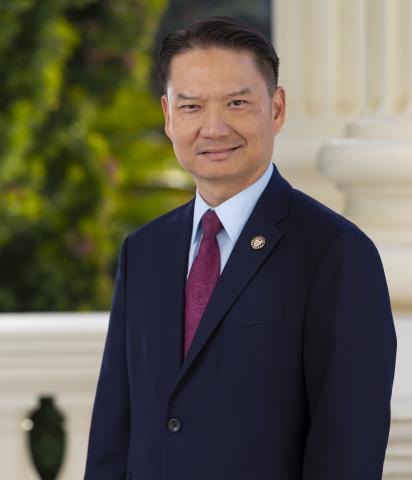
Existing federal law, the Patient Protection and Affordable Care Act (PPACA) , requires each state to establish an American Health Benefit Exchange to facilitate the purchase of qualified health benefit plans by qualified individuals and qualified small employers. Existing state law creates the California Health Benefit Exchange, also known as Covered California, to facilitate the enrollment of qualified individuals and qualified small employers in qualified health plans as required under PPACA. Existing law requires the Exchange to apply for a federal waiver to allow persons otherwise not able to obtain coverage through the Exchange because of their immigration status to obtain coverage from the Exchange. This bill would delete that requirement and would instead require the Exchange, no sooner than January 1, 2027, and upon appropriation by the Legislature for this purpose, to administer a program to allow persons otherwise not able to obtain coverage by reason of immigration status to enroll in health insurance coverage in a manner as substantially similar to other Californians as feasible, consistent with federal guidance and given existing federal law and rules. The bill would require the Exchange to undertake outreach, marketing, and other efforts to ensure enrollment, which would begin on October 1, 2028. The bill would also require the Exchange to adopt an annual program design for each coverage year to implement the program, provide appropriate opportunities for stakeholders, including the Legislature, and the public to consult on the design of the program, and report to the Department of Finance and the Legislature on progress toward implementation, as specified. The bill would establish the Covered California for All Fund in the General Fund, to be administered by the Exchange, into which user fees, appropriations, and other funds would be deposited to be used upon appropriation to pay for the administration of the program.
(1) Existing law, the Medical Practice Act, provides for the licensure and regulation of physicians and surgeons by the Medical Board of California and requires the board to adopt and administer standards for the continuing education of those licensees. Existing law requires the board, in determining its continuing education requirements, to consider including a course in menopausal mental or physical health. This bill would delete that requirement of the board. The bill would require, beginning July 1, 2026, and until July 1, 2032, a qualifying physician and surgeon, as defined, who completes continuing medical education courses in perimenopause, menopause, and postmenopausal care to receive 2 hours of credit for each hour completed of that coursework, as specified. Existing law, the Osteopathic Act, provides for the licensure and regulation of osteopathic physicians and surgeons by the Osteopathic Medical Board of California and requires the board to adopt and administer standards for the continuing education of those licensees. This bill would require osteopathic physicians and surgeons to receive the same credit as described above for completed coursework relating to perimenopause, menopause, and postmenopausal care. (2) Existing law, the Knox-Keene Health Care Service Plan Act of 1975, provides for the licensure and regulation of health care service plans by the Department of Managed Health Care and makes a willful violation of the act a crime. Existing law also provides for the regulation of health insurers by the Department of Insurance. Existing law sets forth specified coverage requirements for health care service plan contracts and health insurance policies. This bill would require a health care service plan contract or health insurance policy that covers outpatient prescription drugs, except as specified, that is issued, amended, or renewed on or after January 1, 2026, to include coverage for evaluation and treatment options for symptoms of perimenopause and menopause. The bill would require a health care service plan or health insurer to annually provide clinical care recommendations, as specified, for hormone therapy to all contracted primary care providers who treat individuals with perimenopause and menopause. Because a willful violation of these provisions by a health care service plan would be a crime, the bill would impose a state-mandated local program. (3) The California Constitution requires the state to reimburse local agencies and school districts for certain costs mandated by the state. Statutory provisions establish procedures for making that reimbursement. This bill would provide that no reimbursement is required by this act for a specified reason.
Existing law provides for the licensure of various health facilities, including general acute care hospitals, acute psychiatric hospitals, and special hospitals, by the State Department of Public Health. Existing law requires the department to adopt regulations that establish minimum, specific, and numerical licensed nurse-to-patient ratios by licensed nurse classification and by hospital unit for all general acute care hospitals, acute psychiatric hospitals, and special hospitals. Existing law requires the department to assess an administrative penalty of $15,000 for the first violation and $30,000 for the second and each subsequent violation if the department determines that a specified health facility has violated nurse-to-patient ratios, as specified. Under existing law, an acute general hospital is not subject to this administrative penalty if the hospital demonstrates it has met specified requirements, including that any fluctuation in required staffing levels was unpredictable and uncontrollable, prompt efforts were made to maintain required staffing levels, and the hospital immediately used and subsequently exhausted the hospital's on-call list of nurses and the charge nurse. Existing law specifies that multiple violations found on the same inspection survey constitute a single violation for purposes of determining whether the violation was a first, 2nd, or subsequent violation. This bill would define "on-call list" for the above purpose and would specify that a hospital contacting, or attempting to contact, licensed nurses who are not scheduled to be on call and who are not assigned to a float pool for the unit and shift where an alleged violation occurred is not considered as exhausting an on-call list. The bill would require the department to treat violations on separate days as separate violations.
Existing law, the Pharmacy Law, provides for the licensure and regulation of pharmacists and pharmacies by the California State Board of Pharmacy. Existing law, until January 1, 2026, authorizes a physician or pharmacist to, without a prescription or permit, furnish hypodermic needles and syringes for human use to a person 18 years of age or older, and authorizes a person 18 years of age or older to, without a prescription or license, obtain hypodermic needles and syringes solely for personal use from a physician or pharmacist, as a public health measure, as specified. Existing law, until January 1, 2026, requires a pharmacy that furnishes nonprescription syringes to provide written information or verbal counseling to consumers, as specified, at the time of furnishing or sale of nonprescription hypodermic needles or syringes. Existing law, when no other penalty is provided, makes a knowing violation of the Pharmacy Law a misdemeanor and, in all other instances, makes a violation punishable as an infraction. This bill would delete the January 1, 2026, repeal date, thereby extending those provisions indefinitely, and would make other conforming changes. By indefinitely extending an existing requirement under the Pharmacy Law, the violation of which is a crime, the bill would impose a state-mandated local program. The California Constitution requires the state to reimburse local agencies and school districts for certain costs mandated by the state. Statutory provisions establish procedures for making that reimbursement. This bill would provide that no reimbursement is required by this act for a specified reason.
(1) The United States Constitution generally requires a state to give full faith and credit to the public acts, records, and judicial proceedings of every other state. Existing law generally authorizes a California court or attorney to issue a subpoena if a foreign subpoena has been sought in this state but prohibits the issuance of a subpoena based on another state's law that interferes with a person's right to allow a child to receive gender-affirming health care or gender-affirming mental health care. Existing law generally prohibits a provider of health care, a health care service plan, or a contractor from disclosing medical information regarding a patient, enrollee, or subscriber without first obtaining an authorization unless an exception applies, including that the disclosure is in response to a subpoena. Existing law prohibits a provider of health care, a health care service plan, or a contractor from releasing medical information related to a person or entity allowing a child to receive gender-affirming health care or gender-affirming mental health care in response to a civil action, including a foreign subpoena, based on another state's law that authorizes a person to bring a civil action against a person or entity that allows a child to receive gender-affirming health care or gender-affirming mental health care. This bill would additionally prohibit a provider of health care, a health care service plan, or a contractor from releasing medical information related to a person seeking or obtaining gender-affirming health care or gender-affirming mental health care in response to a criminal or civil action, including a foreign subpoena, based on another state's law that interferes with an individual's right to seek or obtain gender-affirming health care or gender-affirming mental health care. The bill would also prohibit a provider of health care, health care service plan, contractor, or employer from cooperating with or providing medical information to an individual, agency, or department from another state or, to the extent permitted by federal law, to a federal law enforcement agency that would identify an individual and that is related to an individual seeking or obtaining gender-affirming health care, as specified. The bill would prohibit these entities from releasing medical information related to sensitive services, as defined, in response to a foreign subpoena that is based on a violation of another state's laws authorizing a criminal action against a person or entity for provision or receipt of legally protected health care activity, as defined. The bill would also generally prohibit the issuance of a subpoena based on a violation of another state's law that interferes with a person's right to seek or obtain gender-affirming health care or gender-affirming mental health care, as specified. (2) Existing law requires the Department of Justice to maintain the Controlled Substance Utilization Review and Evaluation System (CURES) for the electronic monitoring of the prescribing and dispensing of certain controlled substances by a health care practitioner authorized to prescribe, order, administer, furnish, or dispense those controlled substances. Existing law authorizes the department to enter into an agreement with an entity operating an interstate data sharing hub, or an agency operating a prescription drug monitoring program in another state, for purposes of interstate data sharing of prescription drug monitoring program information. Existing law limits the entities to which data may be provided from CURES, as well as the type of data that may be released and the uses to which it may be put. This bill would prohibit a state or local agency or employee, appointee, officer, contractor, or official or any other person acting on behalf of a public agency from knowingly providing any CURES data or knowingly expending any resources in furtherance of any interstate investigation or proceeding seeking to impose civil, criminal, or disciplinary liability based upon another state's law for the provision or receipt of legally protected health care activity, as defined. The bill would prohibit the department from sharing data with an out-of-state law enforcement agency without a warrant, subpoena, or court order and would prohibit an out-of-state user from providing any data in furtherance of an investigation or proceeding to impose liability based on another state's law for the provision or receipt of legally protected health care activity. This bill would make it a misdemeanor for a person to access the CURES database when not authorized by law and would make it a misdemeanor for a person who is authorized to access the database to knowingly furnish information from the CURES database to a person who is not authorized by law to receive that information. By creating new crimes, the bill would impose a state-mandated local program. (3) This bill would provide that its provisions are severable. (4) This bill would incorporate additional changes to Section 11165 of the Health and Safety Code proposed by AB 82 to be operative only if this bill and AB 82 are enacted and this bill is enacted last. (5) The California Constitution requires the state to reimburse local agencies and school districts for certain costs mandated by the state. Statutory provisions establish procedures for making that reimbursement. This bill would provide that no reimbursement is required by this act for a specified reason. (6) This bill would declare that it is to take effect immediately as an urgency statute.
(1) Existing law authorizes reproductive health care service providers, employees, volunteers, and patients, and individuals who face threats of violence or violence or harassment from the public because of their affiliation with a reproductive health care services facility, to complete an application to be approved by the Secretary of State for the purposes of enabling state and local agencies to respond to requests for public records without disclosing a program participant's residence address contained in any public record and otherwise provide for confidentiality of identity for that person, subject to specified conditions. Under existing law, any person who makes a false statement in an application is guilty of a misdemeanor. This bill would expand the address confidentiality program to a gender-affirming health care provider, employee, or volunteer, as defined, who faces threats of violence or harassment from the public because of their affiliation with a gender-affirming health care services facility. The bill would also make conforming changes. By imposing new duties on local agencies and expanding the scope of a crime, this bill would create a state-mandated local program. (2) Existing law prohibits a person, business, or association from knowingly publicly posting or publicly displaying, disclosing, or distributing on internet websites or on social media, the personal information or image of any reproductive health care services patient, provider, or assistant, or other individuals residing at the same home address, with the intent to incite a 3rd person to cause imminent great bodily harm to the person identified in the posting or display, or to a coresident of that person, as specified, or to threaten the person identified in the posting or display, or a coresident of that person, as specified. Existing law additionally prohibits a person, business, or association from soliciting, selling, or trading on the internet or social media the personal information or image of a reproductive health care services patient, provider, or assistant with the intent described above. Existing law establishes a cause of action for injunctive or declarative relief for a violation of these prohibitions. Existing law prohibits a person from posting on the internet or social media, with the intent that another person imminently use that information to commit a crime involving violence or a threat of violence against a reproductive health care services patient, provider, or assistant, or other individuals residing at the same home address, the personal information or image of a reproductive health care services patient, provider, or assistant, or other individuals residing at the same home address. Existing law makes a violation of this prohibition punishable by a fine of up to $10,000 per violation, imprisonment, as specified, or by both that fine and imprisonment. This bill would additionally prohibit a person, business, or association from soliciting, selling, or trading on the internet or social media the personal information or image of a gender-affirming health care services provider, employee, volunteer, or patient with the intent described above. The bill would also prohibit a person from posting on the internet or social media, as described above, the personal information or image of a gender-affirming health care services provider, employee, volunteer, or patient, or other individuals residing at the same home address. The bill would define various terms for these purposes. By expanding the scope of a crime, this bill would create a state-mandated local program. (3) Existing law, the California Uniform Controlled Substances Act (the act) , classifies controlled substances into 5 designated schedules, with the most restrictive limitations generally placed on controlled substances classified in Schedule I, and the least restrictive limitations generally placed on controlled substances classified in Schedule V. The act requires the Department of Justice to maintain the Controlled Substances Utilization Review and Evaluation System (CURES) for the electronic monitoring of the prescribing and dispensing of certain controlled substances by a health care practitioner authorized to prescribe, order, administer, furnish, or dispense those controlled substances. Existing law limits the entities to which data may be provided from CURES, as well as the type of data that may be released and the uses to which it may be put. Existing law makes a violation of the act a crime. Existing law defines the term "legally protected health care activity" to include the exercise of, or an act undertaken to aid a person to exercise, the provision of reproductive health care services, gender-affirming health care services, or gender-affirming mental health care services. This bill would prohibit a prescription for or the dispensing of testosterone or mifepristone from being reported to the department, CURES, or a contractor, as specified. The bill would require the department, on or before January 1, 2027, to remove certain existing records that were created or maintained prior to January 1, 2026, and make other conforming changes. By creating a new crime, the bill would establish a state-mandated local program. (4) Existing law authorizes a court to issue various orders relating to criminal investigations, including the interception of wire or electronic communications, the installation and use of a pen register or trap and trace device, or a search warrant upon specified grounds. Existing law prohibits the issuance of any orders or warrants for the purpose of investigating or recovering evidence of a prohibited violation. Existing law defines "prohibited violation" for this purpose as a violation of a law that creates liability for, or arising out of, either providing, facilitating, or obtaining an abortion or intending or attempting to provide, facilitate, or obtain an abortion that is lawful under the laws of this state. This bill would instead define a prohibited violation as a violation of a law that creates liability for, or arising out of, either providing, facilitating, or obtaining a legally protected health care activity or intending or attempting to provide, facilitate, or obtain a legally protected health care activity, as defined. (5) Existing law requires superior court judges in each county to prepare, adopt, and annually revise a uniform countywide schedule of bail for all bailable offenses, as specified. Existing law requires a uniform countywide schedule of bail to set $0 bail for an individual who has been arrested in connection with a proceeding in another state regarding an individual performing, supporting, or aiding in the performance of an abortion in this state, or an individual obtaining an abortion in this state, if the abortion is lawful under California law. This bill would instead require a uniform countywide schedule of bail to set $0 bail for an individual who has been arrested in connection with a proceeding in another state regarding an individual performing, supporting, or aiding in the performance of a legally protected health care activity in this state, or an individual obtaining a legally protected health care activity in this state, as specified. (6) Existing law prohibits a state or local law enforcement agency or officer from knowingly arresting or knowingly participating in the arrest of any person for performing, supporting, or aiding in the performance of an abortion or for obtaining an abortion, if the abortion is lawful in this state. Existing law prohibits a state or local public agency from cooperating with or providing information to an individual or agency from another state or a federal law enforcement agency, as specified, regarding a lawful abortion. Existing law prohibits specified persons, including a judicial officer, a court employee, or an authorized attorney, among others, from issuing a subpoena in connection with a proceeding in another state regarding an individual performing, supporting, or aiding in the performance of an abortion in this state, or an individual obtaining an abortion in this state, if the abortion is lawful in this state. Existing law does not prohibit the investigation of criminal activity that may involve an abortion, provided that no information relating to any medical procedure performed on a specific individual is shared with an agency or individual from another state for the purpose of enforcing another state's abortion law. This bill would instead expand those above-described provisions to apply to legally protected health care activity, as defined. (7) Existing law prohibits a state or local government employee or a person acting on behalf of the local or state government, among others, from providing information or expending resources in furtherance of an investigation that seeks to impose civil or criminal liability or professional sanctions on an individual for a legally protected health care activity, as defined, that occurred in this state or that would be legal if it occurred in this state. Existing law requires any out-of-state subpoena, warrant, wiretap order, pen register trap and trace order, or other legal process to include an affidavit or declaration under penalty of perjury that the discovery request is not in connection with an out-of-state proceeding relating to a legally protected health care activity, except as specified. This bill would authorize the Attorney General to bring a civil action against a person or entity that submitted a false affidavit under these provisions and would make submission of a false affidavit punishable by a civil penalty of $15,000, in addition to any other penalties or remedies provided by law. (8) Existing constitutional provisions require that a statute that limits the right of access to the meetings of public bodies or the writings of public officials and agencies be adopted with findings demonstrating the interest protected by the limitation and the need for protecting that interest. This bill would make legislative findings to that effect. (9) This bill would incorporate additional changes to Section 11165 of the Health and Safety Code proposed by SB 497 to be operative only if this bill and SB 497 are enacted and this bill is enacted last. (10) The California Constitution requires the state to reimburse local agencies and school districts for certain costs mandated by the state. Statutory provisions establish procedures for making that reimbursement. This bill would provide that with regard to certain mandates no reimbursement is required by this act for a specified reason. With regard to any other mandates, this bill would provide that, if the Commission on State Mandates determines that the bill contains costs so mandated by the state, reimbursement for those costs shall be made pursuant to the statutory provisions noted above.
Existing law, the California Health Care Quality and Affordability Act, establishes within the Department of Health Care Access and Information the Office of Health Care Affordability to analyze the health care market for cost trends and drivers of spending, develop data-informed policies for lowering health care costs for consumers and purchasers, set and enforce cost targets, and create a state strategy for controlling the cost of health care and ensuring affordability for consumers and purchasers. Existing law requires the office to conduct ongoing research and evaluation on payers, fully integrated delivery systems, and providers to determine whether the definitions or other provisions of the act include those entities that significantly affect health care cost, quality, equity, and workforce stability. Existing law defines multiple terms relating to these provisions, including a health care entity to mean a payer, provider, or a fully integrated delivery system and a provider to mean specified entities delivering or furnishing health care services. This bill would update the definitions applying to these provisions, including defining a provider to mean specified entities delivering or furnishing health care services. The bill would include additional definitions, including, but not limited to, a hedge fund to mean a pool of funds managed by investors for the purpose of earning a return on those funds, regardless of strategies used to manage the funds, subject to certain exceptions. The bill would require the office to conduct ongoing research and evaluation on management services organizations, as specified, and to establish requirements for management services organizations to submit data and other information as necessary to carry out the functions of the office. Existing law requires a health care entity to provide the Office of Health Care Affordability with written notice of agreements or transactions that do specified actions, including sell or transfer, among other things, a material amount of its assets to one or more entities. The bill would similarly require a noticing entity, as defined, to provide the office written notice of agreements or transactions between the noticing entity and a health care entity or management services organization, or an entity that owns, or controls the health care entity or management services organization that perform the same specified actions described above. The bill would additionally require a management services organization to provide the office with written notice of any agreement or transaction between the organization and any other entity.
(1) Under existing law, a licensed health care provider who is authorized by law to prescribe an opioid antagonist may issue standing orders for the distribution of an opioid antagonist to a person at risk of an opioid-related overdose or to a family member, friend, or other person in a position to assist a person at risk of an opioid-related overdose. Existing law exempts a health care provider who acts with reasonable care in issuing a prescription or order for an opioid antagonist from professional review, civil action, or criminal prosecution, under certain circumstances. Existing law requires that a person who receives an opioid antagonist pursuant to a standing order or otherwise possesses an opioid antagonist receive training, as specified. Existing law provides that a person who is trained in the use of an opioid antagonist and acts with reasonable care and in good faith is not subject to professional review, liable in a civil action, or subject to criminal prosecution. This bill would expand the above-described authorizations to those who are at risk of or any person who may be in a position to assist a person experiencing any overdose and would strike the requirement that those who receive and possess opioid antagonists receive training. The bill would authorize a person in a position to assist a person at risk of an overdose to possess an opioid antagonist and subsequently dispense or distribute an opioid antagonist to a person at risk of an overdose or another person in a position to assist a person at risk of an overdose. The bill would instead exempt a person who administers an opioid antagonist in good faith, whether or not they were trained, from liability for civil damages, as specified, and would instead exempt a health care provider who acts with reasonable care from liability in a civil action for any injuries or damages relating to or resulting from the acts or omissions of any person who administers the opioid antagonist in good faith, as specified. (2) Existing law imposes a drug program fee for each separate controlled substance offense, as specified, to be deposited by the county treasurer in a drug program fund. Existing law requires that a portion of the fund be allocated to primary prevention programs in the community. This bill would state that primary prevention programs may include those activities aligned with evidence-based best practices, as specified. (3) Existing law requires the State Department of Health Care Services to license and regulate facilities that provide residential nonmedical services to adults who are recovering from problems related to alcohol, drug, or alcohol and drug misuse or abuse, and who need alcohol, drug, or alcohol and drug recovery treatment or detoxification services. Existing law authorizes a licensed alcohol or other drug recovery or treatment facility to permit incidental medical services, as defined, to be provided to a resident at the facility premises by a licensed physician and surgeon or other health care practitioner under specified limited circumstances, including that the resident has signed an admission agreement. Existing law requires a licensee to develop a plan to address when a resident relapses, including when a resident is on the licensed premises after consuming alcohol or using illicit drugs. This bill would require the department, on or before January 1, 2027, to offer a combined application for entities seeking licensure as an alcohol or other drug recovery or treatment facility and to provide incidental medical services, as defined. The bill would prohibit the department from requiring an admission agreement to require a person to be abstinent and not intoxicated in order to be admitted to care or continue treatment. The bill would require a licensee to prioritize the individual maintaining some level of connection to treatment, following a relapse. (4) Existing law defines "drug- or alcohol-related program" as any program designed to reduce the unlawful use of, or assist those who engage in the unlawful use of, drugs or alcohol, through various means, such as intervention, treatment, and enforcement, among others. Existing law prohibits the encumbrance of state funds for a drug- or alcohol-related program unless it contains a component that explains that there is no unlawful use of drugs or alcohol and requires all aspects of a drug- or alcohol-related program receiving state funds to be consistent with the "no lawful use" message. This bill would redefine that term to mean any program designed to assist persons with substance use disorders and would strike enforcement from the specified means. The bill would repeal the above-described provisions related to the "no lawful use" message.
Existing law requires a hospital to provide patients with a written notice containing information about the availability of the hospital's discount payment and charity care policies, including information about eligibility and the contact information for a hospital employee or office from which a person may obtain further information about these policies. Existing law defines "charity care" and "discount payment" for these purposes. Existing law requires a hospital to provide to the Department of Health Care Access and Information a copy of its discount payment policy, charity care policy, eligibility procedures for those policies, review process, and the application for charity care or discounted payment programs, among other information. A violation of these provisions results in an administrative penalty, as specified. This bill would, commencing July 1, 2027, require a hospital to screen a patient to determine if they meet specific criteria, including that the patient is enrolled in CalFresh or CalWORKs, and, if they do, presumptively determine that a patient is eligible for participation under the hospital's charity care policy and discount payment policy. The bill would require a hospital to screen a patient for eligibility if the patient meets other specified criteria, including, among others, that the patient is uninsured. The bill would prohibit a hospital from requiring a patient to apply for the federal Medicare program, the Medi-Cal program, or other coverage before the patient is screened for or provided with discounted payment, as specified. The bill would require a hospital to provide patients with the ability to opt out of the screening process through a specified form. The bill would authorize a hospital, at its discretion or as established in its charity care policy or discount payment policy, to make presumptive determinations of eligibility or to conduct screening for patients that do not meet the criteria described above. The bill would authorize certain procedures and tools for screening, including, among others, allowing a hospital to use third-party software tools or services or to contract with a third party under specified conditions. The bill would require a hospital to provide a specified written notice to those patients determined to be eligible, presumptively or otherwise, under these provisions and would prohibit any billing statements from being sent prior to the written notice. The bill would require the billing statements to reflect the adjustments made to the patient's hospital charges under the hospital's charity care policy or discount payment policy.
Existing law, the Nevaeh Youth Sports Safety Act, requires a youth sports organization to ensure, by January 1, 2027, that its athletes have access to an automated external defibrillator (AED) during any practice or match. Existing law requires the AED to be administered by a medical professional or other certified and qualified person designated by a youth sports organization. This bill would delay the requirement to have access to an AED until January 1, 2028, would remove the requirement that it be administered by a medical professional, and would also require, by January 1, 2027, a youth sports organization to ensure that its coaches are certified, as specified, to perform cardiopulmonary resuscitation and to operate an AED. The bill would require, by January 1, 2027, a youth sports organization to have a written emergency response plan that includes certain information, including the location and procedures to be followed during a sudden cardiac event. The bill would require, by January 1, 2028, a youth sports organization to properly maintain and test its AED, as specified.