

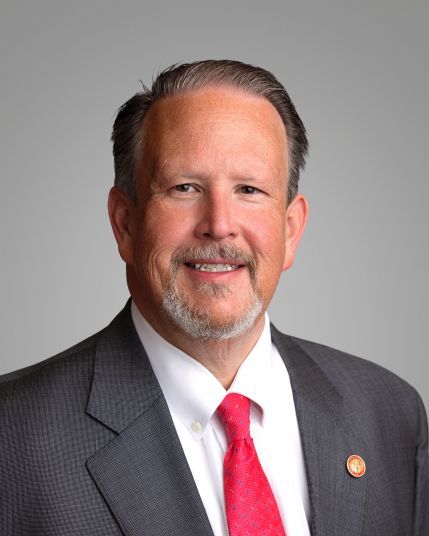
Maddy summaryThis House Resolution honors Larry Walther for his exceptional service to the State of Arkansas and the United States of America. It formally recognizes his career in public service, including roles with the Arkansas Economic Development Commission, U.S. Trade and Development Agency, Export-Import Bank, and as Chief Fiscal Officer and Treasurer of State for Arkansas.
Rep. Howard Beaty
Sponsored bills
Maddy summaryHouse Bill 1519 aimed to allow the Secretary of the Department of Commerce to participate in the hiring and contracting of employees. This authority would extend to the State Insurance Department, State Bank Department, and State Securities Department. The bill's intent was to establish "shared services" to streamline administrative functions like human resources and procurement across these entities. The goal was to enhance efficiency, reduce costs, and foster collaboration by pooling resources.
Maddy summaryHouse Bill 1970 aims to amend Arkansas law concerning the prepayment of sales tax. It directly affects retailers registered to collect gross receipts tax within the state. The bill increases the average monthly net sales threshold for retailers required to prepay sales tax from $200,000 to $500,000. This change means that only retailers with average net sales exceeding $500,000 per month will be obligated to make electronic prepayment of sales tax, using one of the existing payment options.
Maddy summaryHB 1065, titled "TO CREATE THE INFLATION REDUCTION ACT OF 2025," died in the House Committee on Revenue & Taxation on May 5, 2025, without becoming law. The provided bill text contains no substantive policy language or specific mechanisms; it only includes a list of supporting legislators and procedural details. No concrete policy changes, affected groups, or key provisions are described in the available text. As a bill that stalled in committee with no enacted provisions, it did not implement any inflation-related measures. The title appears to be a placeholder, as no actual inflation reduction policy was outlined in the submitted bill.
Maddy summaryHouse Bill 1472 proposed creating new sales and use tax exemptions for specific purchases related to the agriculture and timber industries in Arkansas. The bill aimed to exempt the sales tax on parts purchased to repair agricultural equipment and machinery used directly in commercial production. It also sought to exempt sales tax on parts used to repair timber equipment and machinery involved in commercial timber production, harvesting, or processing. Furthermore, the bill included an exemption for both parts and services purchased to repair a grain bin.
Maddy summaryHB 1699 proposed to expand the state's existing sales tax holiday. If enacted, it would have allowed consumers to purchase firearm safety devices and firearm storage devices without paying sales tax during the designated holiday period. This measure aimed to make these specific items, intended for secure firearm storage, temporarily more affordable for individuals.
Maddy summaryHouse Bill 1469, known as the "Broadband Expansion and Efficiency Act," aimed to create a sales and use tax exemption for machinery and equipment used by companies providing broadband communications services in Arkansas. This bill would have directly affected telecommunications, video programming, and internet access providers by exempting their purchases of specific infrastructure components like wires, cables, fiber, antennas, routers, and software from state sales taxes. The exemption was intended to encourage investment in broadband infrastructure by reducing costs for these service providers, though it specifically excluded personal consumer electronics and consumer-grade modems/Wi-Fi routers.
Maddy summaryHouse Bill 1500 proposed to repeal Arkansas's "throwback rule" for income tax apportionment, impacting how multistate businesses calculate their taxable income in the state. Currently, if a business ships tangible goods from Arkansas to another state where it is not subject to income tax, those sales are "thrown back" and treated as Arkansas sales for tax purposes. The bill aimed to gradually phase out this rule by progressively reducing the percentage of such sales considered within Arkansas, starting in 2025. By tax year 2030, these sales would be entirely sourced outside Arkansas, meaning they would not be subject to Arkansas income tax. The stated intent was to enhance economic competitiveness and encourage investment and job creation by multistate enterprises.
Maddy summaryHB 1662, titled "TO PROHIBIT LOBBYING FOR A COVERED FOREIGN ENTITY," aimed to prevent individuals or organizations from lobbying on behalf of certain foreign entities. The provided text is an amendment to the bill, which made minor changes to specific wording and references within the original text. Without the full original bill text, the specific definitions of "covered foreign entity" or the detailed mechanisms and scope of the prohibition are not available.
Maddy summaryHouse Bill 1930 aimed to mandate minimum reimbursement levels for healthcare services provided by healthcare insurers. The bill proposed a phased increase in these minimums, starting at 45% in 2026 and reaching 100% by 2030. It would have also required the Insurance Commissioner to consider specific factors, such as an insurer's Risk-Based Capital level and Medical Loss Ratio, when reviewing proposed increases to premium rates or cost sharing for policyholders.