

Maddy summaryHB 1083, the Arkansas Kids Online Safety Act, defines "covered internet services" to protect minors online by excluding certain platforms from its scope. The bill exempts services that solely route internet traffic and interactive gaming platforms complying with federal children's privacy laws (COPPA) as of January 1, 2025. It directly affects internet service providers and digital platforms operating in Arkansas, requiring them to adhere to the defined safety framework for minors. Key provisions clarify which services fall under the law, focusing on protecting children while excluding specific exempted technologies. The bill was withdrawn by its author on March 11, 2025, before final passage.
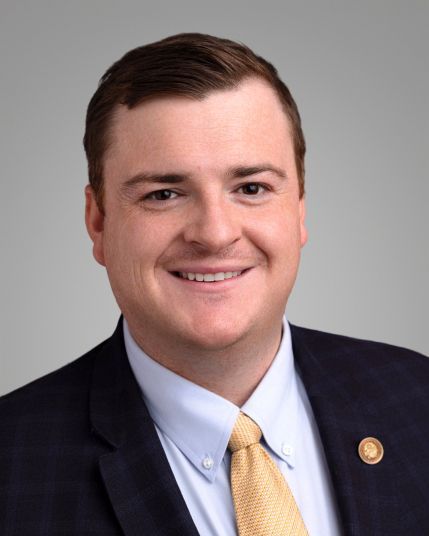
Rep. Zack Gramlich
Sponsored bills
Maddy summaryHB 1166, now Act 245, clarifies who in schools may administer epinephrine for severe allergic reactions. It expands authorization beyond physicians to include advanced practice registered nurses and physician assistants. This directly affects school staff, such as nurses or designated personnel, who may need to use epinephrine during emergencies. The law ensures more qualified individuals can respond quickly to allergic reactions in elementary and secondary schools.
Maddy summarySB 139 (now Act 232) makes non-compete agreements unenforceable for physicians and osteopaths licensed under Arkansas law. Specifically, it voids any agreement restricting a physician's right to practice within their licensed scope, as defined by Arkansas Medical Practices Act statutes. This applies directly to doctors and osteopaths holding active licenses to practice medicine or osteopathy in Arkansas. The law clarifies that standard non-compete rules do not apply to these licensed medical professionals, protecting their ability to work freely after leaving an employer.
Maddy summaryHB 1049 (now Act 238) amends Arkansas criminal law to establish a new offense for "unlawful squattering." The bill makes it a criminal violation for a person to occupy property without the owner's permission, specifically targeting individuals who enter or remain on property after being asked to leave. This directly affects individuals occupying vacant or abandoned properties without legal right, such as vacant homes or land. The key provision creates a specific criminal charge (likely a misdemeanor) for this conduct, distinct from general trespass laws, and specifies that the offense applies after the owner or their agent has issued a verbal or written demand to vacate.
Maddy summaryArkansas' SB 136 (now Act 201) creates a "Right to Try" pathway for patients with life-threatening or severely debilitating illnesses who have exhausted all FDA-approved treatments. It allows access to personalized investigational treatments (like genetically tailored gene therapies or vaccines) based on a patient's unique genomic profile, provided a physician documents eligibility and obtains written informed consent covering risks, costs, and alternatives. The bill specifies that manufacturers may provide treatments without charge or require payment for actual production costs, but heirs are not liable for unpaid costs if the patient dies. Insurance companies may cover these treatments but are not required to, and the law does not expand mandatory coverage for such treatments.
Maddy summaryHB 1368 amends the list of musicians honored on Arkansas Music Appreciation Day by adding specific names to the official roster. The bill directly affects the state's commemorative designation for music professionals recognized annually. It is a procedural update to the existing holiday framework, not a policy change with broader implications. The bill became law as Act 203 on February 27, 2025, after passing both chambers.
Maddy summaryThis House Resolution (HR 1028) formally recognizes National FFA Week (February 15-22, 2025) in Arkansas. It acknowledges the work of the National FFA Organization and Arkansas FFA Association - highlighting their 17,503 members and role in agricultural education - without creating new laws or funding. The resolution serves as a ceremonial acknowledgment, directing the House to send a copy to both FFA organizations. It has no policy impact beyond symbolic recognition.
Maddy summaryHB 1353 regulates vision benefit managers and amends Arkansas' Vision Care Plan Act and Healthcare Contracting Simplification Act. It prohibits insurance contracts from automatically reducing vision benefits solely due to other coverage (e.g., multiple vision plans), requiring such reductions to follow Insurance Commissioner-approved rules instead. The bill defines key terms like "covered materials" (e.g., lenses, frames) and "vision benefit manager," while banning agreements that force providers to charge more for non-covered services than their standard rates. This directly affects Arkansans with vision insurance plans and eye care providers, ensuring fairer billing practices for covered vision care services and materials. The bill passed in February 2025 and became Act 142.
Maddy summarySB 142, now Act 122, bans students from possessing or using personal electronic devices (like phones) during the entire school day, directly affecting public school students. The law requires schools to update discipline policies to include specific exemptions: devices issued by the school for educational use, special events (defined by future rules), and devices needed for students with special education plans or concurrent enrollment college courses. It replaces prior rules with these clear exemptions while maintaining the overall "bell to bell" device ban. The bill passed in February 2025 and became law without additional committee action.
Maddy summarySB 59 requires all public schools to provide one free breakfast daily to every student upon request, without checking if they qualify for federally funded free or reduced-price meals. This policy directly affects all public school students in the state, eliminating eligibility barriers for breakfast access. The bill includes an emergency clause, allowing it to take effect immediately upon enactment. It changes school meal procedures by mandating universal breakfast availability as a standard practice, not tied to existing federal program eligibility. The bill became law as Act 123 on February 24, 2025.