

Maddy summarySB 1209 requires corporations and limited liability companies (LLCs) to register with Arizona’s Corporation Commission before purchasing single-family homes, and mandates that county recorders cannot record deeds without proof of registration matching the deed’s owner name. It limits corporate ownership to no more than 5% of a county’s single-family homes (or 100 units annually in counties with 400,000+ residents) and requires deeds to state the property is not a primary residence. Exceptions apply to entities owning fewer than ten homes statewide and internal transfers within a corporation or LLC. The bill aims to regulate corporate real estate activity while exempting smaller-scale owners from the restrictions.
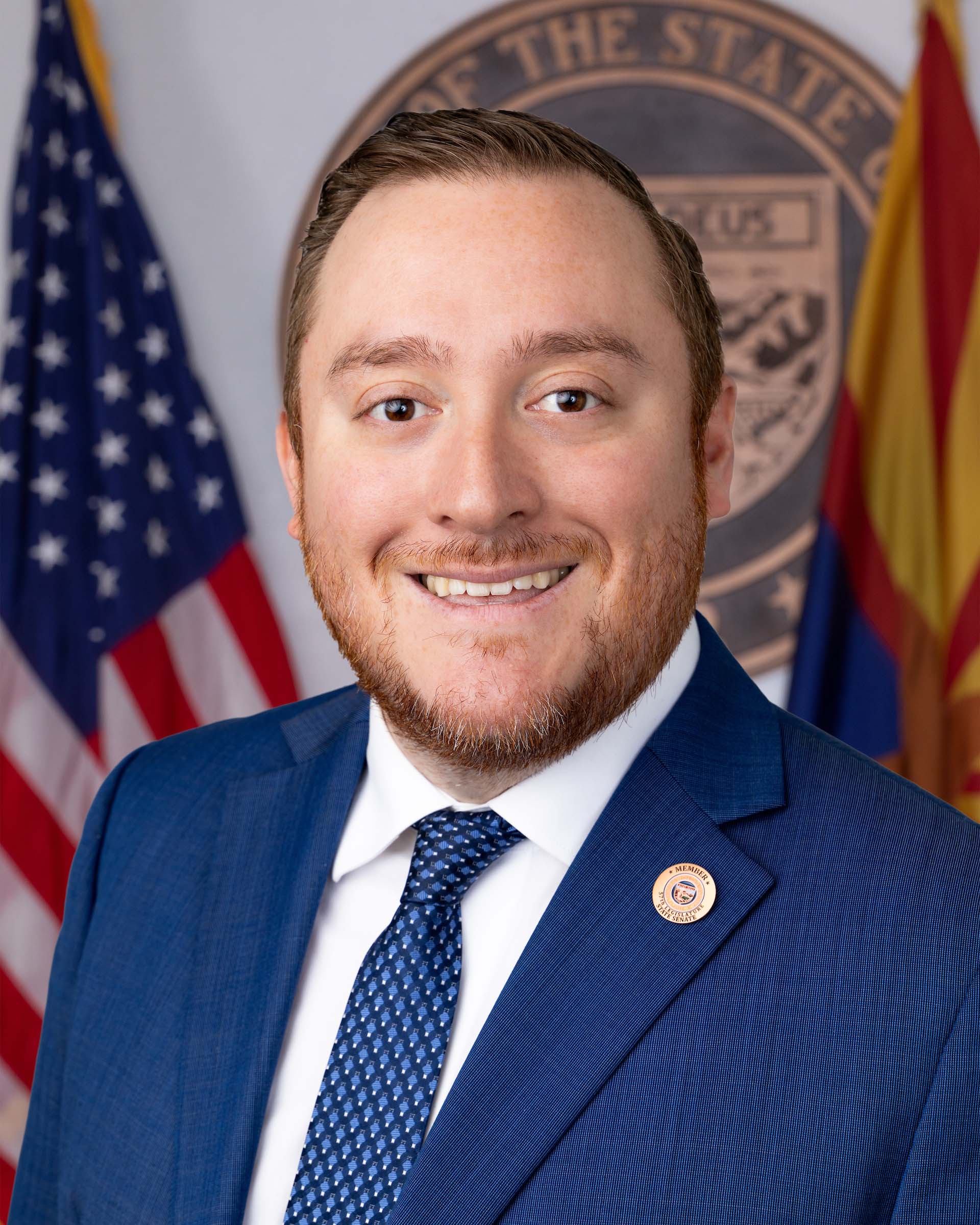
Sen. Flavio Bravo
Sponsored bills
Maddy summaryHB 2383 allocates $8 million from Arizona’s state general fund for fiscal year 2025-2026 to support applied research centers specializing in specific technology fields. It directs $3 million for medical technology centers, $2 million for clean energy/water sustainability tech, $2 million for semiconductors, and $1 million for other beneficial technologies, with centers required to match funds from non-state sources. Centers must collaborate with universities and businesses, report annual expenditures to the legislature, and use funds for workforce training in relevant fields. The funding is exempt from standard budget lapsing rules but requires unspent funds to revert to the state by June 2027.
Maddy summarySB 1194 automatically registers eligible Arizona residents to vote when they apply for or renew a driver's license or nonoperating ID card at a Department of Transportation office. It affects all applicants who meet voting eligibility requirements (citizenship, age, residency) by adding a simple registration step during license processing, with a 21-day window to opt out. Key provisions include electronic transfer of minimal registration data (name, address, date of birth) from DMV to county recorders, mandatory citizenship attestations under penalty of perjury, and confidentiality protections for registration status. The bill takes effect in 2025, streamlining voter registration without altering voting eligibility or requirements.
Maddy summarySB 1193, the Arizona State Voting Rights Act, requires cities, counties, and other local governments with significant language minority populations (e.g., over 2% of voting-age residents in a single language group) to provide voting materials - such as ballots, instructions, and registration forms - in both English and the minority language, along with having election officials fluent in that language at every polling place. Covered areas must correct failures within strict timeframes (e.g., 1 hour on election day) to avoid penalties of up to $250,000 for violations. The law applies to political subdivisions meeting census-based criteria and aims to ensure equal voting access for language minority voters, as defined by the bill. Enforcement can be initiated by affected voters, organizations, or the attorney general.
Maddy summarySB 1171 amends Arizona law to clarify the Arizona Department of Housing's role in allocating federal low-income housing tax credits. It requires the department to obtain written consent from local governments before approving multifamily rental projects in their areas and mandates annual reports to state officials on housing assistance activities. The bill also establishes that processing fees for applications will be deposited into a dedicated housing fund. This legislation directly affects housing developers seeking tax credits, local governments reviewing projects, and the state agency managing the program.
Maddy summaryHB 2466 clarifies that candidate committees in Arizona may legally use campaign funds to cover direct caregiving expenses for a candidate’s child or other dependent they personally care for, such as childcare costs. This specifically affects candidates with caregiving responsibilities who use committee funds for these essential needs. The bill amends Arizona’s campaign finance law (ARS § 16-921) to explicitly list caregiver expenses as an exempt expenditure, aligning with existing rules. The legislature states this is a clarifying change, not a substantive policy shift. It does not expand exemptions beyond this specific provision.
Maddy summarySB 1192 establishes automatic voter registration for Arizona residents applying for or renewing driver’s licenses or nonoperating ID cards at the Department of Transportation, with an opt-out option within 21 days. It also allows same-day voter registration during the 28 days before an election or on election day at polling places, requiring proof of residence and using provisional ballots for that election. The bill mandates that registration information be sent to county recorders within 5 days, and specifies that new registrations qualify for federal, statewide, county, and legislative races but not partisan primaries for 29 days after registration. It updates Arizona Revised Statutes sections 16-106 (voter registration timing) and 16-112 (driver license registration procedures), effective December 31, 2025.
Maddy summarySB 1195 updates Arizona's ballot handling and return procedures to clarify who may collect or deliver ballots and ensure valid submission. It requires election officials to provide clear instructions stating that only voters, family members, household members, or caregivers may handle or return ballots (prohibiting third-party collection). The bill revises mail ballot envelopes to include signature requirements and specifies that ballots must be returned to county offices or polling places by 7:00 p.m. election day (with updated options for 2026). It also reinforces felony penalties for violations, including offering payment for ballots or misrepresenting ballot collection services.
Maddy summaryHB 2460 amends Arizona's children's health insurance program (CHIP) eligibility rules by adjusting income thresholds for children under 19. It sets the following income limits relative to the federal poverty level: 200% for 1999-2023, 225% (with CMS approval) for 2023-2025, and 300% starting October 1, 2025. The bill directly affects low-income Arizona families with children under 19 whose household income meets these revised thresholds. It does not change program benefits or structure, only the income eligibility percentages. The amendment is part of defining program terms in Arizona Revised Statutes Section 36-2981.
Maddy summaryThis bill establishes a housing trust fund in Arizona to support affordable housing for low- and moderate-income households, with a specific requirement that a portion of the money be used exclusively for rural areas. The fund is financed through unclaimed property, transfers from other state accounts, and investment earnings, which the state treasurer will manage. Money from the fund can be used to build or renovate housing facilities and provide assistance for individuals with serious mental illness, while the director must prioritize projects that help families with children. The bill also mandates annual reports to the legislature detailing how the funds were spent and requires the department to consult with local governments before starting construction projects. Finally, the legislation exempts these funds from certain state appropriation rules and allows up to 10% of the fund to be used for administrative costs.