

Maddy summaryHB 2673 prohibits Arizona government entities from using donations from foreign governments or foreign nongovernmental sources for election administration. It requires election service vendors to annually certify they are not receiving such donations, with updates needed within five business days of new information, and mandates quarterly reports to the Secretary of State. The bill also amends early voting procedures to allow voters to request a unique early voter ID for mail-in ballots, requiring identity and address verification. Violations trigger civil penalties of three times the contracted amount plus $1,000 per day for ongoing noncompliance.
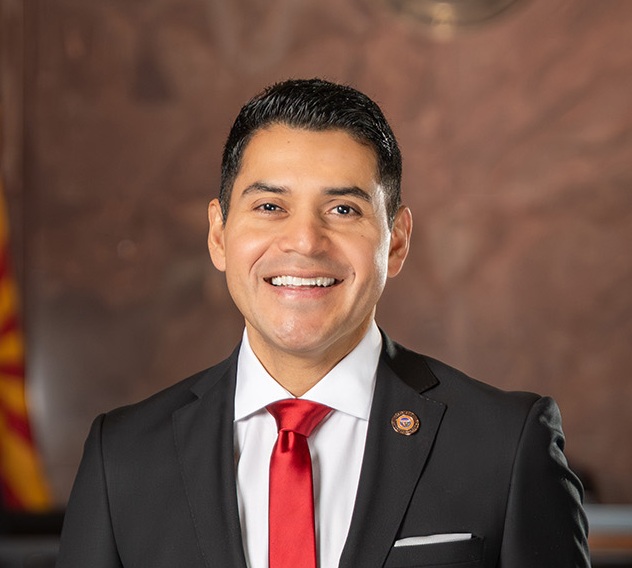
Rep. Steve Montenegro
Sponsored bills
Maddy summarySB 1311 creates a new "West Valley Charity Special Plate" for Arizona vehicle owners. To implement this, a person must pay $32,000 to the state department upfront, then vehicle owners pay a $25 annual fee ($17 of which is donated to the West Valley Charity Special Plate Fund). The department issues the plates after design approval, and the fund receives all $17 annual donations from plate fees. This program affects Arizona drivers who choose this specialty plate, with the charity fund supporting West Valley community initiatives.
Maddy summaryHB 2725 requires Arizona public schools to display U.S. flags (made in the U.S.) and provide Constitution/Bill of Rights copies (also U.S.-made) in classrooms for grades 7-12, and to set aside time daily for students to recite the Pledge of Allegiance. Schools must notify parents if a student skips the Pledge during this designated time. The bill also mandates a 1-2 minute daily moment of silence at the start of each school day for all grades (K-12), with teachers encouraged to discuss its use with parents but not suggesting specific reflections. Private schools, parochial schools, and homeschools are exempt from these requirements.
Maddy summaryHCR 2042 proposes amending Arizona's constitution to prohibit state governments from granting preferential treatment or discrimination based on race, sex, color, ethnicity, or national origin in public employment, education, or contracting. It specifically bans requiring individuals to endorse race-based policies, discuss personal race/ethnicity, or participate in training promoting "diversity, equity and inclusion" beyond equal protection under federal law. The amendment would restrict public funding for offices promoting race-based policies and prohibit differential treatment in hiring, admissions, or contracting decisions. If approved by voters, it would take effect on December 14, 2010, applying only to state actions after that date.
Maddy summaryThis bill prohibits Arizona government entities and election vendors from using money or services from foreign governments or non-citizens for election administration. It also bans foreign entities from funding efforts to influence ballot measure outcomes. Vendors must provide annual written statements confirming they don’t receive foreign funds, with penalties for false statements (up to three times the contract value). The law explicitly excludes federally recognized tribal nations from the definition of "foreign government."
Maddy summaryHB 2635 amends Arizona's tax code to add new sales tax exemptions for specific items. It exempts sales of "cash equivalents" (like gift cards, stored-value cards, and prepaid digital payment tools) and "precious metal bullion" (refined gold, silver, etc.) from retail sales tax. The bill defines "cash equivalents" as pre-paid items denominated in money redeemable for goods/services, excluding telecom prepaids, and clarifies that "monetized bullion" (coins used as currency) is exempt. This directly affects retailers selling these items, removing tax liability on such transactions. The bill focuses solely on tax policy, with no provisions related to firearm storage devices as inaccurately suggested in the title.
Maddy summaryHCR 2040 prohibits foreign governments and foreign individuals (non-U.S. citizens/nationals) from contributing funds or resources to influence Arizona elections or ballot measures. It requires election vendors, government entities managing elections, and campaign committees to certify under penalty of perjury that they haven’t accepted foreign donations, with annual updates needed. Violations can result in misdemeanor charges, invalidating contracts, and lawsuits by the Attorney General or qualified voters seeking $5,000 penalties per violation or $1,000 daily fines. The bill, if approved by voters, applies to election administration, ballot measures, and campaign financing while excluding federally recognized tribal nations from its definitions.
Maddy summaryHB 2869 allows property owners or their contractors to hire licensed independent providers (not affiliated with them) to review building permit applications or conduct inspections instead of using municipal staff. The bill requires these providers to carry professional liability insurance ($2 million/$4 million coverage for projects under $5 million) and mandates municipalities to reduce application/inspection fees by the amount they save. It sets a 5-business-day timeline for municipalities to approve applications reviewed by independent providers or provide written reasons for rejection, with automatic approval if deadlines pass. The law directly affects property developers, contractors, and municipalities in Arizona, streamlining permitting while ensuring provider accountability and cost savings for applicants.
Maddy summaryHB 2123 would allow certain individuals at risk (including public officials, peace officers, and people with protection orders) to request that their personal information - such as home addresses and full names - be removed from public county records. To qualify, applicants must file an affidavit detailing safety concerns and specific property details; a judge would then review the request and, if approved, block public access to that information for five years. The bill applies to documents recorded by county recorders, such as property deeds, and requires counties to restrict access after court approval. This is pending legislative action in Arizona (currently on the House Consent Calendar). Note: The bill’s title mentions "religious leader," but the text focuses on safety-related confidentiality for a broader group of at-risk individuals.
Maddy summaryHR 2006 is a ceremonial resolution passed by the Arizona House of Representatives to honor Michael Hunter for his 25+ years of service, including his role as House Chief of Staff since 2016. It recognizes his contributions to legislative work, policy development (such as school choice and tax code reforms), and leadership across Arizona government branches. The resolution expresses formal appreciation for his "exemplary assistance" and "vast experience," with no policy changes or legal effect. It serves solely as a tribute to his career, as he transitions to a new role with Christian Family Care.