

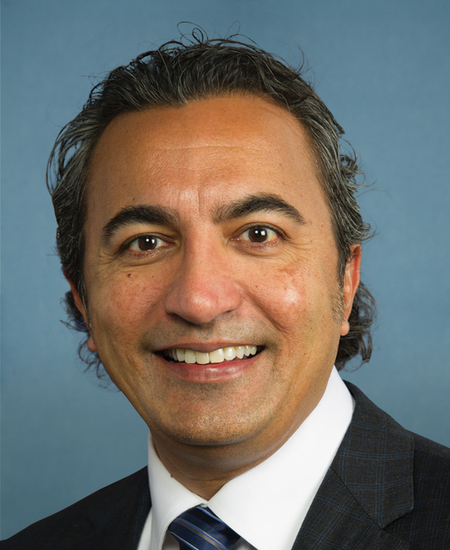
Photo of Ami Bera
D United States House · District 6 · California On the 2026 ballot

Rep. Ami Bera

Compare
Total votes
2,837
all sessions
Attendance
98%
52 missed
Near the chamber average
With party
98%
of cast votes
Near the chamber average
Bipartisan score
1%
crosses aisle rarely
Near the chamber average
Sponsored
987
bills & resolutions
Near the chamber average
Committees
6
assignments
987 bills and resolutions

Sponsored bills

Total
987
Primary
69
Co-sponsor
918
This page
987
matching current filters
Co-sponsor HR 6160
In committee · Alaska House · Co-sponsor
Strengthening Medicare for Patients and Providers Act

Maddy summaryThis bill changes how Medicare pays doctors and healthcare providers after 2025. It replaces the current two-part payment system with a single annual update based on the Medicare Economic Index (MEI), which tracks costs providers face. Starting in 2026, the payment rate for physician services will automatically adjust each year using the MEI, rather than separate calculations. This directly affects doctors, clinics, and other Medicare providers who receive payments under the physician fee schedule.

In committee Nov 19, 2025 1 co-sponsor
Co-sponsor HR 6132
In committee · Alaska House · Co-sponsor
Housing Affordability Act

Maddy summaryHR 6132, the Housing Affordability Act, updates inflation-adjusted dollar limits for multifamily housing loans under the National Housing Act. It increases specific loan caps (e.g., raising the maximum for certain units from $38,025 to $167,310) using the Bureau of the Census' Price Deflator Index for multifamily construction, with adjustments calculated annually based on March-to-March data. These changes directly affect lenders and borrowers participating in federally backed multifamily housing programs by setting new maximum loan amounts. The bill makes technical adjustments to existing limits without creating new programs or altering eligibility rules.

In committee Nov 19, 2025 1 co-sponsor
Co-sponsor HR 6151
In committee · Alaska House · Co-sponsor
Global Respect Act

Maddy summaryThe Global Respect Act (HR 6151) requires the U.S. President to publicly list foreign officials responsible for severe human rights violations against LGBTQI individuals, including torture, prolonged detention, or violence based on sexual orientation or gender identity. It mandates denying visas and entry to listed individuals and requires annual reports on the list's updates and impacts. The bill also directs the State Department to track global violence against LGBTQI people and update annual human rights reports to include discrimination based on sexual orientation or gender identity. These provisions directly affect foreign government officials and entities implicated in such abuses, aiming to increase accountability through U.S. visa restrictions.

In committee Nov 19, 2025 1 co-sponsor
Primary HRES 880
In committee · Alaska House · Lead sponsor
Recognizing the strategic value of the historical partnership between the United States and India.

Maddy summaryHRES 880 is a symbolic House resolution recognizing the strategic U.S.-India partnership, not a bill with new policy or funding. It reaffirms longstanding cooperation on defense, counterterrorism, technology, and people-to-people ties, citing historical milestones like the 2008 nuclear agreement and recent Quad collaboration. The resolution has no binding effect but formally supports continued partnership through existing mechanisms like the U.S.-India Transforming Relationship Utilizing Strategic Technology initiative. It highlights shared priorities including Indo-Pacific stability and counterterrorism efforts, with no new legislative requirements or changes to law.

In committee Nov 17, 2025 0 co-sponsors
Co-sponsor HR 5940
In committee · Alaska House · Co-sponsor
Seniors Deserve SMARTER Care Act of 2025

Maddy summaryHR 5940, the Seniors Deserve SMARTER Care Act of 2025, prohibits the implementation of the Medicare WISeR model (described in a July 2025 federal notice). The bill specifically blocks the Secretary of Health and Human Services from using the WISeR model, which would have required prior authorization for certain medical services under Medicare. This directly affects Medicare beneficiaries and healthcare providers who would have been subject to the model's requirements. The key provision is a clear ban on implementing WISeR or any substantially similar payment model, preventing changes to Medicare's service authorization process. The bill does not create new programs but stops a specific proposed Medicare policy change.

In committee Nov 7, 2025 1 co-sponsor
Co-sponsor HR 5959
In committee · Alaska House · Co-sponsor
North Korean Human Rights Reauthorization Act of 2025

Maddy summaryThe North Korean Human Rights Reauthorization Act of 2025 reauthorizes U.S. programs supporting human rights in North Korea through 2030, extending funding and reporting requirements from previous timelines. It mandates annual reports to Congress on U.S. efforts to improve human rights conditions, including coordination with international partners and support for nongovernmental organizations. The bill directs diplomatic actions urging China to halt forced returns of North Korean refugees, allow UNHCR access to refugees in China, and address refugee resettlement. It also requires the State Department to report on efforts to appoint a Special Envoy for North Korean Human Rights and expands U.S. support for information access into North Korea. These provisions directly affect U.S. foreign policy implementation, international humanitarian coordination, and the protection of North Korean refugees.

In committee Nov 7, 2025 1 co-sponsor
Co-sponsor HR 5973
In committee · Alaska House · Co-sponsor
Stop Excessive Force in Immigration Act of 2025

Maddy summaryThis bill, HR 5973, requires federal immigration enforcement personnel to follow strict limits on force use, including proportional application, mandatory de-escalation efforts, and prohibitions on equipment like flash bangs or rubber bullets except for specific public safety threats. It mandates body-worn and vehicle cameras for all operations, with footage retained for one year (three years for force incidents or complaints), and grants affected individuals the right to inspect recordings. The law also requires annual training on force policies, First Amendment compliance, and racial bias avoidance, while demanding detailed quarterly reports to Congress on force usage, assaults on agents, and equipment approvals. These provisions directly affect all federal immigration agents conducting enforcement actions, aiming to increase transparency and accountability during operations.

In committee Nov 7, 2025 1 co-sponsor
Co-sponsor HR 5972
In committee · Alaska House · Co-sponsor
Right to Enroll Act of 2025

Maddy summaryThis bill extends the annual open enrollment period for health insurance marketplaces (Exchanges) to cover the 2026 plan year. It requires the Health and Human Services Secretary to adjust the enrollment window to begin November 1, 2025, and end May 1, 2026 - significantly lengthening the typical enrollment period. This change directly affects individuals and families purchasing health insurance through federal or state-based marketplaces who rely on the annual enrollment period to select or change coverage. The key provision modifies the existing enrollment timeline under the Affordable Care Act, providing a longer window for enrollment decisions.

In committee Nov 7, 2025 1 co-sponsor
Co-sponsor HR 5907
In committee · Alaska House · Co-sponsor
To authorize the Secretary of Housing and Urban Development to award grants to eligible entities to select pre-reviewed designs of covered structures of mixed-income housing for use in the jurisdiction of the eligible entity, and for other purposes.

Maddy summaryHR 5907 authorizes the U.S. Department of Housing and Urban Development (HUD) to award grants to local governments, tribal entities, and municipal organizations to select pre-approved construction plans for mixed-income housing structures. These structures include duplexes, cottage courts, and other small-scale developments (up to 25 units) designed to promote affordability, with a specific requirement that 10% of annual funding must support rural areas. The bill mandates grantees to report on housing impacts, permits issued using the approved designs, and units built, while requiring the return of funds if selected designs aren’t adopted within five years. It focuses on streamlining housing approvals through pre-reviewed plans, not construction funding, to increase affordable housing supply.

In committee Nov 4, 2025 1 co-sponsor
Showing 131 to 140 of 987 bills
Previous 1 13 14 15 99 Next