

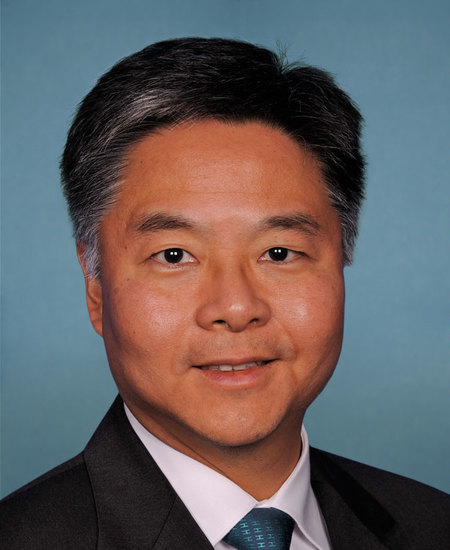
Photo of Ted Lieu
D United States House · District 36 · California On the 2026 ballot

Rep. Ted Lieu

Compare
Total votes
2,818
all sessions
Attendance
97%
85 missed
Near the chamber average
With party
98%
of cast votes
Near the chamber average
Bipartisan score
1%
crosses aisle rarely
Near the chamber average
Sponsored
2,316
bills & resolutions
Higher than 94% of chamber peers
Committees
3
assignments
2,316 bills and resolutions

Sponsored bills

Total
2,316
Primary
159
Co-sponsor
2,157
This page
2,316
matching current filters
Co-sponsor HR 8914
In committee · Alaska House · Co-sponsor
No Taxpayer-Funded Settlement Slush Funds Act of 2026

Maddy summaryThe No Taxpayer-Funded Settlement Slush Funds Act of 2026 prohibits the use of federal money to pay specific settlements involving high-ranking government officials and their close associates. It bars payments to the President, Vice President, their immediate families, cabinet members, senior executive staff, political appointees, and individuals connected to these roles, as well as any entity owned by the President or Vice President. Additionally, the bill restricts settlements related to claims about the January 6 Capitol attack, foreign election interference, or previously dismissed lawsuits, while requiring Treasury reports for large settlements and allowing the government to seek repayment if rules are broken.

In committee May 20, 2026 1 co-sponsor
Co-sponsor HR 7024
In committee · Alaska House · Co-sponsor
Hemp Planting Predictability Act

Hemp Planting Predictability Act This bill extends by two years the implementation of changes to the regulation of hemp products, which reimpose certain federal controls over some hemp products. Specifically, Congress enacted the FY2026 agriculture appropriations act (P.L. 119-37) on November 12, 2025. Effective November 12, 2026, the act modifies the statutory definition of hemp products that are considered to be lawful. This bill extends the effective date to November 12, 2028. As background, the 2018 farm bill excluded hemp from the Controlled Substances Act definition of marijuana and defined hemp . As a result, hemp and hemp-derived products at or below the 0.3% delta-9 tetrahydrocannabinol (THC, the psychoactive component of marijuana) concentration threshold were no longer regulated as Schedule I controlled substances and registration with the Drug Enforcement Administration was no longer required to cultivate or handle hemp and hemp-derived products. However, hemp remained subject to Department of Agriculture and Food and Drug Administration regulation. The 2025 changes to the definition of hemp, include changing the limit to a total THC concentration of not more than 0.3% on a dry weight basis rather than only delta-9 THC, explicitly including industrial hemp, excluding seeds from a cannabis plant that exceed a certain THC concentration, and excluding various types of hemp-derived cannabinoid products. Cannabinoids refer to unique chemical compounds that are found in hemp and marijuana (e.g., THC) and are known to exhibit a range of psychological and physiological effects.

In committee May 20, 2026 1 co-sponsor
Co-sponsor HR 6780
In committee · Alaska House · Co-sponsor
Producing Real Opportunities for Technology and Entrepreneurs Investing in Nutrition Act

Maddy summaryThis bill creates federal programs to advance alternative protein production through biomanufacturing and bioprocessing. It authorizes $15 million annually for research centers focused on protein diversification, $50 million for grants to companies building food biomanufacturing facilities, and $25 million for workforce development programs. The bill also requires a national strategy on protein security coordinated across multiple federal agencies. These provisions aim to strengthen food supply chains, create jobs in the growing protein sector, and reduce reliance on foreign commodities. The bill explicitly excludes insect-based food production from its scope.

In committee May 20, 2026 1 co-sponsor
Co-sponsor HR 3087
In committee · Alaska House · Co-sponsor
Civil Rights Cold Case Records Collection Reauthorization Act

Maddy summaryThis bill reauthorizes and strengthens the Civil Rights Cold Case Records Collection program. It establishes that all federal, state, and local government records related to historical civil rights cases must carry a presumption of immediate public disclosure, with full access intended for public understanding. Key provisions include allowing the Review Board to reimburse state/local governments for digitizing or copying records to add to the national collection, removing an exception that previously blocked state records from being included, and extending the Review Board's term from 7 to 11 years. The bill directly affects government agencies holding these records and the public seeking historical transparency about civil rights cases.

In committee May 20, 2026 1 co-sponsor
Co-sponsor HR 210
In committee · Alaska House · Co-sponsor
Dental Care for Veterans Act

Dental Care for Veterans Act This bill expands eligibility for veterans for dental care provided by the Department of Veterans Affairs (VA). Specifically, the bill makes all veterans who are enrolled in the VA health care system eligible for VA-provided dental services. Currently, only veterans who have a service-connected dental issue or meet other narrow criteria are eligible for certain dental services. The bill phases in eligibility over four years based upon existing eligibility, degree of service-connected disability or other disability, prisoner of war status, award of a Purple Heart, financial need, or VA health care eligibility.

In committee May 20, 2026 1 co-sponsor
Co-sponsor HR 8831
In committee · Alaska House · Co-sponsor
Protecting Our Democracy Act

Maddy summaryThe Protecting Our Democracy Act is a comprehensive legislative bill designed to prevent abuses of presidential power, restore checks and balances, and defend elections against foreign interference. Key provisions include prohibiting the President from granting self-pardons, requiring congressional oversight for pardons involving the President or their family, and banning the President from accepting payments from individuals who have received clemency. The bill also strengthens enforcement of the Hatch Act and ethics rules for political appointees, mandates greater transparency in presidential tax returns and campaign finances, and restricts the use of federal property for political conventions. Additionally, it expands reporting requirements for foreign contacts in federal campaigns and imposes stricter penalties for violations of election laws.

In committee May 14, 2026 1 co-sponsor
Primary HR 8819
In committee · Alaska House · Lead sponsor
Federal Artificial Intelligence Risk Management Act of 2026

Maddy summaryThis bill directs the National Institute of Standards and Technology to create standards and guidelines for managing risks associated with artificial intelligence systems used by federal agencies and their contractors, while explicitly excluding national security systems. The legislation requires the development of rules for authenticating, tracking, and labeling synthetic content generated by AI, as well as establishing testing and evaluation procedures for future AI acquisitions. Additionally, the bill mandates that the NIST Director provide training recommendations, performance indicators, and periodic assessments to ensure these standards are effectively implemented across the government.

In committee May 14, 2026 0 co-sponsors
Co-sponsor HR 8807
In committee · Alaska House · Co-sponsor
Maternal Health Pandemic Response Act

Maddy summaryThe Maternal Health Pandemic Response Act allocates $200 million to the Centers for Disease Control and Prevention to improve data collection, surveillance, and research on how public health emergencies affect pregnant and postpartum individuals. This funding supports efforts to gather detailed demographic information on maternal health outcomes, establish regional centers of excellence, and expand surveys to better reach underrepresented communities. The legislation also requires the CDC to make this data publicly available in a disaggregated format while protecting patient privacy, and mandates public education campaigns to ensure accurate information reaches families and healthcare providers. Additionally, the bill creates a diverse task force to develop federal recommendations for respectful maternity care during emergencies, addressing issues such as telehealth access, doula coverage, and the treatment of mental health and substance use disorders. These measures aim to reduce health disparities and improve care quality for pregnant people from racial and ethnic minority groups during public health crises.

In committee May 14, 2026 1 co-sponsor
Co-sponsor HR 8802
In committee · Alaska House · Co-sponsor
January 6th Law Enforcement Heroes Compensation Fund Act

Maddy summaryThis bill establishes a compensation fund to provide financial support to law enforcement officers who actively defended the U.S. Capitol on January 6, 2021, and suffered injuries, emotional distress, or death as a result. The program is administered by a Special Master appointed by the Attorney General, who will review individual claims for economic and non-economic losses while ignoring any questions of negligence. Eligible officers can receive specific payments for their injuries or the death of a colleague, with a guaranteed minimum of $4.975 million for death claims, plus an additional equal distribution to all qualifying officers regardless of injury status. The legislation also includes provisions to reduce payouts by any other compensation the claimant has already received and grants the federal government the right to recover funds if they are later paid out in related legal settlements.

In committee May 13, 2026 1 co-sponsor
Co-sponsor HR 8798
In committee · Alaska House · Co-sponsor
Universal School Meals Program Act of 2026

Maddy summaryThe Universal School Meals Program Act of 2026 mandates that all public schools provide free breakfast and lunch to every enrolled student, regardless of income. It establishes specific funding rates for these meals, adjusts payments based on the use of locally sourced food, and eliminates the ability of schools to collect debt for unpaid charges. Additionally, the bill expands free meal access to summer programs, afterschool care, and incarcerated juveniles while updating poverty measurement standards across various federal education and nutrition laws.

In committee May 13, 2026 1 co-sponsor
Showing 71 to 80 of 2,316 bills
Previous 1 7 8 9 232 Next