

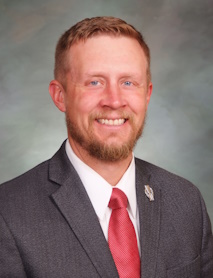
Photo of Brian Boner
R Wyoming Senate · District 2

Sen. Brian Boner

Compare
Total votes
4,655
all sessions
Attendance
98%
71 missed
Higher than 85% of chamber peers
With party
92%
of cast votes
Near the chamber average
Bipartisan score
5%
crosses aisle rarely
Near the chamber average
Sponsored
387
bills & resolutions
Higher than 96% of chamber peers
Committees
3
assignments
387 bills and resolutions

Sponsored bills

Total
387
Primary
77
Co-sponsor
310
This page
387
matching current filters
Primary SF 127
Signed into law · Wyoming House · Lead sponsor
Administrative rules-legislative review.

Maddy summarySF 127 requires the Wyoming legislature to approve "major agency rules" before they take effect. This affects state agencies creating significant regulations (like environmental or business rules) and the legislature, which must vote to approve or reject these rules within the next regular or special session after receiving them. The bill establishes a timeline for review, specifies that rules not approved become void, and allows the governor to temporarily bypass this for emergency rules (limited to 120 days). Key provisions include requiring agencies to provide impact analyses and ensuring rules cannot take effect without legislative approval, except for short-term emergencies.

Signed into law Mar 6, 2025 0 co-sponsors
Co-sponsor HB 183
Failed · Wyoming House · Co-sponsor
Net metering amendments.

Maddy summaryHB 183 amends Wyoming's net metering rules by setting a 25-kilowatt maximum per meter for residential systems and 200 kilowatts per meter for nonresidential systems. It allows customer-generators to combine multiple meters on their property under specific conditions, such as being physically located on the same premises, using the same electricity rate, and served by the same power line. Electric utilities must report annually by July 1 on the total installed capacity and peak demand of net metering systems, with additional reporting to a legislative committee when systems reach 5% of an utility's peak demand. The bill takes effect on July 1, 2025.

Failed Mar 5, 2025 1 co-sponsor
Co-sponsor SF 103
Vetoed · Wyoming House · Co-sponsor
Terminating and defunding diversity, equity and inclusion.

Maddy summaryWyoming's SF 103 prohibits state agencies, schools, and colleges from using public funds for diversity, equity, and inclusion (DEI) programs or activities. The bill bans funding for DEI offices, hiring DEI staff, requiring DEI statements, giving preference based on race or gender, and mandating DEI training - unless required by federal law or court orders. Exceptions include academic courses, scholarly research, student organization activities, and data collection related to diversity efforts, as specified in the bill.

Vetoed Mar 5, 2025 1 co-sponsor
Co-sponsor HB 249
Failed · Wyoming House · Co-sponsor
Runoff elections.

Maddy summaryHB 249 requires runoff elections for Wyoming's governor, secretary of state, state treasurer, state auditor, state superintendent of public instruction, and federal offices when no primary candidate receives over 50% of the vote. If a runoff is needed, the top two candidates from the primary advance to a runoff held on the first Tuesday after the second Monday in August, with ballot rules specifying how voters mark choices for candidates or write-ins. The bill creates a runoff election account funded by the state to cover costs, including reimbursement to counties for runoff administration. It directly affects voters and candidates in primary elections for these specific statewide and federal offices by changing nomination procedures when no majority is achieved.

Failed Mar 4, 2025 1 co-sponsor
Co-sponsor HB 188
Signed into law · Wyoming House · Co-sponsor
Two families-one nanny.

Maddy summaryHB 188 exempts home-based child care providers who care for up to four children from multiple families (with no more than two children under age two) at one parent's home from standard child care facility certification requirements. This directly affects informal caregivers operating in private residences, allowing them to provide care without full licensing while still meeting basic safety standards. The bill requires the Wyoming Department of Family Services to create implementing rules within 180 days. It takes effect immediately upon becoming law, streamlining oversight for small-scale, family-shared home care arrangements. The legislation does not alter certification rules for licensed child care centers or larger facilities.

Signed into law Mar 4, 2025 1 co-sponsor
Co-sponsor SF 46
Signed into law · Wyoming House · Co-sponsor
Water, irrigation and sewer districts-bid requirements.

Maddy summaryThis bill increases the cost threshold requiring competitive bidding for purchases and projects by Wyoming water, sewer, and water/sewer districts. It raises the mandatory bidding requirement from $30,000 to $75,000 for contracts involving labor, materials, or supplies. Districts can now make purchases under $75,000 without competitive bidding, but must still follow bidding rules for $75,000+ projects and accept the lowest responsible bid. The law applies to projects initiated on or after July 1, 2025.

Signed into law Mar 4, 2025 1 co-sponsor
Co-sponsor HB 285
died · Wyoming House · Co-sponsor
Pesticide warning labels.

Maddy summaryHB 285 requires pesticide manufacturers and sellers in Wyoming to use warning labels approved by the U.S. Environmental Protection Agency (EPA) under federal law to meet their legal duty to warn consumers about risks. This creates a legal presumption that warnings are sufficient if based on EPA-approved labels and federal registration, shifting the burden to challenge this if scientific evidence shows the warning wasn't supported by peer-reviewed research. To rebut the presumption, challengers must provide academically peer-reviewed, published evidence demonstrating the warning lacked scientific support at the time of sale. The bill takes effect July 1, 2025, directly affecting pesticide manufacturers, sellers, and consumers relying on label warnings.

died Mar 4, 2025 1 co-sponsor
Co-sponsor SF 62
Signed into law · Wyoming House · Co-sponsor
Sex-designated facilities and public schools.

Maddy summaryThis bill requires Wyoming public school districts to designate all multiple-occupancy restrooms and changing rooms as exclusively for males or females based on sex assigned at birth. It mandates reasonable accommodations like single-occupancy rooms for students who cannot use designated facilities, while allowing exceptions for maintenance staff, emergency medical help, and coaches under specific conditions (e.g., accompanied by same-sex adults). School districts failing to comply risk losing accreditation, and parents can sue for noncompliance. The law directly affects public school students, staff, and districts, with enforcement tied to state education standards. (Note: Bill is pending in Wyoming Legislature as of 2025.)

Signed into law Mar 4, 2025 1 co-sponsor
Co-sponsor HB 199
Signed into law · Wyoming House · Co-sponsor
Steamboat Legacy Scholarship Act.

Maddy summaryHB 199, titled the "Wyoming Freedom Scholarship Act" (not "Steamboat Legacy," which appears to be a misreference), creates a state-funded scholarship program for K-12 students in Wyoming. It increases the maximum annual scholarship from $6,000 to $7,000 for students at or below 150% of the federal poverty level, with annual inflation adjustments, and funds it through a new "Wyoming Freedom Scholarship Program Account" using state education revenues. The bill eliminates mandatory certification for private schools and providers but adds voluntary registration, while prohibiting funding from local taxes. It directly affects low-income Wyoming families seeking to use scholarships for public, private, or online education options.

Signed into law Mar 4, 2025 1 co-sponsor
Co-sponsor SF 83
died · Wyoming House · Co-sponsor
Large energy project funding-legislative approval.

Maddy summarySF 83 requires legislative approval before state funds can be used for large energy projects exceeding $400,000. It mandates that state agencies, universities, cities, and counties (awarding entities) report annual project details to the legislature and seek new approval for any project funding beyond $200,000 after initial authorization. The bill defines "large energy projects" broadly to include carbon capture, hydrogen production, solar, wind, and other energy infrastructure. It applies to all state-funded projects starting July 1, 2025, shifting approval authority from agencies to the legislature for significant energy investments.

died Mar 3, 2025 1 co-sponsor
Showing 51 to 60 of 387 bills
Previous 1 … 5 6 7 … 39 Next