

Maddy summaryHB 234 prohibits state and local governments from collecting or maintaining lists of privately owned firearms or their owners using specific merchant codes (like "firearms codes") in payment processing. It also bans payment processors from requiring such codes for firearm retailers or discriminating against them by charging higher fees or refusing transactions based on firearm sales. The bill directly affects firearm retailers, payment processors, and state agencies by restricting how firearm-related transaction data can be handled. Violations could lead to civil actions or criminal penalties, including misdemeanor charges for knowingly violating these provisions.
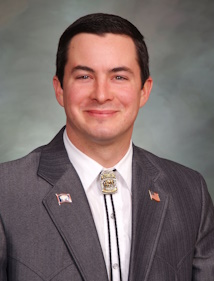
Rep. Dalton Banks
Sponsored bills
Maddy summaryHB 168 prohibits the manufacture, sale, and distribution of cultivated meat in Wyoming. It directly affects businesses producing or selling lab-grown meat products within the state. The bill defines "cultivated meat" as meat grown from cultured animal cells in a lab (not harvested from animals) and bans its sale under state law, with penalties including license suspension for violators. The law takes effect July 1, 2025, except for implementation rules that take effect immediately upon passage.
Maddy summaryWyoming's HB 153 creates a permanent vehicle registration option for non-commercial vehicles that are 15 years old or older. Owners pay a one-time fee (including an $87.50 state admin fee plus three times the standard annual registration fee) to replace annual renewal, receiving permanent license plates marked "Permanent" with no expiration date. This change applies only to qualifying vehicles owned by individuals, not commercial fleets, and permanently registered vehicles cannot be transferred to new owners - new owners must pay full registration fees. The bill modifies existing registration statutes to implement this system while maintaining annual renewal requirements for all other vehicles.
Maddy summaryHB 102 changes Wyoming's Attorney General from a governor-appointed position to a statewide elected office starting in the 2026 general election. It establishes a four-year term, sets the salary, and creates rules for filling vacancies, making the Attorney General a state-elected official like the governor and other top state officers. The bill also updates ethics laws and other statutes to apply to the elected Attorney General, requiring them to be a licensed attorney with four years of practice. This directly affects Wyoming voters, who will elect the Attorney General beginning in 2026, and the Attorney General’s office, which will now operate under elected official rules.
Maddy summaryThis bill prohibits Wyoming property owners from selling or transferring real property to the federal government without prior consent from the Wyoming legislature. It requires sellers to submit a notice and evidence that the federal government's acquisition would be based on a constitutional power (like eminent domain) before signing any binding agreement. Failure to comply results in a civil penalty equal to the sale's net proceeds. The law applies to all such transactions occurring on or after July 1, 2025, directly affecting property owners and federal agencies seeking land acquisitions in Wyoming.
Maddy summaryWyoming's SF 124 would require employers to verify the immigration status of potential employees before hiring and report unauthorized workers to law enforcement. It mandates that law enforcement officers ask about immigration status during detentions and notify federal agencies when encountering unauthorized aliens. The bill also requires verification of lawful presence for individuals applying for state or local public benefits (excluding emergency medical care and disaster relief). These provisions directly affect employers, law enforcement agencies, and immigrants seeking public benefits or employment in Wyoming. The bill is currently pending in the Judiciary Committee with a recommendation for amendment.
Maddy summaryThis Wyoming joint resolution (SJ 2) demands that the U.S. Congress extinguish federal ownership of public lands and subsurface resources within Wyoming's boundaries - currently covering over 46% of the state's surface and 69% of its subsurface resources - to fulfill Wyoming's constitutional right to "equal footing" as a state admitted to the Union. It cites the state's 1890 admission act and the U.S. Constitution's Admissions and Property Clauses, arguing that continued federal control violates Wyoming's sovereignty. The resolution specifically asks Congress to confirm its intent to transfer these lands to Wyoming by October 2025, proposes that transferred lands become state public lands, and offers to negotiate cession of lands deemed nationally significant. As a non-binding resolution, it serves as a formal request to Congress, not a legislative action with immediate effect.
Maddy summaryHB 205 creates the Wyoming State Fair Department, transferring all state fair operations - including staff, funding, equipment, and responsibilities - from the Department of Agriculture. The new department will be led by a director appointed by the State Fair Board (with Senate approval), who will manage the annual fair held in Douglas and oversee fairgrounds maintenance. Existing state fair functions, including budgeting for the fair and its grounds, will now fall under this standalone department instead of Agriculture. The bill formalizes this structural change while maintaining the fair's current purpose of celebrating Wyoming's agricultural heritage through competitions and exhibits.
Maddy summaryHB 119 establishes minimum standards for property easements acquired through eminent domain in Wyoming. It requires condemners (like government agencies or utilities) to provide 30 days' notice to local officials before taking property, clarifies landowners aren't liable for most issues arising from the easement (only intentional acts), and mandates condemnors cover reclamation costs after the easement ends. The bill also ensures property improvements are included in compensation calculations and restricts existing easements to their original purpose unless amended. It applies to condemnation actions starting July 1, 2025, and doesn't affect current contracts.
Maddy summaryHB 146 increases penalties for taking stray livestock without the owner's consent in Wyoming. It sets a minimum $750 fine (up from prior) and maximum $1,500 fine for first offenses, and a minimum $1,500 fine with a maximum $3,000 fine for second or subsequent offenses under W.S. 11-24-103. The bill directly affects individuals who take, retain, or restrain lost animals without the owner's knowledge or permission. It becomes effective July 1, 2025, and modifies existing penalties for violations of livestock estray laws.