

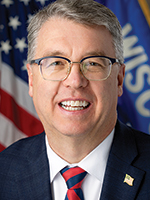
Photo of Brad Pfaff
D Wisconsin Senate · District 32

Sen. Brad Pfaff

Compare
Total votes
595
all sessions
Attendance
100%
1 missed
Near the chamber average
With party
94%
of cast votes
Near the chamber average
Bipartisan score
4%
crosses aisle rarely
Near the chamber average
Sponsored
526
bills & resolutions
Near the chamber average
Committees
3
assignments
526 bills and resolutions

Sponsored bills

Total
526
Primary
526
Co-sponsor
0
This page
526
matching current filters
Primary SB 1151
Failed · Wisconsin Senate · Lead sponsor
Relating to: general equalization aids, the reimbursement rate for special education costs, excluding special education reimbursement from certain per pupil payments, and making an appropriation. (FE)

Maddy summaryThis bill proposes changes to how Wisconsin calculates and distributes state funding for special education and related school programs. It would adjust the reimbursement rate for special education costs to distribute the full appropriated amount, capping reimbursement at 60 percent of eligible costs, and modifies how certain special education funds are excluded from per-pupil payment calculations. The legislation also increases the general school aid appropriation by approximately $446 million for the 2026-27 fiscal year. These changes would affect the Wisconsin Department of Public Instruction and school districts receiving state education funding. The bill was introduced in March 2026 but failed to pass the Senate.

Failed Mar 23, 2026 0 co-sponsors
Primary SB 1149
Failed · Wisconsin Senate · Lead sponsor
Relating to: prescription drug cost reporting by manufacturers, making an appropriation, and providing a penalty. (FE)

Maddy summaryThis bill requires prescription drug manufacturers to report price increases and new drug introductions to the state health department and insurance office, affecting companies that sell brand-name or generic drugs in the state. Manufacturers must notify regulators at least 30 days before raising prices by more than 25 percent over two years or introducing high-cost drugs, providing justification including cost-effectiveness data and comparisons to similar medications. The bill also mandates annual reports on manufacturer-sponsored patient assistance programs and requires posting of pricing documentation online with public hearings to review trends. Failure to submit required notices or reports can result in daily penalties of up to $10,000. The legislation authorizes funding for two additional state staff positions to administer these reporting requirements.

Failed Mar 23, 2026 0 co-sponsors
Primary SJR 145
Failed · Wisconsin Senate · Lead sponsor
Relating to: state contracts for stationery and printing (first consideration).

Maddy summaryThis bill proposes amending the state constitution to require that all stationery and printing contracts for state use be awarded to the lowest bidder operating within the state, unless federal law or international agreements prohibit it. It allows the legislature to set a maximum price for these contracts and prohibits any state legislators or officers from having a financial interest in such agreements. The measure would be submitted to voters at the next general election after a three-month public notice period.

Failed Mar 23, 2026 0 co-sponsors
Primary SB 1095
Failed · Wisconsin Senate · Lead sponsor
Relating to: the property tax deferral loan program administered by the Wisconsin Housing and Economic Development Authority.

Maddy summaryThis bill modifies Wisconsin's property tax deferral loan program to increase the maximum loan amount from $3,525 to $5,000 annually. It also establishes an annual adjustment mechanism that ties the loan limit to changes in the consumer price index, ensuring the amount keeps pace with inflation. The legislation applies these changes to loans where applications are filed after the bill's effective date. Additionally, the bill allows the Wisconsin Housing and Economic Development Authority to use up to 5 percent of allocated funds for marketing the program. Eligible participants must still meet existing income requirements, earning no more than $20,000 or 80 percent of the area median income.

Failed Mar 23, 2026 0 co-sponsors
Primary SB 1129
Failed · Wisconsin Senate · Lead sponsor
Relating to: unfair sales practices at publicly funded stadiums.

Maddy summaryThis bill establishes rules to limit price markups on food and drinks sold at publicly funded stadiums in the state. It defines a stadium as a facility with at least 3,000 seats that receives public financial support, while excluding schools and charter schools from these requirements. The law prohibits stadium operators and concessionaires from charging more than the retail cost of items plus a 20 percent markup. Violations of these pricing limits would be classified as unfair trade practices under state law.

Failed Mar 23, 2026 0 co-sponsors
Primary SJR 140
Failed · Wisconsin Senate · Lead sponsor
Relating to: congratulating the U.S. Olympic Women’s Ice Hockey Team on winning the Olympic gold medal.

Maddy summaryThis bill congratulates the U.S. Olympic Women's Ice Hockey Team on winning the gold medal at the 2026 Winter Olympics. It specifically highlights the achievements of Wisconsin-affiliated players and staff, including former and current University of Wisconsin athletes who competed on the team. The resolution formally commends the athletes, coaches, and support staff for their success and wishes them continued success. The bill is a ceremonial measure with no regulatory or policy changes.

Failed Mar 23, 2026 0 co-sponsors
Primary SR 7
Failed · Wisconsin Senate · Lead sponsor
Relating to: convening additional senate floor periods to address affordability for Wisconsin.

Maddy summaryThis Senate resolution directs the Wisconsin Senate to schedule additional floor sessions between April 14 and April 16, 2026, and to hold extraordinary sessions through December 31, 2026, to consider bills aimed at reducing costs for Wisconsinites. The measure specifically calls for passing legislation introduced by minority party members that address affordability issues such as utility rates, health care premiums, child care costs, and agricultural expenses. It was introduced in March 2026 by a bipartisan group of senators and referred to the Committee on Senate Organization, where it later failed to adopt following a vote to withdraw from committee. The resolution does not create new laws itself but establishes procedural requirements for the Senate to convene additional voting periods during the 2025-26 legislative session.

Failed Mar 23, 2026 0 co-sponsors
Primary SB 1138
Failed · Wisconsin Senate · Lead sponsor
Relating to: banning products containing intentionally added PFAS and providing a penalty. (FE)

Maddy summaryThis bill would ban the sale of products containing intentionally added PFAS chemicals starting in 2032, covering items like food packaging, cookware, cosmetics, and textiles used in homes. It requires manufacturers to submit detailed information about PFAS use in their products and allows the state to add more product categories to the ban through future rules. A complete ban on all intentionally added PFAS would take effect in 2038, except for uses deemed necessary for public safety or the environment. The law includes exemptions for medical devices, firefighting foam, and products governed by federal law, with a penalty of $100 per violating product per day for noncompliance.

Failed Mar 23, 2026 0 co-sponsors
Primary SB 965
Failed · Wisconsin Senate · Lead sponsor
Relating to: collective bargaining for employees of the University of Wisconsin Hospitals and Clinics Authority.

Maddy summarySB 965 modifies collective bargaining rules specifically for employees of the University of Wisconsin Hospitals and Clinics Authority (UWHCA). It allows multiple bargaining units at UWHCA to share a single representative if majority employees in each unit agree, streamlining negotiations under existing public employee bargaining laws. The bill also updates definitions and references to clarify that UWHCA employees are covered under collective bargaining agreements for benefits like health insurance and sick leave accrual. These changes directly affect UWHCA staff by adjusting how their workplace representation and benefit calculations are structured under state law.

Failed Mar 23, 2026 0 co-sponsors
Primary SB 985
Failed · Wisconsin Senate · Lead sponsor
Relating to: administration of the veterans at risk alert system.

Maddy summarySB 985 amends a statute to define "veteran at risk" for the veterans at risk alert system. The bill specifies that a "veteran at risk" includes veterans, active-duty service members, National Guard, or military reservists known to have a physical or mental health condition related to their military service, based on reports. This definition change directly affects how the alert system identifies individuals eligible for support. The bill is purely definitional and does not create new programs or alter system operations.

Failed Mar 23, 2026 0 co-sponsors
Showing 31 to 40 of 526 bills
Previous 1 3 4 5 53 Next