

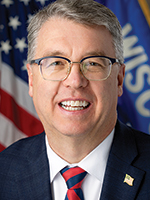
Photo of Brad Pfaff
D Wisconsin Senate · District 32

Sen. Brad Pfaff

Compare
Total votes
595
all sessions
Attendance
100%
1 missed
Near the chamber average
With party
94%
of cast votes
Near the chamber average
Bipartisan score
4%
crosses aisle rarely
Near the chamber average
Sponsored
526
bills & resolutions
Near the chamber average
Committees
3
assignments
526 bills and resolutions

Sponsored bills

Total
526
Primary
526
Co-sponsor
0
This page
526
matching current filters
Primary SB 548
Failed · Wisconsin Senate · Lead sponsor
Relating to: chronic wasting disease sampling and making an appropriation. (FE)

Maddy summarySB 548 establishes a state program for chronic wasting disease (CWD) testing in deer. It requires the Department of Natural Resources to set up sampling stations - including self-service kiosks - where hunters can drop off deer tissue for CWD testing. The department may contract with private entities to conduct the testing, paying per sample. The bill appropriates $500,000 for fiscal year 2025-26 and $500,000 for 2026-27 to fund this program, directly affecting hunters who submit samples and the state agency administering the testing.

Failed Mar 23, 2026 0 co-sponsors
Primary SB 564
Failed · Wisconsin Senate · Lead sponsor
Relating to: qualified new business venture eligibility. (FE)

Maddy summarySB 564 modifies tax credit eligibility rules for qualified new business ventures in Wisconsin. It increases the investment cap for tax credit eligibility from $12 million to $20 million for businesses seeking credits after 2025, while maintaining the $12 million limit for pre-2026 ventures. The bill also updates relocation requirements, requiring businesses to stay in-state for three years after receiving certain tax credits or pay penalties if they move more than 51% of their headquarters outside Wisconsin. These changes directly affect new businesses seeking tax credits under statutes related to investments in ventures like startups. The bill is currently under review by the Government Operations, Labor and Economic Development committee.

Failed Mar 23, 2026 0 co-sponsors
Primary SB 618
Failed · Wisconsin Senate · Lead sponsor
Relating to: allowing renters to claim the veterans and surviving spouses property tax credit. (FE)

Maddy summarySB 618 allows renters who are veterans or surviving spouses to claim the property tax credit based on their rent payments instead of property taxes. The bill amends tax statutes to define "rent constituting property taxes" and permits eligible renters to file for this credit against their income taxes, with unused portions paid via state funds. It specifically applies to renters in veterans' principal dwellings, and couples filing separately can claim 50% of total rent paid. The law takes effect for taxable years beginning January 1, 2026. This expands an existing homeowner-focused credit to include qualifying renters without creating new funding.

Failed Mar 23, 2026 0 co-sponsors
Primary SB 644
Failed · Wisconsin Senate · Lead sponsor
Relating to: prohibiting individuals under age 21 from accessing intoxicating hemp products and providing a penalty. (FE)

Maddy summarySB 644 prohibits the sale of intoxicating hemp products to anyone under age 21. It defines "intoxicating hemp products" as those containing specific cannabinoids (like delta-8 or delta-9 THC) above 0.3% concentration in solids or 1mg per 12oz beverage. The bill requires manufacturers to test products, provide certificates of analysis via QR codes, and package products in child-resistant, tamper-evident containers with clear age warnings and ingredient labels. Retailers must verify ages, display age restriction signs, and avoid vending machines accessible to minors. This directly affects hemp product manufacturers, retailers, and consumers under 21 in the state.

Failed Mar 23, 2026 0 co-sponsors
Primary SB 664
Failed · Wisconsin Senate · Lead sponsor
Relating to: reducing the eligibility threshold to claim the veterans and surviving spouses property tax credit. (FE)

Maddy summarySB 664 lowers the disability rating requirement for veterans and surviving spouses to qualify for the state property tax credit. Previously, claimants needed a 100% service-connected disability rating; this bill reduces that threshold to 70% or higher. It also creates a new provision allowing the credit amount to be calculated as a percentage of the full credit based on the veteran's actual disability rating (e.g., a 70% rating would yield 70% of the full credit). The bill directly affects veterans and surviving spouses with service-connected disabilities rated between 70% and 99%, who now qualify for a proportional tax credit. The change applies to taxable years beginning in the year the bill takes effect.

Failed Mar 23, 2026 0 co-sponsors
Primary SB 574
Failed · Wisconsin Senate · Lead sponsor
Relating to: funding for the supplemental food program for women, infants and children during the federal government shutdown and making an appropriation. (FE)

Maddy summarySB 574 creates a state funding mechanism to maintain Wisconsin's WIC (Women, Infants, and Children) program benefits during federal government shutdowns. It requires the Department of Health Services to continue providing WIC benefits at pre-shutdown levels if federal funding lapses, specifically referencing the October 1, 2025 funding gap. The bill ensures uninterrupted access to nutrition support for low-income pregnant women, new mothers, infants, and young children who rely on WIC. This temporary provision expires on October 1, 2026, and is repealed upon federal funding restoration. The measure directly affects WIC participants and state budgeting during federal funding interruptions.

Failed Mar 23, 2026 0 co-sponsors
Primary SB 825
Signed into law · Wisconsin Senate · Lead sponsor
Relating to: environmental review prerequisites for certain major highway project actions.

Maddy summarySB 825 streamlines environmental review processes for major highway projects by establishing clearer timelines and requirements. It defines "categorical exclusion" (avoiding full environmental reviews for standard projects) and requires the transportation department to submit a report to the commission before construction begins, including proof that financing is secured to start work within 6 years of project approval. The bill directly affects highway projects listed under Section 84.013(3) and those described in Section 84.013(1)(a)2m., requiring project reports to include approved environmental documentation and a financing plan. These changes aim to accelerate project timelines while ensuring compliance with federal environmental review standards.

Signed into law Mar 20, 2026 0 co-sponsors
Primary SB 23
Signed into law · Wisconsin Senate · Lead sponsor
Relating to: extension of eligibility under the Medical Assistance program for postpartum women. (FE)

Maddy summarySB 23 extends Medicaid eligibility for postpartum women from 60 days to 365 days (one year) after pregnancy, directly affecting pregnant and postpartum women enrolled in the Medical Assistance program. The bill modifies eligibility rules to ensure coverage continues without regard to income changes during this extended period. It also adds a provision allowing women with family income above 300% of the poverty line to qualify if medical expenses for family members are covered, extending this eligibility to all family members. The bill requires federal approval for the 365-day extension to take effect.

Signed into law Mar 19, 2026 0 co-sponsors
Primary SB 466
Signed into law · Wisconsin Senate · Lead sponsor
Relating to: age for the issuance of a Missing Child Alert.

Maddy summarySB 466 raises the age threshold for issuing a Missing Child Alert from under 10 to under 12 years. It directly affects minors aged 10 or 11 who go missing and are deemed unable to return home without assistance due to a disability or condition. The bill amends statute 175.51(1m)(a)2 to change the age requirement from "not attained the age of 10 years" to "not attained the age of 12 years." This adjustment ensures children in this age group qualify for alerts when their safety is at risk. The change applies to alerts issued when a minor's location is unknown and other alert criteria aren't met.

Signed into law Mar 9, 2026 0 co-sponsors
Primary SJR 34
Passed · Wisconsin Senate · Lead sponsor
Relating to: honoring the 50th anniversary of the child support program.

Maddy summarySJR 34 is a ceremonial resolution honoring Wisconsin's child support program on its 50th anniversary, specifically commemorating January 4, 2025 - the date President Ford signed the 1975 federal law establishing the program. It recognizes the program's role in serving 341,000 children and collecting $841 million in support during fiscal year 2023, while highlighting its anti-poverty impact and collaboration between county, state, and tribal agencies. The resolution does not create new laws or alter funding; it solely expresses legislative commendation for program staff and the program's national leadership in child support collection. This is a symbolic gesture with no direct policy changes or new obligations for affected parties.

Passed Jan 15, 2026 0 co-sponsors
Showing 201 to 210 of 526 bills
Previous 1 … 20 21 22 … 53 Next