

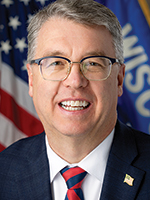
Photo of Brad Pfaff
D Wisconsin Senate · District 32

Sen. Brad Pfaff

Compare
Total votes
595
all sessions
Attendance
100%
1 missed
Near the chamber average
With party
94%
of cast votes
Near the chamber average
Bipartisan score
4%
crosses aisle rarely
Near the chamber average
Sponsored
526
bills & resolutions
Near the chamber average
Committees
3
assignments
526 bills and resolutions

Sponsored bills

Total
526
Primary
526
Co-sponsor
0
This page
526
matching current filters
Primary SB 1020
Failed · Wisconsin Senate · Lead sponsor
Relating to: grants for patient lift devices and making an appropriation. (FE)

Maddy summarySB 1020 creates a $300,000 grant program to help specific healthcare facilities purchase patient lift devices. Eligible facilities include adult family homes, nursing homes, community-based residential facilities, and residential care apartment complexes. Grants cover devices approved by the department that can be operated independently by residents or with staff assistance, and mechanically lift people. Recipients must report usage data, with up to $100,000 of the appropriation reserved for data collection and analysis.

Failed Apr 15, 2026 0 co-sponsors
Primary SB 837
Failed · Wisconsin Senate · Lead sponsor
Relating to: grants for alternatives to prosecution and incarceration programs for persons with mental illness and making an appropriation. (FE)

Maddy summarySB 837 creates a new state grant program providing $1.6 million annually to counties and tribes for mental health treatment alternatives to prosecution and incarceration. It directly affects low-to-medium risk individuals with mental illness who interact with the criminal justice system, excluding violent offenders as defined by law. Key provisions require grantees to establish programs using restorative justice principles, integrate mental health services, and meet evidence-based treatment standards while tracking outcomes like reduced jail populations and recidivism. Grantees must submit annual reports on program impact to the Department of Justice and an oversight committee, with data shared monthly for state evaluation. The bill mandates collaboration between courts, prosecutors, public defenders, and health agencies to coordinate care and services.

Failed Apr 15, 2026 0 co-sponsors
Primary SB 1109
Failed · Wisconsin Senate · Lead sponsor
Relating to: grants to school districts to pay student teachers an hourly wage, granting rule-making authority, and making an appropriation. (FE)

Maddy summaryThis bill creates a state grant program to help school districts pay student teachers an hourly wage of at least $15 for the hours they spend teaching in district schools. Beginning in the 2026-27 school year, school boards must compensate student teachers enrolled in approved teacher preparation programs, with the state reimbursing districts based on the number of hours taught. The legislation also gives the state department authority to create rules for administering the program and includes an appropriation to fund the payments.

Failed Apr 9, 2026 0 co-sponsors
Primary SB 921
Signed into law · Wisconsin Senate · Lead sponsor
Relating to: personal financial literacy high school graduation requirement.

Maddy summarySB 921 requires Wisconsin high schools to offer a 0.5-credit personal financial literacy course for graduation. The course must cover topics like money management, saving, investing, credit, and debt, and can be delivered through traditional classroom instruction or approved partnerships with local financial institutions. Schools may also award credit for completing an advanced placement business course with a personal finance focus. This requirement directly affects all Wisconsin high school students seeking graduation.

Signed into law Apr 9, 2026 0 co-sponsors
Primary SB 267
Signed into law · Wisconsin Senate · Lead sponsor
Relating to: the fee for filing limited liability company articles of organization with the Department of Financial Institutions. (FE)

Maddy summaryThis bill's title claims to address LLC filing fees, but the provided text actually amends an unrelated education-related statute (183.0122) regarding student enrollment criteria. The bill text modifies a section defining where students must be enrolled to qualify for certain benefits, specifying they must be in a postsecondary institution, public/private/tribal high school, or home-based program in the state. The content does not relate to LLC fees or business filings as indicated in the title. The inconsistency between the title and the actual bill text suggests a potential error in the document provided.

Signed into law Apr 9, 2026 0 co-sponsors
Primary SB 181
Signed into law · Wisconsin Senate · Lead sponsor
Relating to: a levy limit exemption for regional emergency medical systems and eligibility for the expenditure restraint incentive program. (FE)

Maddy summarySB 181 creates a levy limit exemption for local governments that fund regional emergency medical services (EMS). It allows counties or municipalities to count costs for regional EMS (via joint districts or agreements) toward their budget without triggering standard spending limits, provided the service area covers at least 232 square miles or 8+ municipalities. The bill requires that annual EMS funding increases stay within an inflation-adjusted cap (U.S. CPI plus 5%) and that the local government confirms a coordinated regional service area. This directly affects local governments operating regional EMS systems by making their funding more flexible under budget constraints. The exemption applies to costs for fire department-provided EMS and excludes these expenditures from standard spending limit calculations.

Signed into law Apr 9, 2026 0 co-sponsors
Primary SB 248
Signed into law · Wisconsin Senate · Lead sponsor
Relating to: license eligibility and restriction extensions relating to ignition interlock devices.

Maddy summarySB 248 modifies Wisconsin's driver's license rules for individuals required to use ignition interlock devices (IIDs) after DUI convictions. It extends license restrictions by 180 days for specific IID violations, including three or more failed breath tests within 60 days, tampering with the device, or unauthorized removal. Drivers can dispute violations by providing documentation within 15 days, such as proof of device malfunction or an explanation for the incident. The bill also clarifies eligibility for a work driving license (occupational license) after 30-45 days of license suspension, contingent on IID installation and compliance with safety plans. These changes apply to drivers with multiple DUI convictions or license suspensions under existing law.

Signed into law Apr 9, 2026 0 co-sponsors
Primary SB 366
Signed into law · Wisconsin Senate · Lead sponsor
Relating to: technical education equipment grants. (FE)

Maddy summarySB 366 amends rules for technical education equipment grants to clarify how funds can be used and require matching contributions. It allows grant recipients (primarily school districts) to use funds for facility improvements, tools, equipment, or instructional software in construction and advanced manufacturing programs. The bill requires recipients to provide matching funds equal to the grant amount, which can be cash or in-kind contributions like equipment or software. This change directly affects school districts seeking these grants by adding a funding match requirement.

Signed into law Apr 9, 2026 0 co-sponsors
Primary SB 387
Signed into law · Wisconsin Senate · Lead sponsor
Relating to: indication of veteran status of certain service members on operators’ licenses or identification cards. (FE)

Maddy summarySB 387 amends state license and ID laws to allow veterans to indicate their service status on driver's licenses or state ID cards. It defines eligible veterans as former U.S. armed forces members discharged honorably, or reserve/guard members who completed their service with honorable conditions. This change directly affects veterans applying for or renewing licenses/ID cards in this state. The bill updates specific sections of the law (343.14 and 343.17) to implement this requirement, with no new benefits or costs specified.

Signed into law Apr 9, 2026 0 co-sponsors
Primary SB 1139
Failed · Wisconsin Senate · Lead sponsor
Relating to: preference in state and local government contracts and procurement for materials manufactured in the United States and granting rule-making authority. (FE)

Maddy summaryThis bill requires state and local government agencies to prioritize purchasing materials manufactured in the United States when all other factors are equal, unless federal law or international agreements prohibit it. It mandates that contracts for public works projects include provisions requiring contractors to use domestically manufactured materials, with exemptions for commercial resale, stationery, printing supplies, and situations where U.S. materials are unavailable or foreign nations offer similar purchasing preferences. Local municipalities are also restricted from using bidding methods that favor bidders based on geographic location, except when necessary to secure federal aid. The bill grants the relevant state department authority to define what constitutes U.S. manufacturing through rule-making.

Failed Apr 8, 2026 0 co-sponsors
Showing 11 to 20 of 526 bills