

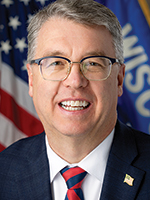
Photo of Brad Pfaff
D Wisconsin Senate · District 32

Sen. Brad Pfaff

Compare
Total votes
595
all sessions
Attendance
100%
1 missed
Near the chamber average
With party
94%
of cast votes
Near the chamber average
Bipartisan score
4%
crosses aisle rarely
Near the chamber average
Sponsored
526
bills & resolutions
Near the chamber average
Committees
3
assignments
526 bills and resolutions

Sponsored bills

Total
526
Primary
526
Co-sponsor
0
This page
526
matching current filters
Primary SB 615
Failed · Wisconsin Senate · Lead sponsor
Relating to: the University of Wisconsin Missing-in-Action Recovery and Identification Project and making an appropriation. (FE)

Maddy summarySB 615 appropriates $500,000 annually for the University of Wisconsin Missing-in-Action Recovery and Identification Project during the 2025-27 fiscal biennium. The project, managed by the University of Wisconsin System's Board of Regents, directly supports Wisconsin veterans missing in action by funding recovery and identification efforts. The bill requires the project to submit annual reports to state legislative committees, the governor, and veterans' agencies detailing mission outcomes and how funds were used. This funding provides concrete support for resolving cases of Wisconsin veterans who went missing during military service.

Failed Mar 23, 2026 0 co-sponsors
Primary SB 438
Failed · Wisconsin Senate · Lead sponsor
Relating to: requiring certain sales invoices and sales receipts to include tariff costs.

Maddy summarySB 438 requires large retailers to clearly show the total tariff cost (import tax) on each sales invoice or receipt for consumer goods. It applies to businesses that sold $3 million or more in consumer goods during the previous calendar year. The law mandates that these documents must list the tariff cost separately from the product price, making it visible to shoppers. This affects major retailers selling consumer goods, not small businesses or services. The bill aims to increase transparency about how import taxes impact final product pricing.

Failed Mar 23, 2026 0 co-sponsors
Primary SB 418
Failed · Wisconsin Senate · Lead sponsor
Relating to: a sales and use tax exemption for ski lifts. (FE)

Maddy summarySB 418 creates a sales and use tax exemption for ski lift operators in Wisconsin. It specifically exempts the purchase, storage, use, or consumption of ski lifts, related machines, equipment, and parts used exclusively for operating ski lifts from state sales and use taxes. This bill directly affects ski resorts and mountain operations that purchase or maintain ski lift infrastructure. The exemption applies to qualifying equipment purchases and is effective starting the first day of the third month following publication. The bill was recently recommended for passage by the Agriculture and Revenue Committee.

Failed Mar 23, 2026 0 co-sponsors
Primary SB 457
Failed · Wisconsin Senate · Lead sponsor
Relating to: the unemployment insurance waiting period.

Maddy summarySB 457 modifies Wisconsin's unemployment insurance rules by repealing outdated provisions and clarifying how ineligibility periods work for claimants who conceal work or income. It specifically ensures claimants cannot earn "waiting period credit" during ineligibility periods caused by concealment, and if no current benefit rate applies, the department must use the next benefit year's rate to calculate reductions. This directly affects individuals who previously concealed work while receiving benefits, changing how their ineligibility is calculated and their future benefit eligibility. The bill takes effect after publication, impacting future unemployment benefit claims.

Failed Mar 23, 2026 0 co-sponsors
Primary SB 639
Failed · Wisconsin Senate · Lead sponsor
Relating to: veterans mental health services and making an appropriation. (FE)

Maddy summarySB 639 allocates $5 million in state funds specifically for veterans' mental health services through the Department of Veterans Affairs. It requires the department to promote veterans' access to community-based mental health care and provide grants to organizations offering these services. The bill also streamlines rulemaking by allowing the department to issue emergency rules for administering these services without usual requirements for emergency rule justification. This directly affects veterans seeking mental health support and community organizations delivering those services. The funding and program structure are established for the 2026 biennium.

Failed Mar 23, 2026 0 co-sponsors
Primary SB 579
Failed · Wisconsin Senate · Lead sponsor
Relating to: collective bargaining for employees of the University of Wisconsin System, granting rule-making authority, and making an appropriation. (FE)

Maddy summarySB 579 standardizes collective bargaining processes for employees of the University of Wisconsin (UW) System, directly affecting faculty, staff, and other workers covered by existing union contracts. The bill requires that pay increases align with approved compensation plans or collective bargaining agreements, and it establishes funding mechanisms to cover costs for grievance arbitrations and training related to bargaining disputes. Key provisions update statutes to clarify that bargaining agreements govern pay decisions and define "governmental body" to exclude bargaining committees. The bill also creates new appropriation accounts to fund administrative functions of the state's employment relations system, including mediation and arbitration services.

Failed Mar 23, 2026 0 co-sponsors
Primary SB 203
Failed · Wisconsin Senate · Lead sponsor
Relating to: regulation of pharmacy benefit managers, fiduciary and disclosure requirements on pharmacy benefit managers, and application of prescription drug payments to health insurance cost-sharing requirements. (FE)

Maddy summarySB 203 regulates pharmacy benefit managers (PBMs) by requiring them to pay pharmacies within 30 days for electronic claims and 60 days for paper claims. It mandates that claims for 340B drugs (federally discounted medications) include specific identifiers for processing. The bill also prohibits PBMs from forcing pharmacies to join multiple networks or penalizing them for declining to join such networks. These provisions directly affect PBMs, pharmacies, and prescribers within the state’s health insurance system.

Failed Mar 23, 2026 0 co-sponsors
Primary SB 539
Failed · Wisconsin Senate · Lead sponsor
Relating to: allowing the enactment of family and medical leave ordinances. (FE)

Maddy summarySB 539 removes legal barriers that previously prevented cities, towns, and counties from creating their own family and medical leave policies. It repeals restrictions (like Section 103.10 (1m)) that blocked local governments from requiring employers to provide such benefits. The bill amends Section 103.12 to explicitly allow local ordinances on employment benefits, meaning cities like Madison or Milwaukee could set their own rules for paid leave. This directly affects employers in municipalities that adopt such local ordinances, requiring them to comply with local standards instead of only state-level rules. The bill does not specify leave details but enables local governments to establish their own requirements.

Failed Mar 23, 2026 0 co-sponsors
Primary SB 170
Failed · Wisconsin Senate · Lead sponsor
Relating to: rehired annuitants in the Wisconsin Retirement System. (FE)

Maddy summarySB 170 creates a new option for Wisconsin state retirees who return to work: they can choose to keep receiving their retirement annuity for up to 60 months (non-consecutive) instead of having it automatically suspended. To qualify, retirees must have separated from a state job at least 75 days prior, not have a pre-existing agreement to return to work, and elect not to become a participating employee. If they choose this option, their new employer must pay the Wisconsin Retirement System the same contributions they would have made as an active employee. This bill directly affects retirees who return to state employment after separation, changing the default rule from automatic annuity suspension to this voluntary arrangement.

Failed Mar 23, 2026 0 co-sponsors
Primary SB 589
Failed · Wisconsin Senate · Lead sponsor
Relating to: statutory right to contraception.

Maddy summarySB 589 establishes a statutory right for individuals to obtain contraception and for health care providers to offer it, directly affecting patients, providers, and local governments. It prohibits state or local governments from restricting access to FDA-approved contraceptives (like pills, condoms, or IUDs) through laws, regulations, or policies that single out contraception or impede access. The bill allows individuals or providers to sue if a policy violates these rights, and courts can block such policies and award attorney fees to winning parties. It explicitly does not change health insurance coverage requirements or override existing constitutional protections.

Failed Mar 23, 2026 0 co-sponsors
Showing 181 to 190 of 526 bills
Previous 1 … 18 19 20 … 53 Next