

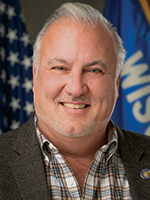
Photo of Cory Tomczyk
R Wisconsin Senate · District 29 On the 2026 ballot

Sen. Cory Tomczyk

Compare
Total votes
411
all sessions
Attendance
100%
of floor votes
Near the chamber average
With party
99%
of cast votes
Near the chamber average
Bipartisan score
2%
crosses aisle rarely
Near the chamber average
Sponsored
385
bills & resolutions
Near the chamber average
Committees
6
assignments
385 bills and resolutions

Sponsored bills

Total
385
Primary
385
Co-sponsor
0
This page
385
matching current filters
Primary SB 116
Failed · Wisconsin Senate · Lead sponsor
Relating to: designating University of Wisconsin and technical college sports and athletic teams based on the sex of the participants.

Maddy summarySB 116 requires University of Wisconsin and technical college athletic programs to designate intercollegiate or club sports teams as "male" or "female" based solely on the sex assigned at birth (per birth certificate). It prohibits students assigned male at birth from participating on women's teams or using women's locker rooms. The bill allows female students to sue institutions for violations denying participation or causing harm, and permits institutions to sue organizations penalizing them for compliance. This law applies to all affected athletic teams starting in the first semester after its effective date.

Failed Mar 23, 2026 0 co-sponsors
Primary SB 120
Failed · Wisconsin Senate · Lead sponsor
Relating to: school board policies related to changing a pupil’s legal name and pronouns.

Maddy summarySB 120 requires all school boards to create written policies by July 2026 governing how schools handle changes to a student's legal name and pronouns in official records. The bill mandates that schools must obtain written parental consent or specific affidavits (with documentation for minors or age 18+ students) before updating records, notify parents for minor requests, and allow appeals for denied requests. It also specifies that school staff may not use names or pronouns conflicting with a student's biological sex without parental written permission, except for shortened legal names. The policy must align with federal privacy laws (20 USC 1232g) and directly affects students, parents, and school staff in implementing name/pronoun changes.

Failed Mar 23, 2026 0 co-sponsors
Primary SB 18
Failed · Wisconsin Senate · Lead sponsor
Relating to: changes to the educational assessment program and the school and school district accountability report. (FE)

Maddy summarySB 18 standardizes how schools and districts are rated in annual accountability reports by maintaining consistent scoring methods. It requires using the same cut scores, score ranges, and performance categories (like "Proficient" or "Advanced") that were applied in the 2019-20 school year for all schools and districts. For grades 3-8 English/language arts and math tests, it mandates alignment with National Assessment of Educational Progress (NAEP) standards, while grades 9-11 will use scoring from the 2021-22 school year. This bill directly affects public schools and districts in the state that receive these accountability reports. The changes apply starting with the 2025-26 school year.

Failed Mar 23, 2026 0 co-sponsors
Primary SB 100
Failed · Wisconsin Senate · Lead sponsor
Relating to: the requirement that first class cities and first class city school districts place school resource officers in schools. (FE)

Maddy summarySB 100 requires first-class cities and their school districts to place at least 25 school resource officers (SROs) in schools during normal hours, before/after school, and at events starting January 1, 2024. It mandates SROs complete a 40-hour training course and requires school districts to use specific safety statistics when assigning officers. The bill establishes a cost-sharing agreement where school districts cover 75% of SRO costs and cities cover 25%, with new certification deadlines for both parties to the joint committee on finance. Failure to meet these requirements risks withholding up to 20% of school district aid or 10% of municipal payments under related statutes. The bill directly affects first-class cities and their school districts through these staffing, training, and financial obligations.

Failed Mar 23, 2026 0 co-sponsors
Primary SB 157
Failed · Wisconsin Senate · Lead sponsor
Relating to: prohibiting gender transition medical intervention for individuals under 18 years of age.

Maddy summarySB 157 prohibits healthcare providers from performing or referring minors under 18 for specific gender transition medical interventions. The bill bans surgeries (like hysterectomy or mastectomy), puberty-blocking drugs, and supraphysiologic hormone treatments aimed at changing a minor’s body to align with a gender discordant with their biological sex (defined as female or male based on chromosomes, sex organs, and hormones). Exceptions apply for minors with genetic disorders of sex development, infections, injuries, or life-threatening conditions requiring immediate surgery. Violations could lead to license revocation for healthcare providers, with disciplinary processes outlined in the bill.

Failed Mar 23, 2026 0 co-sponsors
Primary SB 55
Failed · Wisconsin Senate · Lead sponsor
Relating to: prohibiting the Department of Justice from using the legal services of nongovernmental employees. (FE)

Maddy summarySB 55 prohibits the state Department of Justice from using legal services provided by non-governmental employees (such as private attorneys or outside contractors) for civil or criminal investigations or prosecutions. The bill allows limited use of legal interns who are not state or federal employees, but only if they are paid $10,000 or less annually by their internship program. This rule directly affects the Department of Justice’s contracting practices and sets a specific pay cap for intern involvement in legal work. The bill would take effect upon enactment, changing how the agency hires legal support.

Failed Mar 23, 2026 0 co-sponsors
Primary SB 6
Failed · Wisconsin Senate · Lead sponsor
Relating to: impoundment of vehicles used in certain traffic offenses.

Maddy summarySB 6 modifies vehicle impoundment rules for traffic offenses by requiring law enforcement to check if an impounded vehicle was reported stolen before returning it to the owner. If stolen, the vehicle must be returned without fees, and if unclaimed for over 90 days, it may be disposed of like an abandoned vehicle. The bill directly affects law enforcement agencies handling impoundments and vehicle owners whose vehicles were used in traffic offenses. Key provisions mandate theft verification, waive fees for stolen vehicles, and clarify disposal procedures after 90 days. This changes administrative processes but does not alter the underlying traffic offenses or penalties.

Failed Mar 23, 2026 0 co-sponsors
Primary SB 209
Failed · Wisconsin Senate · Lead sponsor
Relating to: limiting liability relating to traffic control devices for manufacturers and others.

Maddy summarySenate Bill 209 limits the legal liability for manufacturers, distributors, sellers, installers, and owners of traffic control devices. Under this bill, these entities are not liable for damages if a device complies with the specifications outlined in the official traffic control devices manual and operates as intended. This protection covers various claims, including personal injury, property damage, negligence, and breach of warranty. However, the liability limitation does not apply if there is clear evidence that the device failed to meet specifications or operate as intended when the damage occurred. The bill also establishes a rebuttable presumption of compliance if the device was designed and installed according to manual standards or with authorized deviations.

Failed Mar 23, 2026 0 co-sponsors
Primary SB 220
Failed · Wisconsin Senate · Lead sponsor
Relating to: residency requirements for persons circulating nomination papers or recall petitions.

Maddy summarySenate Bill 220 modifies the residency requirements for individuals who collect signatures for political documents. For most candidate nomination papers, the bill expands eligibility, allowing U.S. citizens aged 18 or older to serve as circulators, even if they are not registered voters of the state, provided they would otherwise be eligible to vote. However, for recall petitions, the bill specifically requires circulators to be a qualified elector (registered voter) of the state. These changes directly affect individuals who gather signatures to support candidates or initiate recall efforts.

Failed Mar 23, 2026 0 co-sponsors
Primary SB 154
Failed · Wisconsin Senate · Lead sponsor
Relating to: requiring the Department of Health Services to seek any necessary waiver to prohibit the purchase of candy or soft drinks with FoodShare benefits. (FE)

Maddy summarySenate Bill 154 requires the Department of Health Services (DHS) to request a waiver from the U.S. Department of Agriculture. This waiver aims to prohibit the use of FoodShare benefits, also known as the federal food stamp program, for purchasing candy or soft drinks. If the waiver is granted, individuals receiving FoodShare benefits would no longer be able to use them to buy these specific items. The bill mandates that DHS continue to submit this waiver request annually until it is approved.

Failed Mar 23, 2026 0 co-sponsors
Showing 61 to 70 of 385 bills
Previous 1 6 7 8 39 Next