

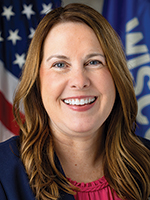
Photo of Dianne Hesselbein
D Wisconsin Senate · District 27 On the 2026 ballot

Sen. Dianne Hesselbein

Compare
Total votes
802
all sessions
Attendance
100%
of floor votes
Near the chamber average
With party
98%
of cast votes
Near the chamber average
Bipartisan score
1%
crosses aisle rarely
Near the chamber average
Sponsored
1,223
bills & resolutions
Near the chamber average
Committees
4
assignments
1,223 bills and resolutions

Sponsored bills

Total
1,223
Primary
1,223
Co-sponsor
0
This page
1,223
matching current filters
Primary SB 991
Failed · Wisconsin Senate · Lead sponsor
Relating to: funding for tribal child care training and technical assistance and making an appropriation. (FE)

Maddy summarySB 991 creates a new annual appropriation of $500,000 for tribal child care training and technical assistance. It directly affects tribal child care providers by funding programs to improve child care quality through training and support. The bill modifies two statutes (49.137 and 49.257) to allow the Department of Children and Families to use this funding for contracts or grants with agencies serving tribal communities. This is a concrete policy change that establishes dedicated funding for tribal child care providers without altering eligibility or requirements for other child care services.

Failed Mar 23, 2026 0 co-sponsors
Primary SB 965
Failed · Wisconsin Senate · Lead sponsor
Relating to: collective bargaining for employees of the University of Wisconsin Hospitals and Clinics Authority.

Maddy summarySB 965 modifies collective bargaining rules specifically for employees of the University of Wisconsin Hospitals and Clinics Authority (UWHCA). It allows multiple bargaining units at UWHCA to share a single representative if majority employees in each unit agree, streamlining negotiations under existing public employee bargaining laws. The bill also updates definitions and references to clarify that UWHCA employees are covered under collective bargaining agreements for benefits like health insurance and sick leave accrual. These changes directly affect UWHCA staff by adjusting how their workplace representation and benefit calculations are structured under state law.

Failed Mar 23, 2026 0 co-sponsors
Primary SB 945
Failed · Wisconsin Senate · Lead sponsor
Relating to: storage of firearms in retail facility when unattended.

Maddy summarySB 945 requires retail stores selling firearms to securely store all firearms when the business is unattended. It mandates one of five specific security methods: locked fireproof safes/cabinets, reinforced display cases with steel frames and anti-break-in features, steel rods/cables through trigger guards with secured locks, windowless rooms with deadbolts, or steel roll-down doors. Street-level stores must also install bollards or roll-down doors on perimeter openings. The bill directly affects firearm retailers operating in the state, imposing concrete storage requirements to prevent unauthorized access. These provisions aim to enhance security at retail locations without altering firearm ownership laws.

Failed Mar 23, 2026 0 co-sponsors
Primary SB 948
Failed · Wisconsin Senate · Lead sponsor
Relating to: storage of a firearm in a house in which a resident is prohibited from possessing a firearm and providing a penalty.

Maddy summarySB 948 requires anyone living in a household with a person banned from owning firearms (due to certain criminal convictions) to store all firearms securely - either in a locked container or with a trigger lock engaged. This applies to all firearms owned by household members who are not prohibited from possessing them. Violating this rule is a Class A misdemeanor for a first offense and a Class I felony for subsequent violations. The bill directly affects households where one resident is legally barred from firearm possession due to specific felony convictions.

Failed Mar 23, 2026 0 co-sponsors
Primary SB 930
Failed · Wisconsin Senate · Lead sponsor
Relating to: beer festivals conducted under temporary retail licenses; inapplicability of a sales tax exemption to beer festivals. (FE)

Maddy summarySB 930 removes a sales tax exemption for beer festivals held under temporary licenses. It specifically states that ticket sales and beer sales at these events are no longer exempt from sales tax. The bill defines a "beer festival" as an event charging admission, lasting no more than two consecutive days, and featuring beer from at least 25 different breweries. This change applies to festival sponsors operating under temporary Class B licenses, ending their previous tax-exempt status for festival-related sales.

Failed Mar 23, 2026 0 co-sponsors
Primary SJR 131
Failed · Wisconsin Senate · Lead sponsor
Relating to: the right to privacy (first consideration).

Maddy summaryThis bill proposes adding a new constitutional right to privacy. It would create Section 1m in Article I of the state constitution stating: "As a necessary part of a free society, the people have an individual and fundamental right to privacy." If approved by voters, this would establish a fundamental constitutional protection directly affecting all residents, requiring future laws to align with this privacy right. The proposal must be approved by voters in the next general election to become part of the constitution.

Failed Mar 23, 2026 0 co-sponsors
Primary SB 1017
Failed · Wisconsin Senate · Lead sponsor
Relating to: funding for child care provider workforce training and making an appropriation. (FE)

Maddy summarySB 1017 allocates $2.17 million annually for workforce training programs for child care providers and prospective providers. The bill creates a new funding line (20.437(2)(d)) to support contracts under section 49.137(4) focused specifically on training. This direct funding affects licensed child care facilities and individuals seeking to work in early childhood education. The measure provides concrete financial support for professional development but does not change eligibility rules or service requirements.

Failed Mar 23, 2026 0 co-sponsors
Primary SB 1016
Failed · Wisconsin Senate · Lead sponsor
Relating to: child care subsidies for custodial parents who are child care employees and making an appropriation. (FE)

Maddy summarySB 1016 creates a new child care subsidy program specifically for custodial parents who work as child care employees in Wisconsin. It establishes separate eligibility rules (under section 49.155(2s)) allowing these parents to qualify for subsidies even if they don't meet standard income or asset requirements, provided they work for a child care provider. The bill appropriates $1.2 million for administrative costs to implement this new program. This directly affects low-income parents employed in the child care sector who need subsidized care for their own children.

Failed Mar 23, 2026 0 co-sponsors
Primary SB 1011
Failed · Wisconsin Senate · Lead sponsor
Relating to: income eligibility for Wisconsin Shares child care subsidy and making an appropriation. (FE)

Maddy summarySB 1011 expands eligibility for Wisconsin Shares child care subsidies to families with incomes above 200% of the federal poverty line but below 100% of the state median income for their family size. It creates a new eligibility category (via 20.437(2)(ct)) allowing subsidies for individuals who qualify under specific provisions but not under the standard 200% threshold, and adjusts income calculation rules to include certain child support payments. The bill modifies existing income guidelines in statutes to clarify eligibility for families who previously lost subsidies due to modest income increases. It appropriates an additional $1.25 million for fiscal year 2026-27 to fund these expanded subsidies. The changes directly affect low-to-moderate-income families seeking child care assistance in Wisconsin.

Failed Mar 23, 2026 0 co-sponsors
Primary SB 1015
Failed · Wisconsin Senate · Lead sponsor
Relating to: increasing the earned income tax credit for families with fewer than three children. (FE)

Maddy summarySB 1015 increases the state's earned income tax credit for low-income working families with fewer than three children. It raises the state credit to 34% of the federal basic earned income credit for families with children (effective 2026), and sets it at 15% for individuals without qualifying children. This directly affects eligible taxpayers who qualify for the federal earned income credit but have limited income. The bill amends tax statutes to replace the previous credit rate (applicable through 2025) with these new percentages for future tax years.

Failed Mar 23, 2026 0 co-sponsors
Showing 51 to 60 of 1,223 bills
Previous 1 … 5 6 7 … 123 Next