

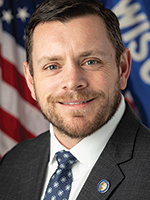
Photo of Patrick Testin
R Wisconsin Senate · District 24

Sen. Patrick Testin

Compare
Total votes
595
all sessions
Attendance
98%
11 missed
Near the chamber average
With party
99%
of cast votes
Near the chamber average
Bipartisan score
1%
crosses aisle rarely
Near the chamber average
Sponsored
632
bills & resolutions
Near the chamber average
Committees
8
assignments
632 bills and resolutions

Sponsored bills

Total
632
Primary
632
Co-sponsor
0
This page
632
matching current filters
Primary SB 173
Failed · Wisconsin Senate · Lead sponsor
Relating to: creating a rural creative economy development grant program. (FE)

Maddy summarySB 173 creates a grant program administered by the Wisconsin Economic Development Corporation to support rural creative economies. It provides competitive grants (max $50,000) to eligible applicants like small towns, counties, tribes, or nonprofits in rural areas (defined as towns under 10,000 people, non-urban areas, or counties under 55,000 people). Grants must fund tourism, public arts, space renovations, arts education, or business support for creative enterprises, requiring applicants to secure matching funds equal to the grant amount. The program requires an effectiveness report to the legislature by May 2027.

Failed Mar 23, 2026 0 co-sponsors
Primary SB 231
Failed · Wisconsin Senate · Lead sponsor
Relating to: creating a tax credit for expenses related to film production services and for capital investments made by a film production company, granting rule-making authority, and making an appropriation. (FE)

Maddy summarySB 231 creates a tax credit program for film production companies in Wisconsin, providing credits for eligible expenses like wages and capital investments incurred within the state. It establishes a State Film Office within the Department of Tourism to administer the program, set accreditation standards for productions (requiring minimum spending thresholds of $50,000 for short productions or $100,000 for longer ones), and issue tax credits. The bill caps annual program spending at $10 million total and $1 million per company, mandates that accredited productions include a state acknowledgment in the final product, and requires annual reports on program usage and efficiency. This directly affects film production companies operating in Wisconsin that meet the accreditation criteria and seek to reduce costs through state tax incentives.

Failed Mar 23, 2026 0 co-sponsors
Primary SB 57
Failed · Wisconsin Senate · Lead sponsor
Relating to: county sheriff assistance with certain federal immigration functions. (FE)

Maddy summarySB 57 reclassifies certain actions by county sheriffs who assist federal immigration authorities as a felony instead of a misdemeanor. It directly affects county sheriffs who provide support for federal immigration enforcement activities. The key provision changes the legal penalty for sheriffs participating in specific immigration-related functions, increasing the potential punishment. This bill modifies existing law to impose stricter criminal penalties for sheriffs engaging in these activities.

Failed Mar 23, 2026 0 co-sponsors
Primary SB 245
Failed · Wisconsin Senate · Lead sponsor
Relating to: a pilot school-centered mental health program. (FE)

Maddy summarySB 245 establishes a two-year pilot program for school-centered mental health services at two selected schools (one rural, one urban) to support at-risk students and families. The bill requires participating schools to offer existing behavioral health resources and allow surveys/data sharing, while mandating providers to deliver year-round therapy, family coaching, classroom observations, and community resource connections. Funding from the Department of Health Services covers full-time therapist and family coach positions at these schools, with providers required to report on improvements in students' mental health symptoms, social needs, and academic/social-emotional growth. The pilot aims to evaluate how integrated school-based mental health services impact student well-being and academic outcomes before potential expansion.

Failed Mar 23, 2026 0 co-sponsors
Primary SB 204
Failed · Wisconsin Senate · Lead sponsor
Relating to: creating a video game production tax credit and making an appropriation. (FE)

Maddy summarySB 204 creates a 30% tax credit for video game companies in the state, allowing them to reduce their tax liability by 30% of wages paid for qualifying game development activities. The credit applies to wages paid for developing, producing, or creating video games (excluding gambling platforms, social media tools, political/religious content, or marketing sites) beginning in 2025. Companies can claim the credit against state taxes, with unused portions paid from a new appropriation fund. This directly affects video game developers operating within the state who meet the eligibility criteria.

Failed Mar 23, 2026 0 co-sponsors
Primary SB 257
Failed · Wisconsin Senate · Lead sponsor
Relating to: the electronic vaping device directory and electronic nicotine devices. (FE)

Maddy summarySB 257 requires manufacturers of electronic vaping devices sold in the state to certify annual compliance with new rules starting July 1, 2025. It creates a specific exemption for devices containing hemp (as defined by state law) without nicotine, which manufacturers must document via lab analysis. To comply, sellers must submit FDA marketing authorization proof, evidence of pending applications, or independent lab results confirming the device meets the hemp/nicotine exemption. This directly affects vaping device manufacturers and distributors operating in the state.

Failed Mar 23, 2026 0 co-sponsors
Primary SB 229
Failed · Wisconsin Senate · Lead sponsor
Relating to: transferring adjudicatory functions for worker’s compensation from the Division of Hearings and Appeals in the Department of Administration to the Department of Workforce Development. (FE)

Maddy summarySB 229 transfers the handling of worker's compensation appeals from the Division of Hearings and Appeals (within the Department of Administration) to the Department of Workforce Development. This change affects workers, employers, and insurers who file or contest compensation claims, as all hearings and decisions will now be processed by the new department. The bill amends over 50 sections of statutes to update references from the old division to the Department of Workforce Development, ensuring consistent application of procedures like appeal processes and evidence rules. The policy change does not alter eligibility rules or benefit amounts - it only shifts administrative responsibility for adjudicating disputes. This is a procedural reorganization, not a substantive change to worker's compensation law.

Failed Mar 23, 2026 0 co-sponsors
Primary SB 256
Failed · Wisconsin Senate · Lead sponsor
Relating to: delivery network couriers and transportation network drivers, Department of Financial Institutions’ approval to offer portable benefit accounts, providing for insurance coverage, modifying administrative rules related to accident and sickness insurance, and granting rule-making authority. (FE)

Maddy summarySB 256 creates state-approved "portable benefit accounts" for app-based delivery and rideshare drivers (defined as "application-based drivers" earning at least $750 quarterly from one company). It allows drivers to deduct contributions to these accounts from state taxable income while imposing a 10% penalty on distributions used for non-permissible purposes (like non-health expenses). The bill modifies tax code sections to treat these accounts similarly to tax-advantaged savings vehicles and requires Department of Financial Institutions approval for their structure. This directly affects gig workers in delivery and rideshare services who meet the earnings threshold.

Failed Mar 23, 2026 0 co-sponsors
Primary SB 71
Failed · Wisconsin Senate · Lead sponsor
Relating to: ratification of the Dietitian Licensure Compact. (FE)

Maddy summarySenate Bill 71 ratifies the Dietitian Licensure Compact, a multi-state agreement designed to streamline the licensing process for dietitians. This bill allows licensed dietitians in participating states to practice in other compact member states by obtaining a "compact privilege" instead of a full separate license. It establishes a dietitian licensure compact commission and amends various state statutes to recognize this new privilege, affecting dietitians and their ability to practice across state lines.

Failed Mar 23, 2026 0 co-sponsors
Primary SB 113
Failed · Wisconsin Senate · Lead sponsor
Relating to: a transition to grazing pilot program and making an appropriation. (FE)

Maddy summarySB 113 creates a pilot program to help farmers transition to managed grazing systems, which rotate livestock between pasture sections to reduce soil erosion and improve forage quality. It directly affects farmers adopting new managed grazing systems or improving existing ones, excluding support for current practices. The program provides grants covering infrastructure (fencing, water systems), technical assistance from specialists, and incentive payments for the first three years of transition, with a $40,000 annual cap per farmer. Funded by $500,000 annually from the environmental fund, grants are paid as 75% in year one and 12.5% each subsequent year. The bill also defines "marginal areas" (land unsuitable for crops like floodplains) as eligible for supplemental feed development.

Failed Mar 23, 2026 0 co-sponsors
Showing 41 to 50 of 632 bills
Previous 1 4 5 6 64 Next