

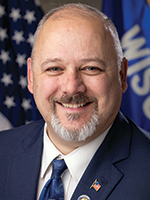
Photo of Jesse James
R Wisconsin Senate · District 23

Sen. Jesse James

Compare
Total votes
702
all sessions
Attendance
100%
of floor votes
Near the chamber average
With party
100%
of cast votes
Near the chamber average
Bipartisan score
1%
crosses aisle rarely
Near the chamber average
Sponsored
558
bills & resolutions
Near the chamber average
Committees
4
assignments
558 bills and resolutions

Sponsored bills

Total
558
Primary
558
Co-sponsor
0
This page
558
matching current filters
Primary SB 372
Failed · Wisconsin Senate · Lead sponsor
Relating to: crime victim notification cards. (FE)

Maddy summarySB 372 creates standardized crime victim notification cards to help victims of crime stay informed about court proceedings involving offenders. The bill requires the director of state courts to design these cards, which victims can complete with their contact information and the offender's details, and send to the relevant court clerk. County courts and victim/witness offices must provide these cards at no cost to victims, and the law protects victim mailing addresses from public inspection under state law. This directly affects crime victims in Wisconsin who need to receive updates about offender sentencing or probation modifications.

Failed Mar 23, 2026 0 co-sponsors
Primary SB 140
Failed · Wisconsin Senate · Lead sponsor
Relating to: provisional social worker certificates and licenses.

Maddy summarySB 140 creates a provisional certification pathway for social workers who haven’t passed the national licensing exam. It allows individuals to obtain a temporary certificate (valid for 36 months) after applying, paying fees, and passing a state law exam, enabling them to practice under supervision while completing required training. The bill requires 37.5 hours of supervised practice (including 25 hours of in-person one-on-one supervision) within the first 2,000 hours of practice, with no renewal option for provisional status. This directly affects new social work professionals seeking licensure after failing the national exam, streamlining their transition to full certification upon completing supervision. The bill modifies existing statutes to establish these provisional requirements and their conversion to permanent credentials.

Failed Mar 23, 2026 0 co-sponsors
Primary SB 318
Failed · Wisconsin Senate · Lead sponsor
Relating to: small law enforcement agency grant pilot program. (FE)

Maddy summarySB 318 creates a temporary pilot program to provide training grants to small law enforcement agencies (those employing 25 or fewer full-time equivalent officers). Agencies qualify if they face imminent retirements, have 20%+ vacancies, or need to train new officers. Grants cover preparatory training for future officers and up to six months of on-the-job training costs for new recruits. Recipients must commit to working at the agency for one year after training, with repayment required if they leave early; the program ends 18 months after all funds are distributed.

Failed Mar 23, 2026 0 co-sponsors
Primary SB 75
Failed · Wisconsin Senate · Lead sponsor
Relating to: venue for actions in which there is a governmental party.

Maddy summarySB 75 creates a process for randomly assigning court venue in lawsuits where a government entity (such as a state official, agency, or legislative body) is a party. If filed in a first or second-class city, any party can request this random assignment within 5 days of filing or service, triggering a clerk to randomly select another circuit court. Once assigned, the venue is final and cannot be changed, and a fee applies for this option. The bill directly affects lawsuits involving government defendants or intervenors in specific cities, altering standard venue rules for these cases.

Failed Mar 23, 2026 0 co-sponsors
Primary SB 416
Failed · Wisconsin Senate · Lead sponsor
Relating to: requiring reports on disturbed burial sites. (FE)

Maddy summarySB 416 requires anyone who discovers a disturbed or potentially disturbed burial site in a cemetery or adjacent land to report it immediately to local police or sheriff's offices. Police and sheriff's departments must then prepare and submit detailed reports - including property address and location - to both the Cemetery Board and the Burial Sites Preservation Board. The bill also mandates the creation of a standardized reporting form and requires the Preservation Board to publicly post all annual reports on its website by March 1. This legislation directly affects cemetery owners, public officials, and law enforcement by establishing a clear reporting process for burial site disturbances.

Failed Mar 23, 2026 0 co-sponsors
Primary SB 21
Failed · Wisconsin Senate · Lead sponsor
Relating to: creating an employee ownership conversion costs tax credit, a deduction for capital gains from the transfer of a business to employee ownership, and an employee ownership education and outreach program. (FE)

Maddy summarySB 21 creates tax incentives to encourage businesses in Wisconsin to transition to employee ownership. It provides a credit covering up to 70% of conversion costs (capped at $100,000) for worker-owned cooperatives and 50% for employee stock ownership plans (ESOPs), plus a deduction for capital gains from such business transfers. These benefits apply to business owners converting ownership to employee-controlled structures where employees own more than 50% of the business. The bill also establishes an education program to support employee ownership transitions, effective for taxable years beginning after December 31, 2024.

Failed Mar 23, 2026 0 co-sponsors
Primary SB 404
Failed · Wisconsin Senate · Lead sponsor
Relating to: creating a Task Force on Missing and Murdered African American Women and Girls and making an appropriation. (FE)

Maddy summarySB 404 creates a Task Force on Missing and Murdered African American Women and Girls, directly affecting African American women and girls experiencing violence in Wisconsin. The task force, established by the attorney general within 45 days, will examine systemic causes of violence against this group, data collection methods, policing and institutional practices, and prevention strategies. It must submit a report by December 15, 2026, with recommendations for policy changes, violence reduction, and victim support. The bill appropriates $80,200 for fiscal year 2025-26 and $99,500 for 2026-27 to fund the task force, which terminates on January 1, 2027, or after the report is submitted.

Failed Mar 23, 2026 0 co-sponsors
Primary SB 192
Failed · Wisconsin Senate · Lead sponsor
Relating to: fatality review teams and granting rule-making authority. (FE)

Maddy summarySB 192 creates a statewide framework for fatality review teams to examine preventable deaths, specifically focusing on maternal deaths, child abuse/neglect, overdoses, homicides, and other reviewable deaths like stillbirths or unexpected child fatalities. The bill establishes definitions for local and state teams, requires the Department of Health to support their development, and allows healthcare providers to share patient health records confidentially with these teams for review purposes. This directly affects hospitals, healthcare providers (who must share records under strict confidentiality rules), and local/state agencies (which must form or support these teams). The key mechanism is enabling secure, confidential record-sharing between healthcare systems and fatality review teams to identify patterns and prevent future deaths, without altering public access to most records.

Failed Mar 23, 2026 0 co-sponsors
Primary SB 99
Failed · Wisconsin Senate · Lead sponsor
Relating to: spinal cord injury research grants and symposia and making an appropriation. (FE)

Maddy summarySB 99 creates a Spinal Cord Injury Council to oversee research grants and allocates $2.5 million biennially for spinal cord injury research in Wisconsin. The council, composed of researchers, individuals with spinal cord injuries, veterans, family members, and medical professionals, develops grant criteria and reviews applications. Researchers receiving grants must present findings at department-hosted symposia every two years and report annual progress to the legislature. The bill specifically funds innovative treatments and rehabilitative approaches, with grants allowing up to 8% for administrative costs.

Failed Mar 23, 2026 0 co-sponsors
Primary SB 385
Failed · Wisconsin Senate · Lead sponsor
Relating to: the veterans housing and recovery program and making an appropriation. (FE)

Maddy summarySB 385 increases funding for Wisconsin's Veterans Housing and Recovery Program. It adds $900,000 for fiscal year 2025-26 and $1,050,000 for 2026-27 to cover program supplies, services, and leasing a new facility in Chippewa Falls. The additional funds address space limitations and facility deficiencies at the current location. This bill directly affects veterans participating in the housing program by ensuring continued support through improved resources and accommodations. The changes are purely fiscal, with no new policy requirements for veterans or service providers.

Failed Mar 23, 2026 0 co-sponsors
Showing 101 to 110 of 558 bills
Previous 1 … 10 11 12 … 56 Next