

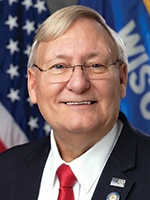
Photo of Van Wanggaard
R Wisconsin Senate · District 21

Sen. Van Wanggaard

Compare
Total votes
595
all sessions
Attendance
99%
4 missed
Near the chamber average
With party
99%
of cast votes
Near the chamber average
Bipartisan score
1%
crosses aisle rarely
Near the chamber average
Sponsored
524
bills & resolutions
Near the chamber average
Committees
4
assignments
524 bills and resolutions

Sponsored bills

Total
524
Primary
524
Co-sponsor
0
This page
524
matching current filters
Primary SJR 133
Passed · Wisconsin Senate · Lead sponsor
Relating to: reaffirming Wisconsin’s commitment to the strengthening and deepening of the sister ties between the State of Wisconsin and Taiwan, reaffirming Wisconsin’s support for the Taiwan Relations Act, supporting Taiwan’s signing of a Bilateral Trade Agreement with the United States, and continuing support for increasing Taiwan’s international profile.

Maddy summarySJR 133 is a symbolic resolution (not a binding law) that reaffirms Wisconsin's longstanding relationship with Taiwan. It expresses support for the U.S. Taiwan Relations Act, highlights Wisconsin's economic ties with Taiwan (including $380 million in exports to Taiwan in 2023), and encourages state agencies to explore establishing a Wisconsin representative office in Taiwan to boost trade and cultural exchanges. The resolution does not create new programs or change laws but formally endorses continued cooperation amid Taiwan's 40th anniversary of Wisconsin's sister-state relationship.

Passed Mar 23, 2026 0 co-sponsors
Primary SB 1047
Failed · Wisconsin Senate · Lead sponsor
Relating to: modifying administrative rules relating to regulation of opioid treatment programs and requiring adjustments to the rates for substance use disorder treatment services with medications for opioid use disorder. (FE)

Maddy summarySB 1047 adjusts payment rates for medication-based opioid treatment services to match Medicare rates starting in 2027, directly affecting opioid treatment programs (OTPs) and their patients. It eliminates a requirement for OTPs to document enrollment details and mandates specific staffing rules, including having a nurse present during dosing and maintaining a 1 counselor-to-55-patient ratio. The bill also updates admission criteria, requiring documented failed detox attempts for minors seeking maintenance treatment and clarifying initial dose limits for new patients. These changes aim to standardize care and payment while ensuring program compliance with federal and state regulations.

Failed Mar 23, 2026 0 co-sponsors
Primary SB 994
Passed · Wisconsin Senate · Lead sponsor
Relating to: public affairs network request for proposals.

Maddy summarySB 994 prohibits the public affairs network from charging fees for accessing live or archived state government proceedings when the network receives state funding for its operations. This applies directly to the state's public affairs network (which broadcasts government meetings) and the public seeking access to those recordings. The bill modifies existing rules to ensure fee-free access regardless of whether state funds are used, removing a prior condition that required explicit state funding for the fee ban. The key provision guarantees public access to government proceedings without cost under state-funded operations.

Passed Mar 23, 2026 0 co-sponsors
Primary SB 956
Failed · Wisconsin Senate · Lead sponsor
Relating to: position authorizations for Internet crimes against children law enforcement. (FE)

Maddy summarySB 956 authorizes three new staff positions within the Department of Justice to strengthen Internet Crimes Against Children (ICAC) enforcement. It adds 2.0 full-time criminal analyst positions, 1.0 outreach specialist position, and 1.0 digital evidence examiner position. These roles will be funded using existing appropriations designated under section 20.455(2)(a). The bill directly affects the Department of Justice's staffing capacity for ICAC investigations and victim support.

Failed Mar 23, 2026 0 co-sponsors
Primary SB 953
Failed · Wisconsin Senate · Lead sponsor
Relating to: Internet crimes against children administrative subpoenas for the crime of sexual extortion when the crime victim is a child. (FE)

Maddy summarySB 953 defines sexual extortion involving child victims as a violation under existing statute 942.095. It specifically applies when the victim is a child, as defined in statute 948.01(1), clarifying that such cases fall under this legal category. The bill creates a new statutory reference (165.505(1)(bg)3.) to ensure these offenses are properly categorized under current law. This procedural change directly affects law enforcement and prosecutors handling internet crimes against children.

Failed Mar 23, 2026 0 co-sponsors
Primary SB 1083
Failed · Wisconsin Senate · Lead sponsor
Relating to: applying the indoor smoking ban to electronic delivery devices and marijuana.

Maddy summarySB 1083 expands the existing indoor smoking ban to include electronic delivery devices (like e-cigarettes, vape pens, and e-hookahs) used for vaping nicotine, cannabis, or other substances. The bill defines "electronic delivery device" broadly to cover all such products except FDA-approved nicotine products. It also amends the definition of "smoking" to explicitly include using activated vaping devices in indoor public spaces. This affects businesses operating in indoor areas (e.g., restaurants, offices) and individuals using these devices indoors, bringing them under the same indoor ban rules that currently apply to traditional tobacco products.

Failed Mar 23, 2026 0 co-sponsors
Primary SB 1081
Failed · Wisconsin Senate · Lead sponsor
Relating to: prohibiting vaping on public and private school property.

Maddy summarySB 1081 bans vaping on all public and private school property, including playgrounds, athletic fields, and other areas regularly used by students. It defines "vaping" as inhaling vapor from any electronic smoking device (like e-cigarettes or vape pens) and covers all school grounds owned, rented, or controlled by school boards, charter schools, or private schools. The law prohibits vaping but allows schools or local governments to adopt stricter rules if desired. This directly affects students, staff, and visitors on school property across all public and private K-12 institutions in the state.

Failed Mar 23, 2026 0 co-sponsors
Primary SB 849
Failed · Wisconsin Senate · Lead sponsor
Relating to: the civil causes of action for human trafficking and trafficking a child.

Maddy summaryThis bill creates new civil legal paths for victims of human trafficking and child trafficking. It extends the deadline for filing lawsuits related to trafficking a child to age 35, allowing victims to seek civil remedies even if no criminal case was prosecuted. The bill also establishes that victims can pursue actual damages, punitive damages up to triple the actual amount, and attorney fees in these cases. It directly affects individuals harmed by trafficking who wish to pursue civil action against perpetrators.

Failed Mar 23, 2026 0 co-sponsors
Primary SB 897
Failed · Wisconsin Senate · Lead sponsor
Relating to: threats to health care providers and providing a penalty.

Maddy summarySB 897 defines specific threats against health care workers as criminal offenses. It makes it illegal to threaten a current or former health care provider, staff member, or their family member when the threat occurs in response to work at a health care facility or actions taken in an official capacity. The law specifies two key conditions: the threatener must know the victim works in health care, and the threat must relate to the victim's professional role. This bill uses existing statutory definitions for "health care facility" and "health care provider" to clarify when such threats violate the law, creating a new criminal penalty for these specific circumstances.

Failed Mar 23, 2026 0 co-sponsors
Primary SB 802
Failed · Wisconsin Senate · Lead sponsor
Relating to: a health professional assistance program and making an appropriation. (FE)

Maddy summarySB 802 creates a voluntary health professional assistance program to support licensed health care providers experiencing conditions that could impair their ability to practice safely. The program, funded by a $70 fee paid by providers when obtaining or renewing a participating credential, offers confidential screening, evaluation, treatment, and ongoing monitoring services. Credentialing boards can choose to participate for specific licenses, and providers or colleagues may report concerns without civil liability for good-faith reports. The program is operated by a contracted entity meeting specific requirements and complements existing disciplinary processes without affecting boards' authority over unrelated conduct.

Failed Mar 23, 2026 0 co-sponsors
Showing 31 to 40 of 524 bills
Previous 1 3 4 5 53 Next