

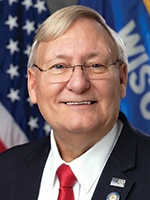
Photo of Van Wanggaard
R Wisconsin Senate · District 21

Sen. Van Wanggaard

Compare
Total votes
595
all sessions
Attendance
99%
4 missed
Near the chamber average
With party
99%
of cast votes
Near the chamber average
Bipartisan score
1%
crosses aisle rarely
Near the chamber average
Sponsored
524
bills & resolutions
Near the chamber average
Committees
4
assignments
524 bills and resolutions

Sponsored bills

Total
524
Primary
524
Co-sponsor
0
This page
524
matching current filters
Primary SB 423
Signed into law · Wisconsin Senate · Lead sponsor
Relating to: the time limitation on prosecution for hiding a corpse.

Maddy summarySB 423 modifies Wisconsin's statute governing time limits for prosecuting individuals who hide a corpse. It creates a new provision (939.74 (2) (ap)) allowing criminal charges under s. 940.11 (2) to be filed within 6 years of when the corpse was discovered or identified, whichever occurs later. This change applies retroactively to cases where the original time limit had not yet expired as of the law's effective date. The bill directly affects prosecutors and defendants in homicide-related cases involving concealed remains, extending the window for legal action.

Signed into law Dec 10, 2025 0 co-sponsors
Primary SB 278
Signed into law · Wisconsin Senate · Lead sponsor
Relating to: sunset of the community-oriented policing-house grant program.

Maddy summarySB 278 prevents the automatic expiration (sunset) of Wisconsin's Community-Oriented Policing-House Grant Program by changing its funding mechanism. The bill amends state law to establish the program as a "continuing appropriation" that receives biennial funding without requiring annual legislative action to renew it. This change directly affects local law enforcement agencies and community organizations that receive these grants to fund policing initiatives focused on community engagement. The policy shift ensures stable, ongoing funding for the program starting July 1, 2025, rather than requiring renewal each biennium. The bill was enacted as 2025 Wisconsin Act 27 and signed into law on August 11, 2025.

Signed into law Aug 11, 2025 0 co-sponsors
Primary SB 169
Signed into law · Wisconsin Senate · Lead sponsor
Relating to: privacy protections for judicial officers.

Maddy summaryWisconsin's SB 169 creates a new system for judicial officers (judges and court staff) to request privacy protections for specific personal information. The bill allows judicial officers to submit written requests to government agencies to shield their home addresses, children's names under 18, and certain financial documents (like economic interest statements and campaign finance reports) from public access. It amends statutes to require agencies like the register of deeds and campaign finance commission to remove this protected information from public records and databases upon request. The law defines "personal information" to include home addresses tied to a judicial officer's name and specifies that agencies must not publicly post or display such information without consent.

Signed into law Aug 11, 2025 0 co-sponsors
Primary SB 125
Signed into law · Wisconsin Senate · Lead sponsor
Relating to: a nuclear power siting study and time limits for taking final action on certain certificate of public convenience and necessity applications. (FE)

Maddy summarySB 125 requires the state to conduct a study on nuclear power and fusion energy siting, including reviewing approval timelines for small modular reactor projects. It mandates the state commission to engage with federal regulators to identify ways to streamline both federal and state permitting processes for advanced nuclear reactors. The bill also sets a new 19th-day deadline for final decisions on certain utility certificate applications (previously 13th), and directs the commission to assess methods for speeding up approvals for large nuclear facilities. This bill directly affects developers of nuclear and fusion energy projects seeking state permits and approvals.

Signed into law Jul 3, 2025 0 co-sponsors
Primary SJR 2
Signed into law · Wisconsin Senate · Lead sponsor
Relating to: requiring photographic identification to vote in any election (second consideration).

Maddy summarySJR 2 proposes a constitutional amendment that would require all qualified voters to present valid photographic identification to cast a ballot in any election. This identification must be issued by the state, federal government, a federally recognized American Indian tribe, or a college or university. The bill allows the legislature to specify acceptable forms of identification and establish exceptions to this requirement. Voters unable to present valid ID on election day would be permitted to cast a provisional ballot, which would only be counted if they present valid identification at a later time. If agreed to by the legislature on this second consideration, the proposed amendment will be submitted to the people for ratification.

Signed into law May 20, 2025 0 co-sponsors
Primary SJR 28
Passed · Wisconsin Senate · Lead sponsor
Relating to: reaffirming Wisconsin’s commitment to the strengthening and deepening of the sister ties between the State of Wisconsin and Taiwan; reaffirming Wisconsin’s support for the Taiwan Relations Act; supporting Taiwan’s signing of a Bilateral Trade Agreement with the United States; and continuing support for increasing Taiwan’s international profile.

Maddy summarySJR 28 is a joint resolution by the Wisconsin Legislature that reaffirms the state's commitment to its sister-state relationship with Taiwan, established in 1986. The resolution expresses support for the federal Taiwan Relations Act and endorses Taiwan's efforts to secure a Bilateral Trade Agreement with the United States. It also advocates for increasing Taiwan's meaningful participation in international organizations that impact its people's well-being. This bill primarily affects the diplomatic and economic relationship between Wisconsin and Taiwan by formally stating the legislature's supportive stance.

Passed Apr 24, 2025 0 co-sponsors
Primary SB 49
Failed · Wisconsin Senate · Lead sponsor
Relating to: restricting local regulation of utility service based on the type or source of energy. (FE)

Maddy summaryThis bill prohibits Wisconsin state agencies and local governments from restricting utility connections based on the type or source of energy, such as natural gas versus renewable sources. It also forbids these entities from discriminating against public utilities or retailers that provide specific energy services to consumers. While the law limits regulatory barriers, it explicitly preserves the government's ability to manage its own utilities, reduce emissions through its own operations, and purchase renewable energy.

Failed May 15, 2024 0 co-sponsors
Primary SB 517
Failed · Wisconsin Senate · Lead sponsor
Relating to: court-issued criminal complaints if the person's actions were in self-defense.

Maddy summaryThis bill allows circuit judges to issue criminal complaints when a district attorney refuses to do so, specifically in cases where the accused claims self-defense. Under the new rules, a judge can only proceed with a hearing if there is new evidence suggesting the person did not act in self-defense, as the law currently protects individuals who defend themselves or others. If the judge determines a crime was committed despite the self-defense claim, they can subpoena witnesses and review police reports to decide whether to file charges. The district attorney must provide all relevant investigation records and explain their reasons for refusing to issue charges if the judge requests them.

Failed May 15, 2024 0 co-sponsors
Primary SB 916
Vetoed · Wisconsin Senate · Lead sponsor
Relating to: requiring local governments to designate an individual for consultation required under a federal program regarding refugee resettlement and assistance. (FE)

Maddy summaryThis bill would require local governments in Wisconsin, such as cities, towns, and counties, to appoint a specific staff member to handle communications with the federal government about refugee resettlement. Under the proposed rules, local officials must report any initial contact with federal agencies regarding refugee placement within seven business days and then notify neighboring local units within 100 miles within 10 days. Following these notifications, the local governing body would be required to hold a public meeting to discuss the contact and officially designate an employee to serve as the point of contact for future federal consultations on refugee assistance.

Vetoed May 14, 2024 0 co-sponsors
Showing 161 to 170 of 524 bills
Previous 1 16 17 18 53 Next