

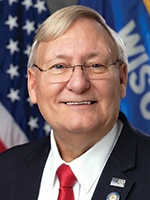
Photo of Van Wanggaard
R Wisconsin Senate · District 21

Sen. Van Wanggaard

Compare
Total votes
595
all sessions
Attendance
99%
4 missed
Near the chamber average
With party
99%
of cast votes
Near the chamber average
Bipartisan score
1%
crosses aisle rarely
Near the chamber average
Sponsored
524
bills & resolutions
Near the chamber average
Committees
4
assignments
524 bills and resolutions

Sponsored bills

Total
524
Primary
524
Co-sponsor
0
This page
524
matching current filters
Primary SJR 87
Failed · Wisconsin Senate · Lead sponsor
Relating to: recognizing the United States Marine Corps’s 250th birthday.

Maddy summarySJR 87 is a resolution by the Wisconsin Legislature to commemorate the U.S. Marine Corps' 250th anniversary on November 10, 2025, marking the date the Continental Congress authorized its founding in 1775. It recognizes the Corps' historical service and acknowledges Marines training at Fort McCoy in Wisconsin, including their role in activities like the Cold Weather Operations Course. The resolution expresses legislative appreciation but does not create new laws, funding, or legal obligations. It is a symbolic gesture celebrating military heritage without imposing concrete policy changes.

Failed Mar 23, 2026 0 co-sponsors
Primary SB 524
Failed · Wisconsin Senate · Lead sponsor
Relating to: raising the legal age for sale, purchase, and possession of cigarettes and nicotine and tobacco products; providing a legal age for sale, purchase, and possession of electronic vaping devices; and providing a penalty. (FE)

Maddy summarySB 524 would raise the legal age for purchasing, selling, and possessing cigarettes, nicotine products, tobacco, and electronic vaping devices from 18 to 21 years. It directly affects retailers, vendors, and individuals under 21 who would no longer be permitted to buy these products. Key provisions include requiring retailers to train staff on age verification, post warning signs, and restrict vending machine sales to locations where minors cannot access them without supervision. The bill also defines electronic vaping devices broadly but excludes FDA-approved nicotine cessation products. Violations could result in penalties, though specific fines are not detailed in the provided text.

Failed Mar 23, 2026 0 co-sponsors
Primary SB 266
Failed · Wisconsin Senate · Lead sponsor
Relating to: human trafficking and trafficking of a child and providing a penalty.

Maddy summarySB 266 amends Wisconsin law to create a new criminal penalty for individuals who knowingly profit from human trafficking. Specifically, it makes it a Class F felony to receive compensation from the earnings of victims subjected to debt bondage, prostitution, or commercial sex acts. This law directly affects traffickers or others who financially benefit from exploiting victims, with penalties applying to offenses committed on or after the law's effective date. The bill also clarifies that the new penalty applies to cases where prosecution time limits had not yet expired as of the effective date.

Failed Mar 23, 2026 0 co-sponsors
Primary SB 475
Failed · Wisconsin Senate · Lead sponsor
Relating to: applicability of the commercial building code to certain buildings. (FE)

Maddy summarySB 475 modifies Wisconsin's building code rules for public buildings, structures, and places of employment (like government offices, schools, or public facilities). It specifies that most commercial building code chapters (SPS 361-366) apply to these public spaces, but excludes one specific provision (SPS 361.03(7)) from applying if building plans are submitted to the department or local government by April 1, 2026. The bill takes effect for projects where plans are submitted by that deadline, altering which code requirements govern public building construction. This change directly affects public construction projects requiring building code compliance.

Failed Mar 23, 2026 0 co-sponsors
Primary SB 202
Failed · Wisconsin Senate · Lead sponsor
Relating to: local guaranteed income programs.

Maddy summarySB 202 prohibits cities, towns, and counties (political subdivisions) from using public funds - such as tax revenue, shared state money, or fees - to fund guaranteed income programs. It defines a "guaranteed income program" as one providing regular cash payments to individuals with no work or training requirements. The bill explicitly blocks local governments from spending taxpayer dollars on such programs, including funds from state shared revenue or local taxes. This directly affects all municipalities and counties considering implementing cash payment programs for residents. (SB 202, Section 1, 66.0601(1)(d))

Failed Mar 23, 2026 0 co-sponsors
Primary SB 311
Failed · Wisconsin Senate · Lead sponsor
Relating to: prohibiting funding for health services for unlawfully present individuals. (FE)

Maddy summarySB 311 prohibits state and local government funds - including those from counties, cities, towns, and federal funds passing through the state treasury - from covering health care services for individuals not lawfully present in the U.S. It directly affects undocumented immigrants seeking health care in Wisconsin. The bill creates a new statute (20.926) banning such funding, with two exceptions: it does not apply if federal law requires payment, or if applying the ban would cause the state to lose federal funds. This policy change restricts public funding for health services based solely on immigration status.

Failed Mar 23, 2026 0 co-sponsors
Primary SB 499
Failed · Wisconsin Senate · Lead sponsor
Relating to: the definition of hemp. (FE)

Maddy summarySB 499 clarifies Wisconsin's legal definition of "hemp" to align with federal standards, specifying that hemp includes the *Cannabis sativa* plant and its derivatives (like seeds and cannabinoids) with no more than 0.3% THC (or up to 1% under federal law, whichever is greater), tested via approved methods. The bill creates new definitions for "hemp-derived cannabinoid products" (excluding synthetic cannabinoids and FDA-approved drugs) and "industrial hemp" (covering non-cannabinoid products like stalk fiber, seed oil, and grain). This directly affects hemp farmers, manufacturers, and retailers by establishing clear regulatory boundaries for products, ensuring consistency with federal law. The changes update existing statutes to prevent confusion between hemp and marijuana under state law.

Failed Mar 23, 2026 0 co-sponsors
Primary SB 787
Signed into law · Wisconsin Senate · Lead sponsor
Relating to: increasing jurisdictional amounts in small claims actions. (FE)

Maddy summarySB 787 increases the dollar limits for cases handled in small claims court across several categories. It raises the threshold for consumer credit transactions from $25,000 to $50,000 (with automatic inflation adjustments), replevin actions from $10,000 to $25,000, personal injury/tort claims from $5,000 to $25,000, and other civil actions from $10,000 to $25,000. These increases take effect in phases starting January 2027, with the final amounts adjusting every five years based on the U.S. consumer price index. The bill directly affects individuals and small businesses seeking to resolve disputes in small claims court instead of higher-cost regular courts.

Signed into law Mar 20, 2026 0 co-sponsors
Primary SB 309
Signed into law · Wisconsin Senate · Lead sponsor
Relating to: immunity for 911 call centers and dispatchers that transfer callers to the national 988 Suicide and Crisis Lifeline.

Maddy summarySB 309 grants legal immunity to 911 call centers and dispatchers who transfer callers to the national 988 Suicide and Crisis Lifeline. It specifically protects them from civil lawsuits related to those transfers, unless the harm resulted from gross negligence or willful misconduct by the dispatcher or center. The bill defines the "national crisis hotline" as the federally managed 988 number (or its successor). This law directly affects public safety answering points in Wisconsin by limiting their liability when connecting individuals in crisis to the 988 service.

Signed into law Mar 19, 2026 0 co-sponsors
Primary SB 66
Signed into law · Wisconsin Senate · Lead sponsor
Relating to: registration plate concealment devices and providing a penalty.

Maddy summarySB 66 prohibits the use of devices designed to conceal, obstruct, or alter vehicle license plates, such as mechanical switches, moving covers, or altered plates that obscure numbers. It bans possessing, selling, installing, or using these devices and requires impounding vehicles equipped with them (with costs paid by the owner for towing/impoundment). Violations carry penalties of up to $1,000 in fines, 90 days in jail, or both. This law directly affects vehicle owners who might attempt to obscure license plates, and it became effective under 2025 Wisconsin Act 37.

Signed into law Mar 19, 2026 0 co-sponsors
Showing 141 to 150 of 524 bills
Previous 1 14 15 16 53 Next