

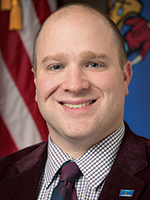
Photo of Eric Wimberger
R Wisconsin Senate · District 2

Sen. Eric Wimberger

Compare
Total votes
595
all sessions
Attendance
100%
of floor votes
Near the chamber average
With party
98%
of cast votes
Near the chamber average
Bipartisan score
2%
crosses aisle rarely
Near the chamber average
Sponsored
181
bills & resolutions
Near the chamber average
Committees
5
assignments
181 bills and resolutions

Sponsored bills

Total
181
Primary
181
Co-sponsor
0
This page
181
matching current filters
Primary SB 203
Failed · Wisconsin Senate · Lead sponsor
Relating to: regulation of pharmacy benefit managers, fiduciary and disclosure requirements on pharmacy benefit managers, and application of prescription drug payments to health insurance cost-sharing requirements. (FE)

Maddy summarySB 203 regulates pharmacy benefit managers (PBMs) by requiring them to pay pharmacies within 30 days for electronic claims and 60 days for paper claims. It mandates that claims for 340B drugs (federally discounted medications) include specific identifiers for processing. The bill also prohibits PBMs from forcing pharmacies to join multiple networks or penalizing them for declining to join such networks. These provisions directly affect PBMs, pharmacies, and prescribers within the state’s health insurance system.

Failed Mar 23, 2026 0 co-sponsors
Primary SB 559
Failed · Wisconsin Senate · Lead sponsor
Relating to: authorizing community solar programs and granting rule-making authority. (FE)

Maddy summarySB 559 authorizes community solar programs in Wisconsin, allowing multiple households or businesses to subscribe to shared solar energy projects. It requires municipalities to approve community solar facility locations with a two-thirds vote of their governing body (with limited exceptions), while ensuring facilities comply with zoning rules. The bill defines key terms like "community solar facility" (ground-mounted or rooftop projects generating electricity for subscribers), sets size limits (max 5MW for ground sites, 20MW for rooftop sites), and requires at least 3 subscribers with 60% of capacity coming from small subscriptions (≤40 kW). Subscribers receive bill credits for the electricity their subscription generates, offsetting their energy costs through the utility.

Failed Mar 23, 2026 0 co-sponsors
Primary SB 607
Failed · Wisconsin Senate · Lead sponsor
Relating to: right to carry a weapon in this state, licenses to carry a concealed weapon, and providing a penalty. (FE)

Maddy summarySB 607 modifies Wisconsin's firearm laws by expanding exemptions for law enforcement officers and adjusting hunting restrictions. It repeals existing limits on concealed carry licenses and creates new exemptions allowing peace officers to carry firearms in vehicles or aircraft while on duty. The bill also reduces the hunting restriction distance near schools and hospitals from 1,700 to 1,200 feet. These changes directly affect law enforcement personnel and hunters, while maintaining existing prohibitions for general firearm use in vehicles and near roadways.

Failed Mar 23, 2026 0 co-sponsors
Primary SB 666
Failed · Wisconsin Senate · Lead sponsor
Relating to: adopting the Uniform Public Expression Protection Act.

Maddy summarySB 666 adopts the Uniform Public Expression Protection Act, creating a legal tool to quickly dismiss lawsuits that challenge free speech on public issues. It directly affects individuals or organizations sued for expressing views in government proceedings, on matters of public concern, or under constitutional rights (like speech or assembly). The key provision allows defendants to file a "special motion" within 60 days of being sued, triggering a court hearing within 60 days to dismiss the case if the plaintiff fails to prove their claim is valid. The law excludes government employees acting officially, lawsuits about commercial sales, and cases involving imminent public health/safety threats. This is procedural, focusing on streamlining court processes for speech-related cases rather than changing substantive policy.

Failed Mar 23, 2026 0 co-sponsors
Primary SJR 87
Failed · Wisconsin Senate · Lead sponsor
Relating to: recognizing the United States Marine Corps’s 250th birthday.

Maddy summarySJR 87 is a resolution by the Wisconsin Legislature to commemorate the U.S. Marine Corps' 250th anniversary on November 10, 2025, marking the date the Continental Congress authorized its founding in 1775. It recognizes the Corps' historical service and acknowledges Marines training at Fort McCoy in Wisconsin, including their role in activities like the Cold Weather Operations Course. The resolution expresses legislative appreciation but does not create new laws, funding, or legal obligations. It is a symbolic gesture celebrating military heritage without imposing concrete policy changes.

Failed Mar 23, 2026 0 co-sponsors
Primary SB 640
Failed · Wisconsin Senate · Lead sponsor
Relating to: tuition and fee remission or grants for certain veterans and their dependents enrolled in the University of Wisconsin System, a technical college, or a private nonprofit institution of higher education; and the University of Wisconsin System nonresident tuition exemption for certain veterans. (FE)

Maddy summarySB 640 modifies Wisconsin's tuition and fee exemption policies for veterans and their families. It reduces the required residency period from five to three consecutive years for veterans' spouses or children to qualify for tuition remission at University of Wisconsin System schools, technical colleges, or private nonprofit institutions. The bill also adjusts residency requirements for veterans themselves seeking nonresident tuition exemptions. These changes apply to veterans who served honorably, or whose families meet specific residency and service-connected disability criteria. The policy aims to make existing benefits more accessible by lowering residency barriers.

Failed Mar 23, 2026 0 co-sponsors
Primary SB 609
Failed · Wisconsin Senate · Lead sponsor
Relating to: a state matching grant program for recipients of federal per diem payments. (FE)

Maddy summarySB 609 creates a state matching grant program for organizations that receive federal per diem payments to house veterans. It directly affects eligible veterans' housing providers (like nonprofits or care facilities) that already qualify for federal per diem payments under 38 USC 2012. The bill provides state matching funds of $25 per day per veteran, up to 365 days yearly, paid quarterly based on the previous quarter's housing. Applications are accepted annually, and grants are awarded in the order received.

Failed Mar 23, 2026 0 co-sponsors
Primary SB 608
Failed · Wisconsin Senate · Lead sponsor
Relating to: a state matching grant program for recipients of federal per diem payments and making an appropriation. (FE)

Maddy summarySB 608 creates a state matching grant program that provides $950,000 in state funds to match federal per diem payments received by eligible non-state entities (like community organizations or service providers). The program directly affects organizations that already receive federal daily living payments, allowing them to access additional state funding through a 1:1 match. Key provisions include allocating $950,000 specifically for this matching grant under the Veterans Affairs budget and defining eligible recipients as non-state entities receiving federal per diem payments. This is a procedural funding measure that establishes a new appropriation line without changing eligibility criteria or creating new requirements.

Failed Mar 23, 2026 0 co-sponsors
Primary SB 598
Failed · Wisconsin Senate · Lead sponsor
Relating to: coverage under the Medical Assistance program for incarcerated individuals. (FE)

Maddy summarySB 598 would require the state health department to seek a federal Medicaid waiver enabling coverage for incarcerated individuals in the Medical Assistance program (state Medicaid) up to 90 days before release. It specifically covers case management, medication-assisted treatment for substance use disorders, and a 30-day supply of prescription medications for those already eligible for Medical Assistance. If approved, the federal government would fund the program’s share of these services, with the state covering its portion. This bill directly affects incarcerated individuals transitioning to community care, aiming to improve continuity of health services upon release.

Failed Mar 23, 2026 0 co-sponsors
Primary SB 546
Failed · Wisconsin Senate · Lead sponsor
Relating to: authorizing additional circuit court and criminal justice system positions. (FE)

Maddy summarySB 546 expands court capacity in specific Wisconsin counties by adding new judicial branches and related positions. It increases circuit court branches in Kenosha County (from 8 to 9, effective 2028), Brown County (from 8 to 9 in 2027, then to 10 in 2028), and Menominee/Shawano Counties (from 2 to 3, effective 2027). The bill authorizes 4 new circuit judge positions, 4 new court reporter positions, and 30.5 additional assistant district attorney positions across 25 counties to support these expansions. All changes take effect between August 2027 and August 2028, with funding tied to existing state appropriations.

Failed Mar 23, 2026 0 co-sponsors
Showing 51 to 60 of 181 bills
Previous 1 5 6 7 19 Next