

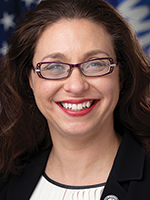
Photo of Rachael Cabral-Guevara
R Wisconsin Senate · District 19 On the 2026 ballot

Sen. Rachael Cabral-Guevara

Compare
Total votes
411
all sessions
Attendance
100%
of floor votes
Near the chamber average
With party
99%
of cast votes
Near the chamber average
Bipartisan score
2%
crosses aisle rarely
Near the chamber average
Sponsored
733
bills & resolutions
Near the chamber average
Committees
5
assignments
733 bills and resolutions

Sponsored bills

Total
733
Primary
733
Co-sponsor
0
This page
733
matching current filters
Primary SB 831
Failed · Wisconsin Senate · Lead sponsor
Relating to: operation of autonomous vehicles on highways and providing a penalty.

Maddy summarySB 831 creates an Autonomous Driving Safety Board within the Department of Transportation to regulate autonomous vehicle operations on state highways. The bill requires operators to obtain a board-approved permit, involving an application, public hearing, and two-thirds board vote for approval before operating, while prohibiting use on interstate highways. It sets a strict blood alcohol limit of 0.02 for anyone operating an autonomous vehicle and imposes a $1,000 penalty for operating without a valid permit. Permit holders must register vehicles, provide insurance coverage, submit annual safety reports, and share protocols for emergency services interaction.

Failed Mar 23, 2026 0 co-sponsors
Primary SB 872
Failed · Wisconsin Senate · Lead sponsor
Relating to: nuisance actions against racing facilities.

Maddy summarySB 872 prevents certain nuisance lawsuits against racing facilities by limiting who can file such claims. It blocks lawsuits started by property owners who bought land within 5 miles of a racetrack *after* the track was already built or operating. The law applies even if the racetrack later changes (e.g., size or technology), as long as those changes followed existing rules. This directly affects nearby property owners and protects racing facilities from specific nuisance claims based on property ownership timing.

Failed Mar 23, 2026 0 co-sponsors
Primary SB 885
Failed · Wisconsin Senate · Lead sponsor
Relating to: digital asset staking and the state’s securities laws.

Maddy summarySB 885 clarifies that digital asset staking and staking-as-a-service are excluded from the state's securities laws. It defines "staking" as locking digital assets to support blockchain security (e.g., via validator nodes) and "staking as a service" as third-party technical support for stakers. The bill directly affects blockchain participants, staking providers, and custodians by removing regulatory burdens under securities rules. This creates a clear regulatory boundary, ensuring staking activities are not treated as investment products under existing state law.

Failed Mar 23, 2026 0 co-sponsors
Primary SB 897
Failed · Wisconsin Senate · Lead sponsor
Relating to: threats to health care providers and providing a penalty.

Maddy summarySB 897 defines specific threats against health care workers as criminal offenses. It makes it illegal to threaten a current or former health care provider, staff member, or their family member when the threat occurs in response to work at a health care facility or actions taken in an official capacity. The law specifies two key conditions: the threatener must know the victim works in health care, and the threat must relate to the victim's professional role. This bill uses existing statutory definitions for "health care facility" and "health care provider" to clarify when such threats violate the law, creating a new criminal penalty for these specific circumstances.

Failed Mar 23, 2026 0 co-sponsors
Primary SB 899
Failed · Wisconsin Senate · Lead sponsor
Relating to: expressly prohibiting a foreign national from making a contribution to a referendum committee.

Maddy summarySB 899 prohibits foreign nationals from contributing to or influencing referendum committees that support or oppose ballot measures. It directly affects referendum committees (groups organizing campaigns for or against voter-approved measures) and their contributors. The bill requires committees to obtain written affirmations from contributors confirming they are not foreign nationals and have not received over $100,000 from foreign sources in the past four years. Committees must also attest in reports that they have not accepted foreign funds and will not do so before the referendum vote.

Failed Mar 23, 2026 0 co-sponsors
Primary SB 802
Failed · Wisconsin Senate · Lead sponsor
Relating to: a health professional assistance program and making an appropriation. (FE)

Maddy summarySB 802 creates a voluntary health professional assistance program to support licensed health care providers experiencing conditions that could impair their ability to practice safely. The program, funded by a $70 fee paid by providers when obtaining or renewing a participating credential, offers confidential screening, evaluation, treatment, and ongoing monitoring services. Credentialing boards can choose to participate for specific licenses, and providers or colleagues may report concerns without civil liability for good-faith reports. The program is operated by a contracted entity meeting specific requirements and complements existing disciplinary processes without affecting boards' authority over unrelated conduct.

Failed Mar 23, 2026 0 co-sponsors
Primary SB 889
Failed · Wisconsin Senate · Lead sponsor
Relating to: immunity for certain controlled substances offenses for aiders and aided persons.

Maddy summarySB 889 creates legal immunity for individuals who assist someone experiencing a drug overdose and for the person receiving that assistance. Aiders (those seeking help during an overdose) cannot lose parole/probation or face prosecution for drug possession charges if they seek help "as soon as practicable" after recognizing the overdose. Aided persons (overdose victims) can avoid prosecution or parole revocation by completing a treatment program or accepting a deferred prosecution agreement that requires treatment. The bill directly affects people involved in overdose situations and shifts consequences from criminal penalties toward treatment for related drug offenses.

Failed Mar 23, 2026 0 co-sponsors
Primary SB 818
Failed · Wisconsin Senate · Lead sponsor
Relating to: demonstration charter school operators. (FE)

Maddy summarySB 818 creates a "demonstration public school operator" designation for charter school operators in Wisconsin. To qualify, operators must document best practices, provide teacher training, participate in research studies, evaluate their educational models, track student progress, and partner with community organizations. Designated operators receive an additional $6,863 per pupil starting in 2026-27, with annual funding adjustments based on state revenue changes. This designation requires annual reporting on finances, student achievement, enrollment, and school transitions, and is limited to five-year terms renewable once. The bill directly affects charter school operators seeking this status and the students in their schools.

Failed Mar 23, 2026 0 co-sponsors
Primary SB 805
Failed · Wisconsin Senate · Lead sponsor
Relating to: recess in public schools. (FE)

Maddy summarySB 805 requires Wisconsin public schools and charter schools to provide at least 60 minutes of daily supervised recess for students in kindergarten through sixth grade starting in the 2026-27 school year. The bill defines recess as unstructured time for physical activity, play, games, or social engagement, prohibits using recess as punishment (except for immediate safety threats), and bans electronic devices during required recess. School boards must schedule this time without counting transfer periods, and the state education department will provide implementation guidance. This directly affects all K-6 public school students and school administrators in Wisconsin.

Failed Mar 23, 2026 0 co-sponsors
Primary SB 851
Failed · Wisconsin Senate · Lead sponsor
Relating to: the use of live animals in medical training and providing a penalty.

Maddy summarySB 851 prohibits medical schools and training programs in this state from using live animals to teach human medical treatment if equivalent alternatives exist, such as human cadavers, realistic simulators, or virtual models. It requires institutions to switch to these alternatives when another accredited program in the same field does not use live animals or when a comparable method is available. Violating this rule would result in a $1,000 fine per animal used. The bill directly affects medical training institutions and their curricula, aiming to reduce live animal use where effective alternatives are already available.

Failed Mar 23, 2026 0 co-sponsors
Showing 51 to 60 of 733 bills
Previous 1 … 5 6 7 … 74 Next