

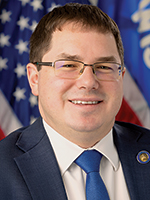
Photo of Mark Spreitzer
D Wisconsin Senate · District 15 On the 2026 ballot

Sen. Mark Spreitzer

Compare
Total votes
795
all sessions
Attendance
99%
5 missed
Near the chamber average
With party
98%
of cast votes
Near the chamber average
Bipartisan score
2%
crosses aisle rarely
Near the chamber average
Sponsored
2,199
bills & resolutions
Near the chamber average
Committees
3
assignments
2,199 bills and resolutions

Sponsored bills

Total
2,199
Primary
2,199
Co-sponsor
0
This page
2,199
matching current filters
Primary SB 761
Failed · Wisconsin Senate · Lead sponsor
Relating to: eliminating and modifying certain provisions enacted under 2023 Act 12 regarding the city of Milwaukee and Milwaukee County. (FE)

Maddy summarySB 761 eliminates and modifies specific provisions from 2023 Act 12 affecting Milwaukee's city government. It repeals requirements that the fire and police commission board must include members from the same political party (removing a 3-member cap for 7-member boards) and removes the need for the mayor to appoint members from employee association lists. The bill also changes the appointment process, allowing the mayor to appoint board members without common council confirmation for existing members, while requiring new members to complete training. Additionally, it modifies a tax provision related to rail transportation projects in Milwaukee, excluding the "Lakefront Line" route.

Failed Mar 23, 2026 0 co-sponsors
Primary SB 784
Failed · Wisconsin Senate · Lead sponsor
Relating to: warrior-style training of law enforcement officers. (FE)

Maddy summarySB 784 bans state law enforcement agencies from providing, arranging, or reimbursing "warrior-style training" for officers. This type of training is defined as instruction that dehumanizes people, encourages aggressive conduct, or de-emphasizes human life or constitutional rights, potentially increasing the likelihood of deadly force use. The bill prohibits state agencies from contracting with organizations offering such training and denies certification or reimbursement for any training involving warrior-style methods. However, it explicitly allows training in aikido (a specific martial art) to continue without restriction.

Failed Mar 23, 2026 0 co-sponsors
Primary SB 696
Failed · Wisconsin Senate · Lead sponsor
Relating to: equalized value calculations, project costs, and local levy limits relating to tax incremental districts. (FE)

Maddy summarySB 696 amends Wisconsin's rules for tax incremental districts (TIDs), which local governments use to finance development projects through future property tax revenues. It reduces a 12% tax levy limit to 5% for the town of Cable, adds park development costs to eligible project expenses, and adjusts how property value increases are calculated after TID termination. These changes directly affect cities and towns operating TIDs by altering how they determine tax levy limits and what projects qualify for TID financing. The bill simplifies calculations for property value increments and ensures consistent application of levy limits across districts.

Failed Mar 23, 2026 0 co-sponsors
Primary SB 723
Failed · Wisconsin Senate · Lead sponsor
Relating to: income tax credits for beginning farmers and owners of farm assets and making an appropriation. (FE)

Maddy summarySB 723 creates a new 5% income tax credit for beginning farmers and owners of agricultural assets in Wisconsin. Beginning farmers receive a credit equal to 5% of lease payments or purchase prices paid for agricultural assets (including land improvements), while asset owners get 5% of lease payments received from beginning farmers. The credit is limited to the first three years of a lease, capped at $75,000 per taxable year, and requires a certificate of eligibility. It applies to taxable years beginning after December 31, 2026, and affects individual taxpayers (not partnerships or corporations directly). The bill also establishes a dedicated funding appropriation for unused credits.

Failed Mar 23, 2026 0 co-sponsors
Primary SB 694
Failed · Wisconsin Senate · Lead sponsor
Relating to: providing certain municipalities with additional supplemental county and municipal aid and establishing a Shared Revenue Advisory Council. (FE)

Maddy summarySB 694 establishes a Shared Revenue Advisory Council to study and recommend improvements to how state aid is distributed to counties and municipalities. The council, composed of legislative leaders, municipal/town/county association representatives, and the revenue secretary, will analyze population, property value, and revenue data to evaluate current aid formulas. It requires the council to recommend a new distribution formula for 2027 and beyond that maintains or increases aid for all jurisdictions, while accounting for population changes and property value declines. The bill also sets a baseline funding level of $16,257,500 for supplemental aid in fiscal year 2026-27, with annual adjustments based on tax revenue changes.

Failed Mar 23, 2026 0 co-sponsors
Primary SB 707
Failed · Wisconsin Senate · Lead sponsor
Relating to: replacing the expenditure restraint incentive program with a municipality payment program and making an appropriation. (FE)

Maddy summarySB 707 replaces Wisconsin's existing "expenditure restraint incentive program" with a new "municipality payment program" that guarantees ongoing funding for eligible municipalities. It directly affects cities and towns that received payments under the old program in 2024, 2025, or 2026, ensuring they receive annual payments equal to their highest prior-year amount starting in 2027. Key provisions include ending the old program after 2026 (via Section 79.05(8)), creating a new payment structure (Section 79.06), and adjusting payment schedules for 2026-2027. The bill makes a specific appropriation to fund this transition, with most changes effective July 1, 2027.

Failed Mar 23, 2026 0 co-sponsors
Primary SB 770
Failed · Wisconsin Senate · Lead sponsor
Relating to: farm to fork grants, farm to school grants, matching funds for the federal farm to school program, granting rule-making authority, and making an appropriation. (FE)

Maddy summarySB 770 establishes two new grant programs: a $200,000 annual Farm to Fork grant for businesses, hospitals, and other non-school entities to connect local farms with cafeterias, and a $250,000 annual Farm to School grant for school districts. The Farm to School grants prioritize proposals from high-poverty school districts (where many students qualify for free/reduced meals) and support initiatives like expanding local food procurement, facility upgrades, and nutrition education. Both programs require the Agriculture Department to award grants with preferences for innovative models, value-added agricultural products (like processed local foods), and projects improving farm access to markets. The bill also adds administrative funding for the department to manage these programs.

Failed Mar 23, 2026 0 co-sponsors
Primary SB 775
Failed · Wisconsin Senate · Lead sponsor
Relating to: sandhill crane damage abatement assistance for corn producers, granting rule-making authority, and making an appropriation. (FE)

Maddy summarySB 775 creates a state program reimbursing corn farmers for nonlethal seed coating costs to prevent sandhill crane damage. Eligible farmers (with at least $6,000 in annual farm revenue) can receive up to 50% of seed coating costs, capped at $6,250 per season. The program prioritizes farmers with federal crane permits, prior reimbursement recipients, or land identified as high-risk for crane damage. It is funded by a new $1.875 million annual appropriation for the Department of Agriculture.

Failed Mar 23, 2026 0 co-sponsors
Primary SB 795
Passed · Wisconsin Senate · Lead sponsor
Relating to: caregiver records maintained by the Department of Transportation. (FE)

Maddy summarySB 795 requires the Department of Transportation to ask license and ID card applicants if they want to voluntarily provide contact information for up to three people they care for as primary caregivers. The bill creates a system where this information is stored in the applicant's file and can be electronically accessed by law enforcement agencies that reasonably identify a person. It does not change existing requirements but adds this optional caregiver contact field to applications, with strict limits on who can access the data (only the applicant or law enforcement under defined conditions). The bill directly affects individuals applying for driver's licenses or state ID cards who choose to share caregiver contacts.

Passed Mar 23, 2026 0 co-sponsors
Primary SB 762
Failed · Wisconsin Senate · Lead sponsor
Relating to: grants for testing privately owned wells and providing education, providing an exemption from emergency rule procedures, granting rule-making authority, and making an appropriation. (FE)

Maddy summarySB 762 creates a state grant program to fund testing and mapping of privately owned wells to assess groundwater quality and contamination. It provides up to $10,000 per grant to counties, cities, villages, or towns for well testing and geologic studies, and up to $10,000 to health departments for public education on well testing. The bill requires grant recipients to submit anonymized testing results to the Department of Natural Resources and the University of Wisconsin-Stevens Point, while directing municipalities to inform residents about well testing importance. The program is funded with $2.5 million annually from the environmental fund, with rule-making authority granted to the Department of Natural Resources.

Failed Mar 23, 2026 0 co-sponsors
Showing 241 to 250 of 2,199 bills
Previous 1 … 24 25 26 … 220 Next