

Maddy summarySB 714 establishes minimum bathing standards for inmates in state correctional facilities and county jails or houses of correction. It requires each facility to provide at least four bathing periods per week, with each period including a minimum of 10 minutes of heated running water and 15 minutes of total time. The bill directly affects all inmates in these facilities by setting concrete, measurable requirements for hygiene access. It creates a new statute (302.072) to implement these standards, applying equally to both state and county custody settings.
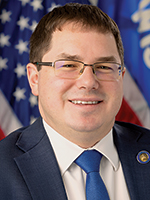
Sen. Mark Spreitzer
Sponsored bills
Maddy summarySB 726 requires the Department of Corrections to create an interactive website system that updates complaint data from state correctional facilities every 72 hours. The system must show the total number of annual complaints per facility and display all complaint details broken down by type (without personal information), making it searchable by category. The bill appropriates $70,000 for fiscal year 2025-26 and $30,000 for 2026-27 to establish and operate this reporting system. This directly affects state correctional institutions by mandating transparent, real-time public reporting of inmate and staff complaints.
Maddy summarySB 720 increases funding to hire three additional full-time caretaker positions at the state's three veterans cemeteries. The bill allocates $131,800 for fiscal year 2025-26 and $170,800 for fiscal year 2026-27 under the Department of Veterans Affairs budget. These positions will directly support the maintenance and care of veterans cemeteries, addressing staffing needs for cemetery operations. The measure makes a concrete budget adjustment without altering eligibility or benefits for veterans.
Maddy summarySB 686 designates the Wisconsin natural pearl as the official state gem. The bill amends Wisconsin statutes to add a new section (1.10 (3) (w)) stating this designation and updates another section (1.10 (4)) to include "gem" in the list of state symbols required for the Wisconsin Blue Book. This is a ceremonial bill with no policy changes or direct impact on citizens or government programs. It simply adds the pearl to the state's official list of symbols, which will be reflected in the Blue Book.
Maddy summarySB 721 adds a specific eligibility category for military funeral honors reimbursement: individuals naturalized under the federal Hmong Veterans’ Naturalization Act of 2000 who were residing in the state at the time of their death. The bill establishes that certified veterans' organizations providing military funeral honors for these individuals are eligible for reimbursement of up to $85 per funeral, adjusted annually based on the U.S. consumer price index. This directly affects Hmong veterans who gained U.S. citizenship through the 2000 federal law and their families. The reimbursement rate replaces the previous $50 limit and ensures annual updates to match inflation. The bill modifies existing statutes to clarify this eligibility and funding mechanism.
Maddy summarySB 744 requires state correctional facilities and county jails to create two new systems: (1) a notification system allowing inmates to designate up to three family members to receive automatic alerts within 24 hours if they face restrictions affecting visits or communication; and (2) a public website reporting system updated every 48 hours, detailing current restrictions, solitary confinement numbers, reasons for solitary confinement, and total inmate populations at all facilities. The bill mandates that sheriffs submit weekly data to the state department to populate the public reporting system, with the system becoming operational by the 7th month after enactment. It appropriates $780,000 for the notification system in fiscal year 2025-26 and $94,200 for staff to support implementation. This directly affects inmates, their families, and the public by increasing transparency around facility restrictions and solitary confinement practices.
Maddy summarySB 743 establishes a minimum wage for inmates working in state correctional institutions and county jails, requiring facilities to pay at least the state's minimum hourly wage rate (currently $10.47/hour) for labor performed. The bill directly affects all inmates engaged in work programs within these facilities, including those in county jails under sheriff oversight. Key provisions include a $2.33/hour wage increase for existing rates and new state funding: $58.9 million for 2025-26 and $88.4 million for 2026-27 for state prison wages, plus $873,000 and $1.31 million for correctional enterprise programs. All wages must be held in trust accounts for inmates and cannot be garnished during their incarceration.
Maddy summarySB 764 sets a $60 annual cap on out-of-pocket costs for two doses of epinephrine delivery systems (like EpiPens) under health insurance policies and self-insured plans. It directly affects people with severe allergies who rely on these devices and their insurers. The bill requires coverage for medically necessary epinephrine delivery systems with cost-sharing limited to $60 for two doses, regardless of device type, while allowing plans to charge less or nothing. This applies to disability insurance policies, state/local government health plans, and all health insurance plans covering these devices. The law takes effect four months after publication, with transitional rules for existing policies and collective bargaining agreements.
Maddy summarySJR 115 is a ceremonial resolution that directs Wisconsin to formally recognize November 20, 2025, and 2026, as "Wisconsin’s Transgender Day of Remembrance." It does not create new laws or policies but affirms the state's acknowledgment of this day, which memorializes transgender and nonbinary people killed due to transphobic violence. The resolution cites rising annual fatalities against transgender individuals (33 in 2023, 30 in 2024) and aligns with the established national observance founded in 1999. As a procedural resolution, it has no direct regulatory impact on individuals or organizations.
Maddy summarySB 776 repeals Wisconsin's dry cleaner environmental response program and creates the "Revitalize Wisconsin" program to support cleanup of contaminated properties. The new program provides $3 million biennially from the environmental fund to cover costs for eligible property owners (including "innocent landowners" who didn't cause pollution) and developers on brownfield sites - abandoned properties affected by environmental contamination. It allows grants, direct services, or reimbursements for cleanup activities like waste removal and sampling, with some sites prioritized for funding. The bill also adjusts related environmental funding rules and repeals outdated provisions.