

Maddy summaryThis bill establishes rules to limit price markups on food and drinks sold at publicly funded stadiums in the state. It defines a stadium as a facility with at least 3,000 seats that receives public financial support, while excluding schools and charter schools from these requirements. The law prohibits stadium operators and concessionaires from charging more than the retail cost of items plus a 20 percent markup. Violations of these pricing limits would be classified as unfair trade practices under state law.
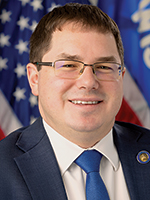
Sen. Mark Spreitzer
Sponsored bills
Maddy summaryThis bill establishes a state assistance program to help smaller municipalities, specifically 3rd and 4th class cities, villages, and towns, upgrade their water infrastructure to meet federal water quality standards. The program would provide up to 50 percent funding for approved construction projects and requires local governments to submit applications for consideration. The Department of Natural Resources would administer the program, set eligibility criteria, prioritize projects, and review project plans before releasing funds. The legislation also allocates $10 million in state funding for the program in the 2025-26 fiscal year.
Maddy summaryThis bill establishes a 20 percent purchasing goal for state agencies and local governments to buy products and services from businesses with a principal place of business in Wisconsin. It requires state departments and purchasing agents to attempt to meet this target each fiscal year, while also ensuring the percentage does not fall below the previous year's level. The legislation mandates that agencies collect and publicly report data on vendor locations and evaluate their progress toward meeting these goals. Local governments are given the option to opt out of the reporting requirements through a formal resolution. The bill also defines "local products or services" and includes exemptions for commercial resale items and situations where foreign vendors face similar government purchasing restrictions.
Maddy summaryThis Senate Joint Resolution honors the life and legacy of Anne Arnesen, a longtime advocate for children and families who passed away in January 2026. The resolution recognizes her contributions as a community leader, school board member, and activist who served in various roles including leading the Wisconsin Council on Children and Families for 22 years. It formally acknowledges her dedication to civil service, women's rights, and social justice through her work with multiple organizations and her years of public service. The bill is a commemorative measure intended to recognize her impact on Wisconsin rather than to change any laws or policies.
Maddy summaryThis bill congratulates the U.S. Olympic Women's Ice Hockey Team on winning the gold medal at the 2026 Winter Olympics. It specifically highlights the achievements of Wisconsin-affiliated players and staff, including former and current University of Wisconsin athletes who competed on the team. The resolution formally commends the athletes, coaches, and support staff for their success and wishes them continued success. The bill is a ceremonial measure with no regulatory or policy changes.
Maddy summaryThis Senate resolution directs the Wisconsin Senate to schedule additional floor sessions between April 14 and April 16, 2026, and to hold extraordinary sessions through December 31, 2026, to consider bills aimed at reducing costs for Wisconsinites. The measure specifically calls for passing legislation introduced by minority party members that address affordability issues such as utility rates, health care premiums, child care costs, and agricultural expenses. It was introduced in March 2026 by a bipartisan group of senators and referred to the Committee on Senate Organization, where it later failed to adopt following a vote to withdraw from committee. The resolution does not create new laws itself but establishes procedural requirements for the Senate to convene additional voting periods during the 2025-26 legislative session.
Maddy summaryThis bill establishes the Wisconsin Climate Corps program, a state initiative designed to create jobs in environmental restoration, home weatherization, and climate resilience projects while providing employment training for underserved communities. The program would be managed by a nonprofit organization under the oversight of a new board that includes state officials, legislators, and representatives from conservation and youth training groups. Key provisions require that at least 50% of workers come from underserved populations, pay workers a minimum of $15 per hour, provide health insurance equivalent to a gold-level plan, and offer weekly housing stipends or accommodations. Projects would focus on activities such as planting trees, restoring natural lands, building community gardens, and improving energy efficiency in homes across both urban and rural areas.
Maddy summarySB 950 eliminates the option for parents or guardians to exempt children from school or childcare immunization requirements based on "personal conviction." It directly affects students, parents, and schools by restricting waivers to only health or religious reasons. The bill amends statutes to remove "personal conviction" from acceptable exemption grounds, requiring schools to inform families about the limited waiver options. This changes current practice by ending non-medical, non-religious exemptions for immunizations in educational settings. The bill is currently pending in the Committee on Licensing, Regulatory Reform, State and Federal Affairs.
Maddy summarySB 992 clarifies and expands eligibility for Wisconsin's child care subsidy program (Shares) to include "like-kin" caregivers - non-biological individuals who have formed family-like bonds with children. It directly affects caregivers who provide regular care for children under court orders but aren't blood relatives, such as close family friends or guardians. Key changes include updating definitions to explicitly include "like-kin" in subsidy eligibility, adjusting income calculations to count certain court-ordered payments, and ensuring these caregivers qualify for subsidies when meeting income thresholds. The bill makes no new funding commitments but streamlines access to existing child care support for these families.
Maddy summarySB 991 creates a new annual appropriation of $500,000 for tribal child care training and technical assistance. It directly affects tribal child care providers by funding programs to improve child care quality through training and support. The bill modifies two statutes (49.137 and 49.257) to allow the Department of Children and Families to use this funding for contracts or grants with agencies serving tribal communities. This is a concrete policy change that establishes dedicated funding for tribal child care providers without altering eligibility or requirements for other child care services.