

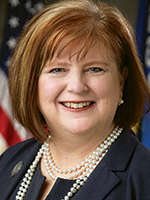
Photo of Barbara Dittrich
R Wisconsin Assembly · District 99 On the 2026 ballot

Rep. Barbara Dittrich

Compare
Total votes
717
all sessions
Attendance
100%
of floor votes
Near the chamber average
With party
99%
of cast votes
Near the chamber average
Bipartisan score
0%
crosses aisle rarely
Near the chamber average
Sponsored
1,126
bills & resolutions
Near the chamber average
Committees
9
assignments
1,126 bills and resolutions

Sponsored bills

Total
1,126
Primary
1,126
Co-sponsor
0
This page
1,126
matching current filters
Primary AB 275
Failed · Wisconsin Assembly · Lead sponsor
Relating to: challenges to the validity of administrative rules and making an appropriation. (FE)

Maddy summaryAB 275 modifies state law to require government agencies to pay legal fees and costs when a court rules that an administrative rule is invalid (e.g., because it violates the constitution or was improperly created). It specifically directs that these costs - awarded to successful challengers - be paid from designated state funds under statutes 20.865(1)(a), (g), or (q). The bill applies to challenges involving agency rules or guidance documents and ensures fees are limited to the scope of the rule validity challenge. This change affects state agencies (who must cover costs) and individuals or groups challenging agency rules (who can recover legal expenses).

Failed Mar 23, 2026 0 co-sponsors
Primary AB 276
Failed · Wisconsin Assembly · Lead sponsor
Relating to: statements of scope for administrative rules. (FE)

Maddy summaryAB 276 sets time limits for state agencies' "statements of scope" when creating administrative rules. It requires permanent rule statements to expire after 30 months and emergency rule statements after 6 months, preventing agencies from using expired statements to propose new rules. The bill also mandates separate statements for concurrent emergency and permanent rules and limits agencies to one rule per statement. These changes directly affect state agencies developing regulations and ensure legislative review occurs within defined timeframes. The bill does not alter rule content but streamlines the process for agency rulemaking and legislative oversight.

Failed Mar 23, 2026 0 co-sponsors
Primary AB 274
Failed · Wisconsin Assembly · Lead sponsor
Relating to: the expiration of administrative rules. (FE)

Maddy summaryAB 274 establishes a 7-year expiration cycle for Wisconsin administrative rules, requiring state agencies to formally request "readoption" before rules expire. It directly affects state agencies that create and maintain administrative rules, mandating they submit detailed notices to the legislature with specific information about each rule's purpose, legal basis, and compliance status. Key provisions include new requirements for readoption notices (including statements on rule compliance), a process for legislative committees to review these notices, and a schedule for expiring rules that were in effect before 2025. The bill also creates a rules procedures manual to guide agencies on drafting and legislative review. These changes streamline rule expiration and renewal while increasing transparency for lawmakers.

Failed Mar 23, 2026 0 co-sponsors
Primary AB 277
Failed · Wisconsin Assembly · Lead sponsor
Relating to: requirements for proposed administrative rules that impose any costs.

Maddy summaryAB 277 requires state agencies to provide detailed cost analyses for new rules that may affect businesses, local governments, or individuals. Agencies must quantify all expected implementation and compliance costs (and potential savings) over a two-year period, broken down by affected groups, and report this as a single net dollar figure. If projected costs exceed $10 million, the rulemaking process must pause until costs are reduced or offset. The bill also establishes rules for funding independent cost analyses when agency estimates vary significantly and mandates revised analyses after rule modifications. This bill aims to increase transparency around financial impacts of new regulations before they are finalized.

Failed Mar 23, 2026 0 co-sponsors
Primary AB 681
Failed · Wisconsin Assembly · Lead sponsor
Relating to: the use of oral fluids for preliminary screening of a person suspected of operating a motor vehicle while intoxicated.

Maddy summaryAB 681 allows law enforcement officers to use oral fluid tests (alongside breath tests) during initial roadside screening when they suspect a driver is impaired by alcohol, drugs, or controlled substances. This applies to drivers suspected of violating DUI laws (e.g., operating under the influence or while impaired). The test results help officers decide whether to arrest the driver or request further chemical testing, but cannot be used as evidence in court except to prove probable cause for an arrest. Refusing this preliminary test carries no penalty, unlike refusing a formal chemical test later.

Failed Mar 23, 2026 0 co-sponsors
Primary AB 691
Failed · Wisconsin Assembly · Lead sponsor
Relating to: service award program. (FE)

Maddy summaryAB 691 amends Wisconsin's service award program for volunteer emergency responders, including fire fighters and emergency medical personnel. It increases the required service years for full benefits from 15 to 20 years, with eligibility also requiring age 60. For those with 10-20 years of service who are age 53-59 (but under 60), the bill creates a reduced payout option, calculated by the department but less than the full amount. The department must establish rules to implement these changes, affecting how volunteer emergency responders receive retirement benefits.

Failed Mar 23, 2026 0 co-sponsors
Primary AB 503
Failed · Wisconsin Assembly · Lead sponsor
Relating to: the definition of hemp. (FE)

Maddy summaryAB 503 updates the legal definition of "hemp" in state law to clarify regulatory boundaries. It establishes a 0.3% THC limit (or up to 1% under federal law) for hemp plants, explicitly excludes FDA-approved drugs, and creates new categories like "hemp-derived cannabinoid products" with restrictions on synthetic cannabinoids. The bill directly affects hemp farmers (who must meet THC testing standards), manufacturers of hemp products (who must comply with new labeling rules), and state agencies like the Department of Agriculture. Key mechanisms include requiring standardized THC testing methods and defining industrial hemp uses (e.g., stalk fiber, seed oil) separate from psychoactive products.

Failed Mar 23, 2026 0 co-sponsors
Primary AB 514
Passed · Wisconsin Assembly · Lead sponsor
Relating to: authorizing additional circuit court and criminal justice system positions. (FE)

Maddy summaryAB 514 authorizes new circuit court branches and additional judicial staff in Kenosha, Brown, and Menominee/Shawano counties to address growing caseloads. Specifically, it adds a ninth branch in Kenosha County (effective August 2028), a ninth branch in Brown County (effective August 2027) and a tenth branch (effective August 2028), and a third branch in Menominee/Shawano Counties (effective August 2027). The bill also authorizes new circuit judge and court reporter positions for these branches, plus 30.5 additional assistant district attorney positions across 24 counties. These changes are funded through existing state court appropriations and will take effect on the specified dates.

Passed Mar 23, 2026 0 co-sponsors
Primary AB 669
Failed · Wisconsin Assembly · Lead sponsor
Relating to: race-based higher education programs and requirements. (FE)

Maddy summaryAB 669 revises higher education program definitions and requirements in Wisconsin, focusing on how "disadvantaged" students are identified and supported. It prohibits the use of race, ethnicity, gender, or group identity in defining "disadvantaged" students, requiring that eligibility be based solely on economic, familial, geographic, or personal hardship. The bill updates existing programs like graduate aid grants (e.g., "Ben R. Lawton grants") and retention plans to operate without race-based considerations, while maintaining reporting requirements for financial aid distribution by student demographics. It affects public universities, technical colleges, and students applying for state-funded aid programs.

Failed Mar 23, 2026 0 co-sponsors
Primary AB 658
Failed · Wisconsin Assembly · Lead sponsor
Relating to: the maximum compensation for compatibility with elective offices in cities, villages, and towns. (FE)

Maddy summaryAB 658 raises the maximum annual compensation limits for volunteer emergency responders (firefighters, EMTs, and emergency medical responders) who also hold elected local government offices in cities, villages, or towns. It increases the cap to $35,000 for communities with under 5,000 residents and $25,000 for larger communities (over 5,000 residents), up from previous limits of $25,000 and $15,000, respectively. The bill clarifies that holding an elected office is compatible with receiving wages from certain local government positions, such as those under sections 60.37(4) or 61.327. This change directly affects volunteer emergency workers seeking to serve in local elected roles without exceeding compensation thresholds.

Failed Mar 23, 2026 0 co-sponsors
Showing 371 to 380 of 1,126 bills
Previous 1 … 37 38 39 … 113 Next