

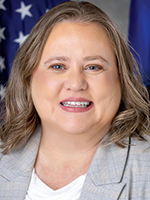
Photo of Jodi Emerson
D Wisconsin House · District 91 On the 2026 ballot

Rep. Jodi Emerson

Compare
Total votes
559
all sessions
Attendance
96%
24 missed
Near the chamber average
With party
96%
of cast votes
Lower than 95% of chamber peers
Bipartisan score
2%
crosses aisle rarely
Higher than 93% of chamber peers
Sponsored
1,033
bills & resolutions
Near the chamber average
Committees
3
assignments
1,033 bills and resolutions

Sponsored bills

Total
1,033
Primary
1,033
Co-sponsor
0
This page
1,033
matching current filters
Primary AB 1205
Failed · Wisconsin House · Lead sponsor
Relating to: a tax credit for local newspaper subscriptions. (FE)

Maddy summaryThis bill creates a state tax credit to help residents offset the cost of subscribing to local newspapers. It directly affects individuals who file state income tax returns and purchase subscriptions from newspapers that are legally qualified to print official notices. Under the bill, eligible taxpayers can claim a credit equal to 50 percent of their newspaper subscription costs, with a maximum credit of $250 per year or $125 for married individuals filing separately. The credit applies to taxable years beginning after December 31, 2024, and must be claimed within the standard tax filing period.

Failed Apr 9, 2026 0 co-sponsors
Primary AB 1070
Failed · Wisconsin House · Lead sponsor
Relating to: the restrictiveness of shoreland zoning ordinances. (FE)

Maddy summaryAB 1070 limits county and state agency regulations on shoreland property maintenance. It prohibits counties from requiring approvals, fees, or restrictions for repairing, replacing, or remodeling existing structures (without expanding their footprint) or for vertical expansions under specific conditions. The bill creates a new provision (59.692(1k)(ag)) allowing counties to charge fees for these activities, while repealing prior restrictions on such fees. It directly affects landowners with properties near shorelines who seek to maintain or repair existing structures without expanding them.

Failed Apr 9, 2026 0 co-sponsors
Primary AB 957
Signed into law · Wisconsin House · Lead sponsor
Relating to: Internet crimes against children law enforcement and making an appropriation. (FE)

Maddy summaryAB 957 increases funding by $400,000 for each of the 2025-26 and 2026-27 fiscal years to support internet crimes against children law enforcement within the Department of Justice. This is a budget adjustment that directly affects the Department of Justice's resources for investigating and prosecuting online crimes targeting minors. The bill does not create new laws or change existing legal standards - it solely allocates additional state funds for enforcement efforts.

Signed into law Apr 9, 2026 0 co-sponsors
Primary AB 958
Signed into law · Wisconsin House · Lead sponsor
Relating to: position authorizations for Internet crimes against children law enforcement. (FE)

Maddy summaryAB 958 authorizes the Department of Justice to add three new positions specifically for its Internet Crimes Against Children (ICAC) unit: two criminal analyst roles, one outreach specialist, and one digital evidence examiner. These positions are funded through existing appropriations under section 20.455(2)(a). The bill directly affects the ICAC unit’s staffing capacity to investigate and respond to online crimes involving children. It does not create new laws or policies but adjusts personnel authorizations to support existing law enforcement efforts. The bill was introduced in the 2026 Legislature and referred to the Criminal Justice and Public Safety Committee.

Signed into law Apr 9, 2026 0 co-sponsors
Primary AB 759
Signed into law · Wisconsin House · Lead sponsor
Relating to: eligibility to receive occupational credentials for recipients of deferred action under the Deferred Action for Childhood Arrivals program. (FE)

Maddy summaryAB 759 allows individuals with deferred action under the federal DACA program to obtain state occupational licenses (like nursing or cosmetology credentials) if they have valid federal work permits. It requires state licensing agencies to verify DACA recipients' federal work authorization through official systems before issuing licenses. Licenses issued under this law expire when the federal work permit expires, and recipients must renew both simultaneously. The bill explicitly states it does not grant eligibility for public benefits beyond occupational credentials.

Signed into law Apr 9, 2026 0 co-sponsors
Primary AB 194
Signed into law · Wisconsin House · Lead sponsor
Relating to: modifications to housing programs under the Wisconsin Housing and Economic Development Authority. (FE)

Maddy summaryAB 194 modifies Wisconsin's housing programs under the Wisconsin Housing and Economic Development Authority. It redefines "developer" to include tribal housing authorities (Section 3) and clarifies "residential housing" to include tax-exempt reservation or trust lands (Section 4). The bill reduces maximum loan limits for housing projects from 33% to 20% of development costs (Section 10) and from 25% to 10% (Section 11). It also requires local governments to submit cost-reduction analyses showing how zoning or fee changes lowered housing costs (Section 7), directly affecting developers, tribal entities, and local governments administering housing programs.

Signed into law Apr 9, 2026 0 co-sponsors
Primary AB 373
Signed into law · Wisconsin House · Lead sponsor
Relating to: creating a refundable individual income tax credit for the parent of a stillbirth and making an appropriation. (FE)

Maddy summaryAB 373 creates a refundable $2,000 individual income tax credit for parents who experience a stillbirth in the state, as documented by a fetal death report. The credit is refundable, meaning parents who owe less in income tax than the credit amount will receive the difference as a cash payment from state funds. Eligibility requires the stillbirth to meet state reporting criteria (per §69.18), and rules specify $2,000 for joint filers per stillbirth or $1,000 each for unmarried parents or separate filers. The credit must be claimed within the standard tax filing deadline and cannot be used by nonresidents or for partial tax years.

Signed into law Apr 9, 2026 0 co-sponsors
Primary AB 604
Signed into law · Wisconsin House · Lead sponsor
Relating to: coverage under the Medical Assistance program for incarcerated individuals. (FE)

Maddy summaryAB 604 would require Wisconsin's Department of Health Services to request a federal Medicaid waiver to provide pre-release medical coverage for incarcerated individuals eligible for Medicaid. It specifically covers case management, medication-assisted treatment for substance use disorders, and a 30-day supply of prescription medications for up to 90 days before release. This bill directly affects incarcerated people who qualify for Medicaid, aiming to improve continuity of care upon reentry. The waiver request must be submitted by January 1, 2027, to allow state and federal reimbursement for these services. The bill focuses on concrete policy changes to expand healthcare access during a critical transition period.

Signed into law Apr 9, 2026 0 co-sponsors
Primary AB 1187
Failed · Wisconsin House · Lead sponsor
Relating to: preference in state and local government contracts and procurement for materials manufactured in the United States. (FE)

Maddy summaryThis bill requires state and local government agencies to prioritize purchasing materials manufactured in the United States when all other factors are equal, unless federal law or international agreements prohibit it. It mandates that contracts for public works projects include provisions requiring contractors to use domestically manufactured materials, while exempting purchases intended for commercial resale, stationery, and cases where foreign suppliers do not reciprocate in their own government procurement. The legislation also restricts municipalities from using bidding methods that favor bidders based on geographic location, except when using the United States manufacturing preference. These changes directly affect state departments, municipalities, and contractors bidding on public projects by establishing a preference for American-made goods in government procurement.

Failed Apr 8, 2026 0 co-sponsors
Primary AB 1204
Failed · Wisconsin House · Lead sponsor
Relating to: residency requirements for certain employees of a local governmental unit. (FE)

Maddy summaryThis bill allows local governments to require that certain top administrative employees live within their jurisdiction. It specifically permits police and fire departments to set residency rules for their chiefs, cities and villages to apply them to administrators, counties without elected executives to apply them to county administrators, and school boards to apply them to school district administrators. Additionally, cities and villages that have or are electing a city manager may require that manager to live locally. The changes take effect only for individuals hired after the bill becomes law, meaning existing employees are not affected.

Failed Apr 8, 2026 0 co-sponsors
Showing 11 to 20 of 1,033 bills