

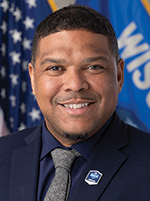
Maddy summaryAB 859 adjusts the state reimbursement rate for special education and school-age parent program costs. It sets the reimbursement rate at 42% of eligible costs for the 2025-26 school year, increasing to 45% for the 2026-27 school year and all subsequent years. The bill applies to costs covered under sections 115.88(1m)-(3), (6), (8), 115.93, and 118.255(4), which include services for students in hospitals, convalescent homes, and school programs. This change directly affects school districts and programs providing these services by altering the state's financial contribution toward their expenses. The bill amends statutes to ensure state funds are distributed according to these revised percentages.
Rep. Amaad Rivera-Wagner
Sponsored bills
Maddy summaryAB 860 requires state and county correctional facilities to provide written guides detailing inmates' and juveniles' rights, updated annually or after legal changes. These guides must account for individual circumstances like confinement status and location, and be posted throughout facilities, provided upon entry or transfer, and explained by staff to all affected individuals. The bill appropriates $200,000 for the Department of Administration to contract with legal organizations - including formerly incarcerated individuals - to develop these guides by June 2027. The law takes effect July 1, 2027, directly affecting all inmates in state prisons, county jails, and juveniles in youth facilities across Wisconsin.
Maddy summaryAB 886 creates a $2 million pilot program to fund grants for local governments and nonprofits that provide non-medication, non-talk therapy mental health treatments for children. The program allocates up to $50,000 per grant to expand access to research-based alternatives, such as art or play therapy, for children in need. Grants are limited to a two-year duration from the program's effective date, with applications open to cities, towns, counties, or qualifying nonprofits. The bill directly affects community organizations serving children by providing targeted funding for specific treatment approaches.
Maddy summaryAB 889 establishes the Wisconsin Climate Corps program to create climate-focused job opportunities for workers aged 16-30, with at least 50% from underserved communities. The program funds projects like restoring natural lands, weatherizing homes for energy efficiency, and building community gardens, administered by a board overseeing contracts with nonprofit managers. Key requirements include paying workers $15/hour, providing housing stipends ($100/week), and gold-level health insurance. Sponsors (local governments, tribes, or nonprofits) must submit annual reports, and completed projects require permanent plaques identifying them as Wisconsin Climate Corps initiatives. The bill appropriates state funds for grants to approved projects under this framework.
Maddy summaryAJR 132 is a commemorative resolution honoring George Meyer, former Wisconsin Secretary of the Department of Natural Resources (DNR), recognizing his decades of service to conservation and public policy. It details his work on wetland protections, tribal rights negotiations, land acquisitions, and environmental advocacy during his 1993-2001 DNR leadership, without creating new laws or affecting any policies. The resolution expresses the Wisconsin Legislature's gratitude for his legacy and extends condolences to his family. As a purely ceremonial measure, it has no direct policy impact or effect on citizens or programs.
Maddy summaryAB 972 allows banks and credit unions to refuse or delay specific financial transactions and decline to accept a power of attorney for vulnerable adults when they reasonably suspect financial exploitation. Financial institutions must report suspected exploitation to adult-at-risk agencies and notify authorized account holders (excluding suspected perpetrators), while maintaining legal immunity for good-faith actions. This law directly affects vulnerable adults (elderly or disabled individuals at risk of exploitation), financial institutions, and the agencies that handle exploitation reports. It creates clear procedures for institutions to act preventively without facing liability, focusing on concrete safeguards rather than new penalties or funding.
Maddy summaryAB 987 amends a state statute to update the purpose statement that local governments must follow when creating zoning regulations. The bill adds specific goals including promoting solar/wind energy access, protecting groundwater, encouraging diverse housing types, advancing "complete streets" for all users, and preserving burial sites. These changes require cities to consider these factors when developing zoning rules that affect land use, housing, transportation, and environmental protection. The bill directly impacts local zoning authorities and the communities they serve by shaping how land development is regulated.
Maddy summaryAB 990 would require Wisconsin high school students to earn at least 0.5 credits in personal financial literacy to graduate. The bill specifies that this course must cover topics like money management, saving/investing, credit/debt, and risk management. Schools could award credit for approved programs offered by financial institutions through school-based branches, as determined by the school board. This requirement would apply to students in high school grades once the law is enacted.
Maddy summaryAB 985 adjusts how cities and towns calculate property tax increases when redeveloping parking lots into commercial or residential buildings. It specifically applies to political subdivisions (like cities) that convert at least 40% of a parcel's paved parking area into new construction, such as buildings. The key change adds a 50% boost (multiplying by 1.5) to the property tax value increase from these parking lot redevelopments when calculating annual tax growth limits. This adjustment applies to all qualifying projects, with separate rules for certain tax increment districts (TIDs) created after 2024.
Maddy summaryAB 912 amends Wisconsin law to allow audiovisual recordings of children's statements as evidence in court for children aged 12 to 18 (previously 12-16). The bill requires recordings to begin before the child's statement is made and directs courts to consider factors like the child's age and the interests of justice when admitting such evidence. It specifically raises the upper age limit for admissibility from 16 to 18 years old. This change directly affects children involved in legal cases where their recorded statements might be used as evidence. The bill does not alter how recordings are made but adjusts the eligibility criteria and court considerations.