

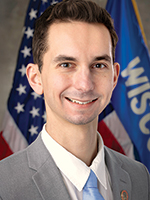
Photo of Ryan Spaude
D Wisconsin House · District 89 On the 2026 ballot

Rep. Ryan Spaude

Compare
Total votes
233
all sessions
Attendance
95%
12 missed
Near the chamber average
With party
91%
of cast votes
Lower than 95% of chamber peers
Bipartisan score
4%
crosses aisle rarely
Higher than 93% of chamber peers
Sponsored
114
bills & resolutions
Near the chamber average
Committees
3
assignments
114 bills and resolutions

Sponsored bills

Total
114
Primary
114
Co-sponsor
0
This page
114
matching current filters
Primary AB 999
Failed · Wisconsin House · Lead sponsor
Relating to: collective bargaining for employees of the University of Wisconsin Hospitals and Clinics Authority.

Maddy summaryAB 999 clarifies that employees of the University of Wisconsin Hospitals and Clinics Authority (UWHCA) are covered under collective bargaining agreements. The bill amends specific statutes (including 40.02, 40.05, and 111.02) to explicitly include UWHCA employees in provisions governing union dues, sick leave conversion, and bargaining unit structures. This ensures UWHCA staff have the same collective bargaining rights as other state employees covered under Chapter 111. The changes directly affect UWHCA employees by integrating them into existing labor frameworks without creating new rights. The bill focuses on administrative alignment within current state labor laws.

Failed Mar 23, 2026 0 co-sponsors
Primary AB 1018
Failed · Wisconsin House · Lead sponsor
Relating to: income eligibility for Wisconsin Shares child care subsidy and making an appropriation. (FE)

Maddy summaryThis bill expands eligibility for Wisconsin's child care subsidy program (Wisconsin Shares) by allowing families with incomes above 200% of the federal poverty line but below 100% of the state median income to continue receiving subsidies. It creates a new eligibility pathway (20.437 (2) (ct)) to cover families previously disqualified due to income thresholds and adjusts copayment rules for those exceeding income limits. The policy directly affects low-income working families who lost subsidies due to modest income increases but remain below the new 100% state median income cutoff. A $1.25 million appropriation for fiscal year 2026-27 funds this expansion.

Failed Mar 23, 2026 0 co-sponsors
Primary AB 1017
Failed · Wisconsin House · Lead sponsor
Relating to: child care subsidies for custodial parents who are child care employees and making an appropriation. (FE)

Maddy summaryAB 1017 creates a new child care subsidy program specifically for custodial parents who work as employees in child care facilities. It allows these parents to qualify for subsidies under revised eligibility rules, bypassing standard income and asset requirements that typically apply to other subsidy recipients. The bill appropriates $1.2 million in fiscal year 2025-26 for administrative costs related to this new program. This directly affects parents employed by child care providers who have primary custody of children under 13 (or 19 if disabled) and meet the new eligibility criteria.

Failed Mar 23, 2026 0 co-sponsors
Primary AJR 136
Failed · Wisconsin House · Lead sponsor
Relating to: the right to privacy (first consideration).

Maddy summaryAJR 136 is a proposed constitutional amendment that would add a new Section 1m to Article I of the state constitution, stating: "As a necessary part of a free society, the people have an individual and fundamental right to privacy." This resolution, introduced by multiple assembly members and senators, would establish this privacy right as a fundamental constitutional protection for all residents. The bill requires voter approval at the next general election, as it must be referred to voters following a three-month publication period. It does not create immediate legal requirements but proposes a foundational constitutional change.

Failed Mar 23, 2026 0 co-sponsors
Primary AB 1030
Failed · Wisconsin House · Lead sponsor
Relating to: increasing the earned income tax credit for families with fewer than three children. (FE)

Maddy summaryAB 1030 increases the state earned income tax credit for low-income working families with fewer than three children. Starting in 2026, eligible individuals will receive a credit equal to 34% of the federal earned income credit (if they have children) or 15% (if they have no children), up from previous rates. This policy directly benefits qualifying working adults and families who earn below certain income thresholds. The change applies to tax returns filed for years beginning after December 31, 2025.

Failed Mar 23, 2026 0 co-sponsors
Primary AB 1015
Failed · Wisconsin House · Lead sponsor
Relating to: Wisconsin Shares copayment amounts and making an appropriation. (FE)

Maddy summaryAB 1015 adjusts Wisconsin Shares child care assistance copayment rules and increases funding. It limits copayments to no more than 7% of a family’s gross income (49.155 (5) (ag)) and waives copayments entirely for families earning below 150% of the federal poverty line (49.155 (5) (ar)). The bill also increases annual funding for child care subsidies by $22.93 million for fiscal years 2025-26 and 2026-27. These changes directly affect low-income families using Wisconsin Shares child care assistance.

Failed Mar 23, 2026 0 co-sponsors
Primary AB 1050
Failed · Wisconsin House · Lead sponsor
Relating to: local regulation of the short-term rental of residential dwellings.

Maddy summaryAB 1050 repeals restrictions that previously limited local governments' ability to regulate short-term residential rentals (like Airbnb). It removes specific provisions that capped the number of days a property could be rented annually and eliminated other barriers to local rulemaking. This bill directly affects cities, towns, and counties (political subdivisions), allowing them to establish their own rules for short-term rentals without these state-imposed limits. The key change is enabling local governments to create comprehensive regulations for short-term rental operations without state-mandated restrictions.

Failed Mar 23, 2026 0 co-sponsors
Primary AB 859
Failed · Wisconsin House · Lead sponsor
Relating to: the reimbursement rate for special education costs and school age parents programs and making an appropriation. (FE)

Maddy summaryAB 859 adjusts the state reimbursement rate for special education and school-age parent program costs. It sets the reimbursement rate at 42% of eligible costs for the 2025-26 school year, increasing to 45% for the 2026-27 school year and all subsequent years. The bill applies to costs covered under sections 115.88(1m)-(3), (6), (8), 115.93, and 118.255(4), which include services for students in hospitals, convalescent homes, and school programs. This change directly affects school districts and programs providing these services by altering the state's financial contribution toward their expenses. The bill amends statutes to ensure state funds are distributed according to these revised percentages.

Failed Mar 23, 2026 0 co-sponsors
Primary AB 921
Failed · Wisconsin House · Lead sponsor
Relating to: cost-sharing cap on insulin.

Maddy summaryAB 921 establishes a $35 monthly cap on out-of-pocket costs for insulin under disability insurance policies and self-insured health plans. It directly affects people with diabetes who rely on these specific insurance types for insulin coverage. The bill prohibits insurers from charging more than $35 for a one-month supply of insulin, covering all cost-sharing elements like deductibles and copays. This policy change applies to existing coverage requirements without altering other insurance benefits or mandates. The bill is pending in the 2026 Wisconsin Legislature.

Failed Mar 23, 2026 0 co-sponsors
Primary AB 974
Passed · Wisconsin House · Lead sponsor
Relating to: a public affairs network trust fund, grants to the WisconsinEye Public Affairs Network, and making an appropriation. (FE)

Maddy summaryAB 974 establishes a permanent "public affairs network fund" to provide annual grants to WisconsinEye, the public affairs network broadcasting state government proceedings. The bill creates a new trust fund using state appropriations, donations, and interest earnings, which will fund WisconsinEye’s operating costs for live broadcasts, civic events, and free online archives of unedited government proceedings. WisconsinEye must meet specific requirements, including appointing legislative designees to its board, focusing coverage on official government business, and providing continuous free public access to broadcasts and archives. If WisconsinEye ceases operations, it must repay all grant funds to the state and transfer its archives to the state historical society.

Passed Mar 23, 2026 0 co-sponsors
Showing 21 to 30 of 114 bills
Previous 1 2 3 4 12 Next