

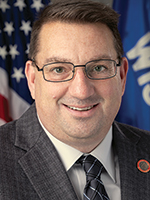
Photo of Dave Maxey
R Wisconsin House · District 83 On the 2026 ballot

Rep. Dave Maxey

Compare
Total votes
421
all sessions
Attendance
99%
5 missed
Near the chamber average
With party
98%
of cast votes
Near the chamber average
Bipartisan score
1%
crosses aisle rarely
Near the chamber average
Sponsored
390
bills & resolutions
Near the chamber average
Committees
7
assignments
390 bills and resolutions

Sponsored bills

Total
390
Primary
390
Co-sponsor
0
This page
390
matching current filters
Primary AB 1042
Failed · Wisconsin House · Lead sponsor
Relating to: driving skills tests for certain drivers. (FE)

Maddy summaryAB 1042 requires drivers aged 75 and older to pass a driving skills test before turning 76 and every five years thereafter. The test evaluates their ability to safely operate a motor vehicle. The state must provide testing at county-level locations for this age group. This applies to license renewals and replaces prior requirements for seniors under the existing statutes.

Failed Mar 23, 2026 0 co-sponsors
Primary AB 1053
Failed · Wisconsin House · Lead sponsor
Relating to: the state or federal benefits of a child in out-of-home care. (FE)

Maddy summaryAB 1053 ensures that children in out-of-home care (like foster care) retain control over their state or federal benefits. It requires child welfare departments to hold these benefits in protected accounts that won’t reduce other benefits, provide regular financial reports to the child and their legal representatives, and return any remaining funds when the child leaves care. The bill explicitly prohibits using a child’s benefits to cover their care costs. This policy change directly affects children in state custody and their legal representatives, focusing on financial accountability and preserving benefits for the child’s future.

Failed Mar 23, 2026 0 co-sponsors
Primary AB 1081
Failed · Wisconsin House · Lead sponsor
Relating to: modifying administrative rules relating to regulation of opioid treatment programs and requiring adjustments to the rates for substance use disorder treatment services with medications for opioid use disorder. (FE)

Maddy summaryAB 1081 adjusts payment rates for opioid treatment programs using medication-based care to match Medicare rates for comparable services starting in 2027. It also sets new staffing requirements, including a medical director with addiction medicine experience who must be present 40% of dosing time (reduced to 20% for the first 60 days of operation), and mandates one counselor for every 55 enrolled patients. The bill changes admission rules for minors, requiring documented failed detox attempts and written parental consent, while adding requirements for initial physical exams and Hepatitis/HIV testing with patient consent. These provisions directly affect all Wisconsin opioid treatment programs providing medication-assisted therapy.

Failed Mar 23, 2026 0 co-sponsors
Primary AB 1078
Failed · Wisconsin House · Lead sponsor
Relating to: creating an innovation grant program for institutions of higher education and making an appropriation. (FE)

Maddy summaryAB 1078 creates a $5 million biennial grant program for Wisconsin's private nonprofit colleges (specifically those in the Wisconsin Association of Independent Colleges and Universities) to fund new academic programs or public infrastructure projects addressing workforce needs. Institutions must provide matching funds equal to the grant amount and demonstrate a self-sustaining revenue plan after program launch. The program limits any single institution to no more than 10% of total grant funds awarded. The bill establishes this program through new statutory sections and appropriates funds for the 2025-26 and 2026-27 fiscal years.

Failed Mar 23, 2026 0 co-sponsors
Primary AB 1062
Failed · Wisconsin House · Lead sponsor
Relating to: prohibited employment for former members of the Public Service Commission.

Maddy summaryAB 1062 prohibits former members of the Public Service Commission from working for 36 months with investor-owned public utilities or transmission companies in roles involving policy-making, executive decisions, operations management, or government relations. It directly affects former commissioners who seek employment in these specific high-level positions within utility companies. The law applies retroactively to those who left the Commission within the 12 months before the bill's effective date. This restriction aims to prevent potential conflicts of interest by limiting immediate post-Commission employment in regulated utility sectors.

Failed Mar 23, 2026 0 co-sponsors
Primary AB 1079
Failed · Wisconsin House · Lead sponsor
Relating to: creating an undergraduate assistance grant program for students enrolled in private nonprofit postsecondary institutions and making an appropriation. (FE)

Maddy summaryAB 1079 creates a state-funded grant program to help Wisconsin residents attend private nonprofit colleges. It provides up to $2.5 million annually for eligible students enrolled full-time at accredited private colleges in Wisconsin, with income limits under $60,000 and requiring FAFSA completion without a federal Pell Grant. Grants cover up to 10 semesters of undergraduate study, funded through the state budget. The program targets students who don’t qualify for federal aid but meet residency and financial criteria.

Failed Mar 23, 2026 0 co-sponsors
Primary AJR 127
Failed · Wisconsin House · Lead sponsor
Relating to: prohibiting the governor from using the partial veto to create or increase any tax or fee (second consideration).

Maddy summaryAJR 127 is a proposed constitutional amendment that would prohibit the governor from using a partial veto to create or increase any tax or fee. If approved by voters, it would amend the state constitution to restrict the governor's partial veto power specifically regarding tax or fee increases. This change would directly affect the governor's authority when reviewing budget bills containing tax or fee provisions. The amendment is currently moving toward a voter referendum in November 2026, following legislative approval. It does not change current law but would require voter ratification to become effective.

Failed Mar 23, 2026 0 co-sponsors
Primary AB 848
Failed · Wisconsin House · Lead sponsor
Relating to: operation of autonomous vehicles on highways and providing a penalty.

Maddy summaryAB 848 creates an Autonomous Driving Safety Board within the Department of Transportation to regulate autonomous vehicle operations on state highways. Operators must obtain a board-approved permit, requiring a public hearing, a two-thirds board vote for approval, and adherence to safety standards like maintaining financial responsibility for damages. The bill sets a lower blood alcohol limit (0.02%) for autonomous vehicle operators and prohibits operation on interstate highways. Violating the permit requirement carries a $1,000 penalty, while operators must submit annual safety reports detailing traffic interactions and incident data.

Failed Mar 23, 2026 0 co-sponsors
Primary AJR 129
Failed · Wisconsin House · Lead sponsor
Relating to: recognizing February 6 as Ronald Reagan Day in Wisconsin.

Maddy summaryAJR 129 is a symbolic resolution designating February 6 as "Ronald Reagan Day" in Wisconsin. It does not create new laws or affect specific groups; instead, it urges Wisconsin citizens to recognize this day in observance of Ronald Reagan's birthday (February 6, 1911). The resolution highlights Reagan's roles as a governor, president, and his historical impact, including economic policies and Cold War contributions. As a commemorative measure, it has no binding effect beyond encouraging public acknowledgment of Reagan's legacy.

Failed Mar 23, 2026 0 co-sponsors
Primary AB 840
Passed · Wisconsin House · Lead sponsor
Relating to: certain requirements related to data centers.

Maddy summaryAB 840 regulates data centers in the state by requiring specific operational and environmental standards. It mandates that data centers use closed-loop cooling systems (recycling water instead of using fresh water) and report annual water usage to the department. The bill also requires renewable energy facilities serving data centers to be located on-site and prohibits utility customers from paying for data center infrastructure costs. Additionally, operators must provide financial bonds for construction and restore land if projects are abandoned. These provisions directly affect all data center operators and developers in the state.

Passed Mar 23, 2026 0 co-sponsors
Showing 51 to 60 of 390 bills
Previous 1 5 6 7 39 Next