

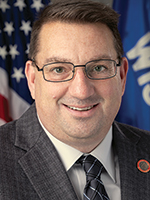
Photo of Dave Maxey
R Wisconsin House · District 83 On the 2026 ballot

Rep. Dave Maxey

Compare
Total votes
421
all sessions
Attendance
99%
5 missed
Near the chamber average
With party
98%
of cast votes
Near the chamber average
Bipartisan score
1%
crosses aisle rarely
Near the chamber average
Sponsored
390
bills & resolutions
Near the chamber average
Committees
7
assignments
390 bills and resolutions

Sponsored bills

Total
390
Primary
390
Co-sponsor
0
This page
390
matching current filters
Primary AB 958
Signed into law · Wisconsin House · Lead sponsor
Relating to: position authorizations for Internet crimes against children law enforcement. (FE)

Maddy summaryAB 958 authorizes the Department of Justice to add three new positions specifically for its Internet Crimes Against Children (ICAC) unit: two criminal analyst roles, one outreach specialist, and one digital evidence examiner. These positions are funded through existing appropriations under section 20.455(2)(a). The bill directly affects the ICAC unit’s staffing capacity to investigate and respond to online crimes involving children. It does not create new laws or policies but adjusts personnel authorizations to support existing law enforcement efforts. The bill was introduced in the 2026 Legislature and referred to the Criminal Justice and Public Safety Committee.

Signed into law Apr 9, 2026 0 co-sponsors
Primary AB 964
Signed into law · Wisconsin House · Lead sponsor
Relating to: Internet crimes against children administrative subpoenas for the crime of sexual extortion when the crime victim is a child. (FE)

Maddy summaryAB 964 clarifies that online sexual extortion targeting children falls under existing law by specifying it as a violation of Section 942.095 when the victim is a child (as defined in Section 948.01). This bill directly affects law enforcement agencies investigating internet crimes against children, enabling them to issue administrative subpoenas to internet companies for relevant data without a court order. The key provision streamlines the process for obtaining evidence from online platforms in cases where children are victims of sexual extortion. It does not create new penalties but ensures these cases are explicitly covered under current statutes for investigative efficiency.

Signed into law Apr 9, 2026 0 co-sponsors
Primary AB 374
Signed into law · Wisconsin House · Lead sponsor
Relating to: compliance with the federal Electoral Count Reform Act. (FE)

Maddy summaryAB 374 updates election procedures to align with the federal Electoral Count Reform Act. It modifies deadlines for handling ballots and canvassing results, requiring municipal clerks to deliver presidential election ballots to county clerks by 9 a.m. on the Saturday after the election (instead of Monday). The bill also clarifies processes for reconciling absentee and in-person ballots to prevent double-voting and mandates public canvassing of election results by specific deadlines, including a 5 p.m. Friday deadline for presidential elections. These changes directly affect local election officials managing municipal and presidential elections.

Signed into law Apr 9, 2026 0 co-sponsors
Primary AB 984
Failed · Wisconsin House · Lead sponsor
Relating to: requirements for the use of a memory care designation by community-based residential facilities. (FE)

Maddy summaryAB 984 sets new standards for community-based residential facilities that use the "memory care" designation in their name, advertising, or communications. It requires these facilities to serve only individuals with irreversible dementia (like Alzheimer’s) and to provide mandatory staff training on dementia care. The training must cover dementia basics, person-centered care, communication techniques, non-drug behavioral interventions, and supporting residents’ independence - both for initial hiring and annually thereafter. These requirements take effect July 1, 2027, with existing facilities needing compliance by that date to continue using the designation.

Failed Apr 7, 2026 0 co-sponsors
Primary AB 131
Signed into law · Wisconsin House · Lead sponsor
Relating to: programs and requirements to address PFAS.

Maddy summaryAB 131 establishes a municipal grant program to test for PFAS (perfluoroalkyl and polyfluoroalkyl substances) in public water systems and fund source reduction measures. It allows water utilities to use customer service fees to cover up to half the cost of PFAS source reduction for connected customers, if cheaper than facility upgrades. The bill also creates eligibility rules for disadvantaged communities extending service due to PFAS contamination and directs PFAS contamination claims to an existing landowner grant program. These provisions directly affect municipal water systems, public utilities, and communities addressing PFAS in drinking water.

Signed into law Apr 6, 2026 0 co-sponsors
Primary AB 130
Signed into law · Wisconsin House · Lead sponsor
Relating to: exempting certain persons from PFAS enforcement actions under the spills law. (FE)

Maddy summaryAB 130 exempts specific groups from certain PFAS enforcement actions under Wisconsin's spills law if they allow the state to clean up contaminated land at no cost to them. It directly affects landowners, fire departments, airports, wastewater spreaders, and waste facilities that handled PFAS-contaminated materials legally. The bill creates exemptions for those who spread permitted biosolids, owned land where such spreading occurred, used PFAS in emergency response (per federal rules), accepted PFAS waste, or own property not responsible for the contamination origin. This applies only to enforcement sections related to PFAS contamination under the spills law, not all PFAS regulations.

Signed into law Apr 6, 2026 0 co-sponsors
Primary AB 905
Signed into law · Wisconsin House · Lead sponsor
Relating to: threats to health care providers and providing a penalty.

Maddy summaryAB 905 creates a new penalty for threatening healthcare providers, staff, or their family members when the threat is related to their work. It specifically targets threats made knowing the victim is a healthcare worker (current or former) or a family member, and the threat occurs in response to actions taken at a healthcare facility or by a provider acting in their official capacity. The bill defines "health care facility" and "health care provider" using existing statutory terms to clarify the scope of protection. This law directly affects healthcare workers and their families by establishing criminal penalties for targeted threats connected to their professional roles.

Signed into law Apr 3, 2026 0 co-sponsors
Primary AB 768
Signed into law · Wisconsin House · Lead sponsor
Relating to: operation of drones over certain utility facilities and providing a penalty.

Maddy summaryAB 768 restricts drone operations near critical utility facilities by prohibiting flights below 300 feet within 500 feet of water reclamation plants, power plants/substations, telecom facilities, or public water systems. Exceptions allow facility owners, local governments, and commercial operators (complying with FAA rules) to operate drones for maintenance, inspections, or official business. The bill also requires law enforcement to seize drone footage during violations and transfer it to relevant local agencies for enforcement. This directly affects drone operators near these infrastructure sites while aiming to protect public safety and facility security.

Signed into law Apr 3, 2026 0 co-sponsors
Primary AB 320
Signed into law · Wisconsin House · Lead sponsor
Relating to: increasing certain court fees and surcharges and indexing those amounts for inflation. (FE)

Maddy summaryAB 320 increases multiple court filing fees and requires these fees to be adjusted for inflation starting in 2030. It raises specific fees, such as the civil filing fee from $75 to $190 and the criminal case fee from $163 to $239, with future adjustments tied to the U.S. consumer price index. These changes directly affect individuals filing court cases (e.g., defendants in criminal matters, plaintiffs in civil or family cases) who pay these fees. The bill mandates that fee amounts be recalculated every five years based on inflation data, rounded up to the nearest dollar, and posted online by the state courts director. The adjustments apply to over 20 specific fee categories across criminal, civil, and family court proceedings.

Signed into law Apr 3, 2026 0 co-sponsors
Primary AB 679
Signed into law · Wisconsin House · Lead sponsor
Relating to: weight limits for vehicles transporting grain, feed, or commercial fertilizer. (FE)

Maddy summaryAB 679 creates a new permit system for trucks carrying grain, feed, or commercial fertilizer that exceed standard weight limits. It allows vehicles with 6 or more axles to operate at up to 91,000 pounds gross weight on state highways, provided they meet axle weight distribution rules and follow department-specified routes. The bill directly affects agricultural haulers and trucking companies transporting these materials, requiring a $325 permit for such operations. Permits are invalid on interstate highways (except as permitted by federal law) and may be suspended during spring thaw conditions. This bill does not change base weight limits but establishes a regulated pathway for heavier agricultural transport.

Signed into law Apr 2, 2026 0 co-sponsors
Showing 31 to 40 of 390 bills
Previous 1 3 4 5 39 Next