

Maddy summaryAB 481 repeals Section 104.001 of the statutes, which currently allows local governments to establish minimum wage rates higher than the state minimum. This bill would eliminate the legal authority for cities and counties to set their own local minimum wage ordinances. As a result, only the state-level minimum wage would apply uniformly across all jurisdictions. The bill does not create new wage requirements or affect existing state minimum wage rates.
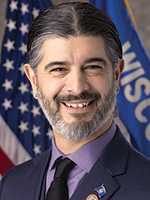
Rep. Vinnie Miresse
Sponsored bills
Maddy summaryAB 534 requires public high schools to offer voter registration during regular school days for enrolled students and school staff. It creates a process where schools appoint "school registration deputies" to collect forms, which are then sent to the local election office; students who register as minors will be automatically added to the voter rolls when they turn 18. Private or tribal high schools with many local students may also participate if they request it. The bill directly affects high school students (especially those approaching voting age) and school staff by expanding access to voter registration at school locations.
Maddy summaryAB 404 establishes and funds the Veterans Outreach and Recovery Program, which provides direct support services to veterans in need. The bill appropriates state funds to cover outreach, counseling, and recovery resources for veterans facing challenges like homelessness, mental health issues, or unemployment. It directly affects veterans seeking these services and the state agencies or community organizations delivering them. The program’s implementation is contingent on the approved budget allocation, with no policy changes beyond the funding mechanism. As a fiscal bill, it focuses on resource allocation rather than new legal requirements.
Maddy summaryAB 504 requires property tax bills to include specific information about state aid reductions for school districts. It mandates disclosing the dollar amount and percentage change in state aid reductions from the previous year to the current year, and explicitly identifies if reductions resulted from enrollment in choice programs (like Milwaukee or Racine Choice) or special needs scholarships. School districts receiving reduced aid must also note that they could raise property taxes to offset the loss. This applies only when an actual aid reduction occurs, not every year. The bill aims to provide property owners with clear, transparent details about how state funding changes affect their local schools.
Maddy summaryAB 533 requires all public K-12 schools in the state to incorporate at least one hour of voter education annually into the social studies curriculum, effective July 1, 2026. It mandates age-appropriate content: elementary students learn election basics, voting importance, and mock elections, while high school students receive instruction on voter registration, absentee ballots, military/student voting procedures, and accessing official election resources. The bill updates state social studies standards to include these requirements and applies to all public schools, including charter schools, through curriculum adjustments. This policy directly affects students, educators, and school districts by embedding civic education into standard coursework.
Maddy summaryAB 31 gives farmers and businesses who buy or lease new farm equipment clear rights when warranty issues can't be fixed. If a farm implement has a warranty problem that remains unresolved after four repair attempts or 30 total days out of service, the buyer or lessee can choose a replacement machine or a full refund. The bill requires manufacturers to cover related costs like alternative equipment rentals during repairs. This applies to new equipment purchased from authorized dealers or leased under written agreements, directly affecting agricultural equipment consumers.
Maddy summaryAB 585 designates the wild turkey (*meleagris gallopavo*) as Wisconsin's official state game bird and the ruffed grouse (*bonasa umbellus*) as the state upland game bird. The bill amends Wisconsin statutes to add these specific designations to the list of official state symbols included in the Wisconsin Blue Book. This is a ceremonial, non-regulatory change that formally recognizes these birds as state symbols without altering laws or affecting public policy. The bill does not impose new requirements, fund programs, or impact citizens or wildlife management. It follows standard procedure for designating state symbols through legislative action.
Maddy summaryAB 586 amends Wisconsin statutes to clarify and strengthen shared governance at University of Wisconsin System institutions by defining the roles of faculty, academic staff, and students in institutional decision-making. The bill requires faculty to ensure STEM disciplines are represented in governance structures, gives academic staff the right to organize and advise on policies affecting them, and ensures students actively participate in policies related to student life and fee management. Key provisions specify that faculty have primary responsibility for academic matters, academic staff for their own policies, and students for advising on campus life and fee use. These changes directly affect all faculty, academic staff, and students across UW System campuses by formalizing their participation in governance and policy development.
Maddy summaryAB 495 adjusts Wisconsin's school funding system to protect districts from funding cuts between 2024 and 2025. It creates a "supplemental hold harmless aid" provision (20.255(2)(ab)) to ensure districts receiving higher state aid in 2024 retain that level in 2025-26. The bill also modifies per-pupil revenue limits, adding $325 for the 2023-24 and 2024-25 school years, and increases state funding appropriations by $493.8 million for 2025-26 and $699.9 million for 2026-27. These changes directly affect public school districts receiving state equalization aid.
Maddy summaryAB 371 allows first-class cities to use automated red-light cameras at intersections with high accident rates (1.0+ annually over 5 years). It requires cities to place warning signs, capture images focused on license plates from behind, and limit camera use to no more than five intersections per city council district. Vehicle owners, not drivers, are liable for violations (like running red lights), with fines collected funding traffic safety programs - not general city budgets. Exceptions include stolen vehicles (reported within 7 days) or rentals/dealerships that provide lessee/operator details.