

Maddy summaryAB 809 prohibits state and local government funding for investigations into pregnancy outcomes (like miscarriage or stillbirth) when treating the person as a crime suspect. It bans law enforcement from investigating individuals as suspects solely due to their own pregnancy outcomes, requiring consent before investigating cases involving others' pregnancy outcomes. The bill exempts women from civil or criminal liability for pregnancy outcomes (including miscarriage, abortion, or stillbirth) and amends statutes to clarify that abortion-related legal protections apply. It directly affects women experiencing pregnancy outcomes, law enforcement agencies, and health services (with limited exceptions for health investigations). The bill creates new legal protections by restricting investigations and eliminating liability for pregnancy-related events.
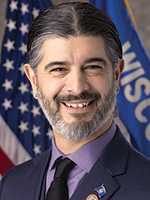
Rep. Vinnie Miresse
Sponsored bills
Maddy summaryAB 805 creates a program to reimburse corn farmers for seed coating that deters sandhill cranes from eating corn seeds. Eligible farmers must have produced at least $6,000 in gross farm revenue the previous year and plant corn on agricultural land. The program covers up to 50% of seed coating costs (max $6,250 per farmer per planting season), prioritizing farmers with prior crane permits, recent reimbursement, or documented vulnerability to crane damage. It is funded by a $1.875 million annual appropriation for two years to cover reimbursements and administrative costs.
Maddy summaryAB 811 creates a $25 million annual grant program for businesses opening new locations or expanding into vacant commercial spaces, administered by the Wisconsin Economic Development Corporation (WEDC). It directly affects eligible businesses in commercial districts, continuing a similar program from June 2023 while explicitly excluding nonprofit organizations from receiving grants. The bill allocates $25 million for the 2025-26 and 2026-27 fiscal years to fund these "Main Street Bounceback Grants" through WEDC's existing grant framework. Key provisions require WEDC to follow eligibility rules nearly identical to the prior "Wisconsin Tomorrow" program, focusing on revitalizing underutilized commercial properties.
Maddy summaryAB 798 requires the Department of Transportation (DMV) to ask applicants for driver's licenses or ID cards whether they want to provide contact information for up to three primary caregivers during the application process. If provided, the DMV stores this information securely in the applicant's file. Law enforcement agencies can electronically request and access this caregiver information (along with emergency contacts from another law section) during emergencies, but the DMV cannot share it with anyone else. The bill aims to improve emergency contact access while maintaining privacy protections for applicants.
Maddy summaryAB 797 creates a $2.5 million grant program to help counties, cities, and towns test privately owned wells for water quality and map well locations. It provides up to $10,000 per grant for well testing, groundwater assessment, and geologic studies, plus separate grants for county health departments to offer well-testing education. The bill also requires municipalities with private wells to inform residents about testing importance and exempts the department from standard emergency rule procedures for implementing this program. The law appropriates funds for fiscal years 2025-26 and 2026-27 to support these concrete actions.
Maddy summaryAB 804 establishes two new grant programs: a $200,000 annual "Farm to Fork" grant for non-school entities (like businesses, hospitals, or universities with cafeterias) to connect local farms with food service operations, and a $250,000 annual "Farm to School" grant for school districts to expand local food sourcing. The bill prioritizes innovative proposals, high-need schools (where many students qualify for free/reduced meals), and projects supporting value-added agricultural products. It requires the Agriculture Department to administer the grants, provide annual legislative reports, and create rules for implementation. The legislation also adds one dedicated staff position to manage the Farm to Fork program.
Maddy summaryAB 796 creates a $5 million annual grant program to help nonprofit religious organizations improve security. It directly affects religious groups facing bias-motivated threats or crime, prioritizing those at higher risk. Grants can cover physical security upgrades (like surveillance or fencing), staff/volunteer training, or emergency planning. No single organization can receive more than $500,000 per biennium, though umbrella groups may apply for multiple members. The program is administered by the Department of Military Affairs with additional staffing.
Maddy summaryAB 755 requires health insurance plans to cover sterilization procedures and related patient education/counseling services, just like other contraceptive benefits. This directly affects health insurers and patients seeking these specific reproductive health services. The bill amends existing law to explicitly include sterilization procedures and counseling under the same coverage requirements applied to other contraceptive services. It applies to new policy years beginning after the effective date, with some exceptions for collective bargaining agreements.
Maddy summaryAB 776 allocates $5 million in state funds to expand veterans' access to mental health services. It requires the Department of Veterans Affairs to promote community-based mental health care and provide grants to organizations offering these services to veterans, including emergency crisis support. The bill streamlines implementation by allowing the department to issue emergency rules without standard public notice requirements. This directly affects veterans seeking mental health care and the community organizations delivering these services. The legislation creates new statutory provisions (45.49) to formalize this program.
Maddy summaryAB 807 creates a new "office of board counsel" in counties that already have a corporation counsel (including jointly designated counsel) and a county executive or administrator. This office, appointed by the county board and staffed by licensed attorneys, provides independent legal advice and services specifically to the county board itself. The bill establishes this role as separate from existing corporation counsel, allows the county board to leave the position unfilled, and specifies that board counsel serves "at the pleasure of the county board." This is a procedural change affecting county governance structures, not a policy impacting residents or taxpayers.