

Maddy summaryAB 1022 establishes a "baby bond program" that creates a state trust fund to provide financial support for newborns. The bill requires sharing birth record information (excluding Social Security numbers) with the Department of Financial Institutions, which opens a baby bond account for each eligible child at birth. Funds in the account can be used later for specific eligible expenses like postsecondary education, home purchases, business startup, or retirement savings (as defined in §224.58). The program is funded through an annual $150,000 state appropriation, donations, and investment earnings from the baby bond fund. It directly affects all newborns in the state whose birth records are processed under the new requirements.
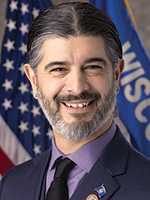
Rep. Vinnie Miresse
Sponsored bills
Maddy summaryAB 790 creates a dedicated "Water Fund for Our Future" with an initial $250 million transfer from the general fund. The fund establishes a rapid response account to cover clean water-related costs during natural disasters or public health emergencies, including remediation and assistance for affected individuals. A new joint committee oversees fund spending, reviewing requests for funding (excluding non-clean-water uses) and recommending approvals to the finance committee. All funds must be used exclusively for clean water activities, with specific rules for disbursement and oversight.
Maddy summaryThis bill requires motorboats with enclosed living spaces to be equipped with carbon monoxide detection systems and warning stickers to protect occupants from dangerous gas exposure. It mandates that the state provide free safety information and stickers when registering cabin motorboats, while also requiring dealers to ensure new boats meet these safety standards before sale. The legislation establishes specific penalties for operating or selling non-compliant boats, with fines up to $500 for first offenses and up to $300 for repeat violations. These rules apply to boats sold, registered, or operated on the bill's effective date.
Maddy summaryThis bill proposes changing the fee for the inland waters trout stamp from $9.75 to $15.75. It directly affects anglers who purchase this stamp to fish for trout in inland waters. The change is made by amending the relevant section of the state statutes. The bill was introduced in 2026 but failed to pass during the legislative session.
Maddy summaryThis bill creates a new category called "very large customer" for electric utilities and gives the state commission authority to define who qualifies for this class. It requires electric utilities to file rate applications every other year for these customers and mandates that the commission review whether the rates charged are fair and not discriminatory. The commission will also develop specific rules to ensure utilities properly justify how rates cover the costs of serving these large customers. If rates are found to be unreasonable or unfairly discriminatory, the commission can adjust them or modify service terms accordingly.
Maddy summaryThis bill establishes a comprehensive clean energy framework requiring Wisconsin to achieve 100 percent clean electricity production and net-zero carbon emissions by 2050. It creates a new Office of Sustainability and Clean Energy within the Department of Administration to develop and update an economy-wide decarbonization roadmap using sector-based modeling. The legislation sets specific interim targets for carbon-free electricity, including 50 percent by 2030, 65 percent by 2035, 80 percent by 2040, 90 percent by 2045, and full carbon-free status by 2050. State agencies must consider purchasing renewable energy from providers with long-term contracts, though the requirements do not apply if generation is not technically feasible or cost-effective. The bill also provides funding for technology implementation and defines carbon-free resources to include hydroelectric power alongside other renewable sources.
Maddy summaryAB 1070 limits county and state agency regulations on shoreland property maintenance. It prohibits counties from requiring approvals, fees, or restrictions for repairing, replacing, or remodeling existing structures (without expanding their footprint) or for vertical expansions under specific conditions. The bill creates a new provision (59.692(1k)(ag)) allowing counties to charge fees for these activities, while repealing prior restrictions on such fees. It directly affects landowners with properties near shorelines who seek to maintain or repair existing structures without expanding them.
Maddy summaryAB 890 allows healthcare providers to administer medically appropriate vaccines to minors aged 16 or older without parental consent if the minor requests it. The bill requires providers to obtain the minor’s consent before billing third parties for the vaccination; if the minor declines third-party billing, they pay directly and the department bills them per existing fee rules. This directly affects minors aged 16+ seeking vaccinations, healthcare providers, and billing processes for such services. The policy changes focus on expanding minor autonomy for specific vaccinations while maintaining clear billing requirements.
Maddy summaryAB 966 requires the Department of Justice to create and run a public awareness campaign focused on children's online safety. The campaign must use digital platforms (like the department’s website and social media) and print materials to educate families about internet risks and prevention steps for children. It specifically mandates that the Department provide free educational materials to schools (as defined in statute 118.257(1)(d)) upon request. The bill directly affects children and schools by promoting accessible resources to help prevent exposure to harmful online content.
Maddy summaryAB 957 increases funding by $400,000 for each of the 2025-26 and 2026-27 fiscal years to support internet crimes against children law enforcement within the Department of Justice. This is a budget adjustment that directly affects the Department of Justice's resources for investigating and prosecuting online crimes targeting minors. The bill does not create new laws or change existing legal standards - it solely allocates additional state funds for enforcement efforts.