

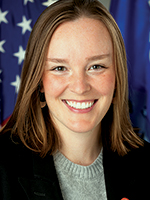
Photo of Greta Neubauer
D Wisconsin Assembly · District 66 On the 2026 ballot

Rep. Greta Neubauer

Compare
Total votes
704
all sessions
Attendance
98%
13 missed
Near the chamber average
With party
98%
of cast votes
Near the chamber average
Bipartisan score
1%
crosses aisle rarely
Near the chamber average
Sponsored
943
bills & resolutions
Near the chamber average
Committees
7
assignments
943 bills and resolutions

Sponsored bills

Total
943
Primary
943
Co-sponsor
0
This page
943
matching current filters
Primary AB 759
Signed into law · Wisconsin Assembly · Lead sponsor
Relating to: eligibility to receive occupational credentials for recipients of deferred action under the Deferred Action for Childhood Arrivals program. (FE)

Maddy summaryAB 759 allows individuals with deferred action under the federal DACA program to obtain state occupational licenses (like nursing or cosmetology credentials) if they have valid federal work permits. It requires state licensing agencies to verify DACA recipients' federal work authorization through official systems before issuing licenses. Licenses issued under this law expire when the federal work permit expires, and recipients must renew both simultaneously. The bill explicitly states it does not grant eligibility for public benefits beyond occupational credentials.

Signed into law Apr 9, 2026 0 co-sponsors
Primary AB 194
Signed into law · Wisconsin Assembly · Lead sponsor
Relating to: modifications to housing programs under the Wisconsin Housing and Economic Development Authority. (FE)

Maddy summaryAB 194 modifies Wisconsin's housing programs under the Wisconsin Housing and Economic Development Authority. It redefines "developer" to include tribal housing authorities (Section 3) and clarifies "residential housing" to include tax-exempt reservation or trust lands (Section 4). The bill reduces maximum loan limits for housing projects from 33% to 20% of development costs (Section 10) and from 25% to 10% (Section 11). It also requires local governments to submit cost-reduction analyses showing how zoning or fee changes lowered housing costs (Section 7), directly affecting developers, tribal entities, and local governments administering housing programs.

Signed into law Apr 9, 2026 0 co-sponsors
Primary AB 1168
Failed · Wisconsin Assembly · Lead sponsor
Relating to: medical debt abolition and making an appropriation. (FE)

Maddy summaryThis bill establishes a program to eliminate medical debt for eligible Wisconsin residents by creating a $10 million annual appropriation for the Department of Health Services to purchase and cancel outstanding medical bills. To qualify, residents must either have household income at or below 400 percent of the federal poverty line or owe medical debt equal to at least 5 percent of their annual household income. The department will identify eligible individuals, negotiate with healthcare providers and debt collectors to buy their outstanding balances, and then formally abolish the debt while minimizing tax consequences for recipients. The program prioritizes purchasing debt from providers serving low-income populations and those in areas disproportionately affected by medical debt, with annual reporting required to track the number of debts eliminated and demographic information of affected residents.

Failed Apr 8, 2026 0 co-sponsors
Primary AB 916
Failed · Wisconsin Assembly · Lead sponsor
Relating to: a home repair program and making an appropriation. (FE)

Maddy summaryAB 916 creates a state-funded home repair program to address habitability issues and improve energy efficiency in affordable housing. It provides grants of up to $25,000 per unit to eligible homeowners (income ≤100% of area median income who own or occupy their homes) and interest-free loans of up to $25,000 to eligible landlords (owning ≤5 properties/15 units of affordable housing). The program prioritizes repairs for homes with health/safety hazards, energy efficiency upgrades, and accessibility improvements for individuals with disabilities or young children. Properties must be between 10 and 40 years old to qualify, and funds are administered by the state authority or contracted counties/nonprofits with strict reporting requirements.

Failed Apr 7, 2026 0 co-sponsors
Primary AB 722
Failed · Wisconsin Assembly · Lead sponsor
Relating to: large energy customer fees; electric utility very large customer class; a renewable resource tariff; building requirements for data centers; water usage by large customers; required pay rate on large-scale data center projects; and granting rule-making authority. (FE)

Maddy summaryAB 722 imposes annual fees on large energy customers in Wisconsin based on their peak electricity demand, starting at $2 million for those using 100-250 megawatts and increasing by $1 million for each additional 250-megawatt increment. Fifty percent of these fees will fund the Green Innovation Fund, managed by the Wisconsin Economic Development Corporation. The bill also requires data centers to report annual water usage to local governments, certify adherence to sustainable building standards (like LEED or BREEAM) within three years of operation, and pay workers the prevailing wage rate for large-scale construction projects exceeding $250 million in cost. These provisions directly affect large energy users, data center operators, and local governments managing water reporting.

Failed Apr 6, 2026 0 co-sponsors
Primary AB 1155
Failed · Wisconsin Assembly · Lead sponsor
Relating to: protection of pregnant individuals’ information, authorization for disclosure, data breach, and providing a penalty.

Maddy summaryThis bill requires unregulated pregnancy centers to obtain written authorization from individuals before disclosing their personal health information, with specific requirements for what the authorization must include and how long it remains valid. The law defines unregulated pregnancy centers as facilities that do not provide abortions or emergency contraception and are not covered by existing medical privacy laws, while also establishing rules for when information can be shared without consent, such as for legal compliance or law enforcement cooperation. Centers must notify individuals if their health data is breached and face penalties for violating these privacy protections, while also being prohibited from discriminating against people who refuse to authorize information sharing. The bill creates a new section in the state statutes to establish these requirements and specifies that the law takes effect three months after publication.

Failed Mar 30, 2026 0 co-sponsors
Primary AB 1075
Failed · Wisconsin Assembly · Lead sponsor
Relating to: the age of juvenile court jurisdiction and making an appropriation. (FE)

Maddy summaryAB 1075 changes the age threshold for juvenile court jurisdiction by reclassifying 17-year-olds as adults for criminal prosecution purposes. It amends definitions to define "adult" as 17 years or older (instead of 18) for investigating and prosecuting criminal violations, while keeping 17-year-olds under juvenile court jurisdiction for specific cases. The bill also creates a new funding mechanism to reimburse counties for costs related to 17-year-olds accused of crimes starting in 2026. This directly affects 17-year-olds facing criminal charges and county juvenile justice systems managing their cases.

Failed Mar 30, 2026 0 co-sponsors
Primary AB 1142
Failed · Wisconsin Assembly · Lead sponsor
Relating to: funding for passenger rail operations and making an appropriation.

Maddy summaryThis bill proposes to increase state funding for passenger rail operations by $10 million and allocate an additional $5.2 million for feasibility studies on rail expansion projects. The funds would be directed to the department of transportation for fiscal year 2026-27 to support existing rail services and evaluate potential new routes. The legislation affects state transportation budgets and rail service providers by authorizing these specific appropriations. The bill is currently in the early stages of the legislative process and has not yet been enacted into law.

Failed Mar 26, 2026 0 co-sponsors
Primary AB 1100
Failed · Wisconsin Assembly · Lead sponsor
Relating to: a sales and use tax exemption for the sale of over-the-counter drugs. (FE)

Maddy summaryThis bill would exempt over-the-counter drugs from state sales and use taxes. It directly affects consumers purchasing non-prescription medications and retailers selling these products. The legislation defines over-the-counter drugs as those with specific labeling requirements, including a drug facts panel or a list of active ingredients. By removing the tax burden, the bill aims to lower costs for buyers of these common health products. The change would take effect on the first day of the third month after the bill is published.

Failed Mar 25, 2026 0 co-sponsors
Primary AB 1130
Failed · Wisconsin Assembly · Lead sponsor
Relating to: a premium assistance individual income tax credit and making an appropriation. (FE)

Maddy summaryThis bill creates a new state tax credit to help Wisconsin residents pay for health insurance premiums. It allows individuals who purchase qualified health plans to claim a credit on their state income tax return for the amount they would have received under federal premium assistance rules between 2021 and 2025. The credit is available only to full-year state residents who file their own tax returns and cannot be claimed if the taxpayer already qualifies for similar federal assistance. The legislation also authorizes state funds to pay any portion of the credit that exceeds the taxpayer's state tax liability.

Failed Mar 24, 2026 0 co-sponsors
Showing 11 to 20 of 943 bills