

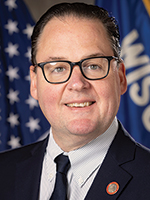
Photo of Ben DeSmidt
D Wisconsin House · District 65 On the 2026 ballot

Rep. Ben DeSmidt

Compare
Total votes
245
all sessions
Attendance
100%
of floor votes
Near the chamber average
With party
95%
of cast votes
Lower than 95% of chamber peers
Bipartisan score
2%
crosses aisle rarely
Higher than 93% of chamber peers
Sponsored
389
bills & resolutions
Near the chamber average
Committees
3
assignments
389 bills and resolutions

Sponsored bills

Total
389
Primary
389
Co-sponsor
0
This page
389
matching current filters
Primary AB 1176
Failed · Wisconsin House · Lead sponsor
Relating to: general equalization aids, the reimbursement rate for special education costs, excluding special education reimbursement from certain per pupil payments, and making an appropriation. (FE)

Maddy summaryThis bill adjusts how Wisconsin calculates and distributes state funding for special education costs and general school aid. It modifies the reimbursement rate for special education expenses, allowing the state to distribute up to 100 percent of eligible costs rather than a lower fixed percentage. The legislation also increases the general school aid appropriation for the 2026-27 fiscal year by approximately $446 million to support public school districts. These changes directly affect school districts and the state Department of Public Instruction by altering how funds are allocated and calculated for educational programs.

Failed Mar 23, 2026 0 co-sponsors
Primary AB 1178
Failed · Wisconsin House · Lead sponsor
Relating to: regional transit authorities and making an appropriation. (FE)

Maddy summaryAB 1178 amends Wisconsin statutes to update definitions and procedures for regional transit authorities, ensuring they are recognized as eligible entities for various state programs including highway relocation orders, right-of-way applications, and employer classifications for employee benefits. The bill creates new funding mechanisms by establishing appropriation accounts to collect and distribute taxes imposed by transit authorities that choose to levy them, with a portion of those revenues retained for administrative costs. Additionally, the legislation clarifies which organizations qualify as municipalities and employers under existing laws, explicitly including transit authorities created under the specified chapter while excluding cultural arts districts from certain employer definitions. This bill does not mandate tax collection but provides the legal framework for transit authorities to adopt resolutions imposing taxes if they choose to do so.

Failed Mar 23, 2026 0 co-sponsors
Primary AB 1008
Failed · Wisconsin House · Lead sponsor
Relating to: references to like-kin under the Wisconsin Shares program.

Maddy summaryAB 1008 clarifies eligibility for Wisconsin's child care subsidy program (Wisconsin Shares) by expanding "relative" definitions to include "like-kin" caregivers. It allows non-relatives who provide care as family (e.g., close family friends) to qualify for subsidies if they meet specific criteria, such as having a court order and receiving payments under certain statutes. The bill also adjusts income calculations for eligibility, including court-ordered support payments exceeding $1,250 monthly. This directly affects caregivers of children under 13 (or 19 if disabled) who seek child care assistance through Wisconsin Shares.

Failed Mar 23, 2026 0 co-sponsors
Primary AB 1023
Failed · Wisconsin House · Lead sponsor
Relating to: funding for tribal child care training and technical assistance and making an appropriation. (FE)

Maddy summaryAB 1023 creates a dedicated $500,000 annual appropriation (for 2025-26 and 2026-27) specifically for training and technical assistance for tribal child care providers. The bill directs the Department of Children and Families to use this funding to contract with agencies or award grants aimed at improving the quality of child care services provided by tribal organizations. This funding is separate from other child care funding streams and must be used exclusively for these tribal provider support activities. The bill directly affects tribal child care programs in Wisconsin by providing a new, dedicated resource for their professional development and operational support.

Failed Mar 23, 2026 0 co-sponsors
Primary AB 999
Failed · Wisconsin House · Lead sponsor
Relating to: collective bargaining for employees of the University of Wisconsin Hospitals and Clinics Authority.

Maddy summaryAB 999 clarifies that employees of the University of Wisconsin Hospitals and Clinics Authority (UWHCA) are covered under collective bargaining agreements. The bill amends specific statutes (including 40.02, 40.05, and 111.02) to explicitly include UWHCA employees in provisions governing union dues, sick leave conversion, and bargaining unit structures. This ensures UWHCA staff have the same collective bargaining rights as other state employees covered under Chapter 111. The changes directly affect UWHCA employees by integrating them into existing labor frameworks without creating new rights. The bill focuses on administrative alignment within current state labor laws.

Failed Mar 23, 2026 0 co-sponsors
Primary AB 1018
Failed · Wisconsin House · Lead sponsor
Relating to: income eligibility for Wisconsin Shares child care subsidy and making an appropriation. (FE)

Maddy summaryThis bill expands eligibility for Wisconsin's child care subsidy program (Wisconsin Shares) by allowing families with incomes above 200% of the federal poverty line but below 100% of the state median income to continue receiving subsidies. It creates a new eligibility pathway (20.437 (2) (ct)) to cover families previously disqualified due to income thresholds and adjusts copayment rules for those exceeding income limits. The policy directly affects low-income working families who lost subsidies due to modest income increases but remain below the new 100% state median income cutoff. A $1.25 million appropriation for fiscal year 2026-27 funds this expansion.

Failed Mar 23, 2026 0 co-sponsors
Primary AB 1016
Failed · Wisconsin House · Lead sponsor
Relating to: funding for child care provider workforce training and making an appropriation. (FE)

Maddy summaryAB 1016 allocates $2,166,600 annually for two fiscal years (2025-26 and 2026-27) to fund workforce training for child care providers and prospective providers. The bill creates a new funding line (20.437(2)(d)) under the Department of Children and Families, directing these funds toward contracts focused specifically on training child care staff. It directly affects licensed child care providers and those seeking to enter the field by providing financial support for their professional development. The bill establishes a dedicated funding stream but does not change eligibility rules or create new regulatory requirements.

Failed Mar 23, 2026 0 co-sponsors
Primary AB 1017
Failed · Wisconsin House · Lead sponsor
Relating to: child care subsidies for custodial parents who are child care employees and making an appropriation. (FE)

Maddy summaryAB 1017 creates a new child care subsidy program specifically for custodial parents who work as employees in child care facilities. It allows these parents to qualify for subsidies under revised eligibility rules, bypassing standard income and asset requirements that typically apply to other subsidy recipients. The bill appropriates $1.2 million in fiscal year 2025-26 for administrative costs related to this new program. This directly affects parents employed by child care providers who have primary custody of children under 13 (or 19 if disabled) and meet the new eligibility criteria.

Failed Mar 23, 2026 0 co-sponsors
Primary AJR 136
Failed · Wisconsin House · Lead sponsor
Relating to: the right to privacy (first consideration).

Maddy summaryAJR 136 is a proposed constitutional amendment that would add a new Section 1m to Article I of the state constitution, stating: "As a necessary part of a free society, the people have an individual and fundamental right to privacy." This resolution, introduced by multiple assembly members and senators, would establish this privacy right as a fundamental constitutional protection for all residents. The bill requires voter approval at the next general election, as it must be referred to voters following a three-month publication period. It does not create immediate legal requirements but proposes a foundational constitutional change.

Failed Mar 23, 2026 0 co-sponsors
Primary AB 1019
Failed · Wisconsin House · Lead sponsor
Relating to: state parks vehicle admission receipts purchased with motor vehicle registration.

Maddy summaryAB 1019 allows vehicle owners to purchase an annual state park admission receipt when registering or renewing their vehicle license. It adds a line on vehicle registration forms where owners can choose to pay an additional fee (with discounts for seniors or those with existing park passes). The collected fees are deposited quarterly into the conservation fund, specifically for state parks, recreation areas, and forest lands. This affects all vehicle owners in the state during registration, streamlining park access without requiring separate purchases.

Failed Mar 23, 2026 0 co-sponsors
Showing 41 to 50 of 389 bills
Previous 1 4 5 6 39 Next