

Maddy summaryAB 958 authorizes the Department of Justice to add three new positions specifically for its Internet Crimes Against Children (ICAC) unit: two criminal analyst roles, one outreach specialist, and one digital evidence examiner. These positions are funded through existing appropriations under section 20.455(2)(a). The bill directly affects the ICAC unit’s staffing capacity to investigate and respond to online crimes involving children. It does not create new laws or policies but adjusts personnel authorizations to support existing law enforcement efforts. The bill was introduced in the 2026 Legislature and referred to the Criminal Justice and Public Safety Committee.
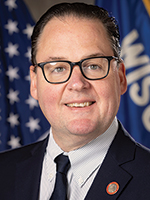
Rep. Ben DeSmidt
Sponsored bills
Maddy summaryAB 968 would require virtual currency kiosks (machines exchanging cash for digital currency or vice versa) to obtain state licenses, display mandatory fraud warnings, and verify customer identities using government ID and photos. It sets a $500 daily transaction limit, caps fees at 3% or $5 per transaction, and mandates detailed receipts showing all transaction details. The bill directly affects kiosk operators and customers, aiming to prevent fraud through identity checks and clear transaction records. Currently under review in the Financial Institutions committee.
Maddy summaryAB 964 clarifies that online sexual extortion targeting children falls under existing law by specifying it as a violation of Section 942.095 when the victim is a child (as defined in Section 948.01). This bill directly affects law enforcement agencies investigating internet crimes against children, enabling them to issue administrative subpoenas to internet companies for relevant data without a court order. The key provision streamlines the process for obtaining evidence from online platforms in cases where children are victims of sexual extortion. It does not create new penalties but ensures these cases are explicitly covered under current statutes for investigative efficiency.
Maddy summaryAB 969 creates a formal drug donation program to redistribute unused medications to eligible patients. It defines key terms like "donor" (including pharmacies, hospitals, and individuals), "eligible patient" (indigent, uninsured, or underinsured individuals), and "recipient" (medical facilities or pharmacies that can receive donations). The bill allows donors to contribute drugs to participating facilities, with recipients permitted to charge a handling fee covering actual costs (e.g., storage, shipping), while prohibiting donations of certain FDA-regulated drugs requiring patient enrollment. This program aims to provide access to medications for underserved patients through a structured, safe, and cost-transparent system.
Maddy summaryAB 194 modifies Wisconsin's housing programs under the Wisconsin Housing and Economic Development Authority. It redefines "developer" to include tribal housing authorities (Section 3) and clarifies "residential housing" to include tax-exempt reservation or trust lands (Section 4). The bill reduces maximum loan limits for housing projects from 33% to 20% of development costs (Section 10) and from 25% to 10% (Section 11). It also requires local governments to submit cost-reduction analyses showing how zoning or fee changes lowered housing costs (Section 7), directly affecting developers, tribal entities, and local governments administering housing programs.
Maddy summaryAB 604 would require Wisconsin's Department of Health Services to request a federal Medicaid waiver to provide pre-release medical coverage for incarcerated individuals eligible for Medicaid. It specifically covers case management, medication-assisted treatment for substance use disorders, and a 30-day supply of prescription medications for up to 90 days before release. This bill directly affects incarcerated people who qualify for Medicaid, aiming to improve continuity of care upon reentry. The waiver request must be submitted by January 1, 2027, to allow state and federal reimbursement for these services. The bill focuses on concrete policy changes to expand healthcare access during a critical transition period.
Maddy summaryThis bill requires state and local government agencies to prioritize purchasing materials manufactured in the United States when all other factors are equal, unless federal law or international agreements prohibit it. It mandates that contracts for public works projects include provisions requiring contractors to use domestically manufactured materials, while exempting purchases intended for commercial resale, stationery, and cases where foreign suppliers do not reciprocate in their own government procurement. The legislation also restricts municipalities from using bidding methods that favor bidders based on geographic location, except when using the United States manufacturing preference. These changes directly affect state departments, municipalities, and contractors bidding on public projects by establishing a preference for American-made goods in government procurement.
Maddy summaryAB 916 creates a state-funded home repair program to address habitability issues and improve energy efficiency in affordable housing. It provides grants of up to $25,000 per unit to eligible homeowners (income ≤100% of area median income who own or occupy their homes) and interest-free loans of up to $25,000 to eligible landlords (owning ≤5 properties/15 units of affordable housing). The program prioritizes repairs for homes with health/safety hazards, energy efficiency upgrades, and accessibility improvements for individuals with disabilities or young children. Properties must be between 10 and 40 years old to qualify, and funds are administered by the state authority or contracted counties/nonprofits with strict reporting requirements.
Maddy summaryAB 1044 creates a state grant program allocating $300,000 for the 2025-26 fiscal year to help adult family homes, community-based residential facilities, nursing homes, and residential care apartment complexes purchase patient lift devices. These devices must be state-approved, allow independent or staff-assisted operation, and mechanically lift a person. Facilities receiving grants must report usage data, with up to $100,000 of the appropriation reserved for collecting and analyzing this information.
Maddy summaryAB 722 imposes annual fees on large energy customers in Wisconsin based on their peak electricity demand, starting at $2 million for those using 100-250 megawatts and increasing by $1 million for each additional 250-megawatt increment. Fifty percent of these fees will fund the Green Innovation Fund, managed by the Wisconsin Economic Development Corporation. The bill also requires data centers to report annual water usage to local governments, certify adherence to sustainable building standards (like LEED or BREEAM) within three years of operation, and pay workers the prevailing wage rate for large-scale construction projects exceeding $250 million in cost. These provisions directly affect large energy users, data center operators, and local governments managing water reporting.