

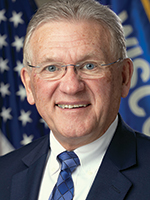
Photo of Jerry O'Connor
R Wisconsin Assembly · District 60

Rep. Jerry O'Connor

Compare
Total votes
420
all sessions
Attendance
99%
6 missed
Near the chamber average
With party
99%
of cast votes
Near the chamber average
Bipartisan score
0%
crosses aisle rarely
Near the chamber average
Sponsored
868
bills & resolutions
Near the chamber average
Committees
6
assignments
868 bills and resolutions

Sponsored bills

Total
868
Primary
868
Co-sponsor
0
This page
868
matching current filters
Primary AJR 72
Failed · Wisconsin Assembly · Lead sponsor
Relating to: recognizing June 19, 2025, as Juneteenth Day in Wisconsin.

Maddy summaryAJR 72 is a ceremonial resolution that officially recognizes June 19, 2025, as Juneteenth Day in Wisconsin. It does not create new laws or policies but formally declares this date to honor the historical significance of Juneteenth, which commemorates the end of slavery in the United States following Union troops' arrival in Galveston, Texas, on June 19, 1865. The resolution acknowledges Wisconsin’s longstanding Juneteenth observance, including Milwaukee’s celebration beginning in 1971. As a symbolic gesture, it has no legal effect beyond promoting awareness of this historical milestone.

Failed Mar 23, 2026 0 co-sponsors
Primary AJR 71
Failed · Wisconsin Assembly · Lead sponsor
Relating to: honoring Jerry Apps for his contributions to Wisconsin’s heritage.

Maddy summaryThis joint resolution (AJR 71) is a ceremonial honor recognizing Jerry Apps for his decades-long contributions to Wisconsin's heritage. It specifically acknowledges his work as a 4-H advocate, UW-Madison professor, author of over 50 books on Wisconsin history and rural life, and recipient of numerous awards. The resolution has no legal effect or policy changes - it solely serves to formally honor his legacy through legislative recognition. It was introduced by multiple legislators and referred to the Rules Committee.

Failed Mar 23, 2026 0 co-sponsors
Primary AB 323
Failed · Wisconsin Assembly · Lead sponsor
Relating to: ratification of the Cosmetology Licensure Compact. (FE)

Maddy summaryAB 323 ratifies the Cosmetology Licensure Compact, an agreement between states to recognize each other's licenses. It allows cosmetologists, aestheticians, and manicurists licensed in another participating state to practice in this state without obtaining a new license, provided they hold a valid "multistate license" from a compact member. The bill amends licensing laws to explicitly permit using such out-of-state licenses (e.g., in sections 454.04(1)(a)2, 454.04(2)(a)) and defines key terms like "multistate license" and "compact." This directly affects licensed professionals seeking to work across state lines within the compact.

Failed Mar 23, 2026 0 co-sponsors
Primary AB 330
Failed · Wisconsin Assembly · Lead sponsor
Relating to: enforcement of the federal Help America Vote Act.

Maddy summaryAB 330 establishes clear deadlines and transparency requirements for handling complaints about voting system compliance with the federal Help America Vote Act (HAVA). It requires Wisconsin's Election Commission to acknowledge complaints within 5 business days, make final decisions within 89 days, and hold public hearings with recorded proceedings. The bill mandates that the Commission must take corrective action for valid complaints and publish dismissal details online and to the legislature. It directly affects the Commission's administrative process for resolving voting-related complaints, ensuring timely, public, and uniform enforcement of HAVA requirements.

Failed Mar 23, 2026 0 co-sponsors
Primary AB 348
Failed · Wisconsin Assembly · Lead sponsor
Relating to: the minimum age of assistant child care teachers.

Maddy summaryAB 348 lowers the minimum age for assistant child care teachers in Wisconsin from 17 or 18 to 16 years old, directly affecting licensed child care centers hiring these staff. To qualify, individuals must complete early childhood education training (e.g., two college credits, a department-approved course, or an approved program) within six months. The bill maintains current rules that assistant teachers may only provide sole supervision during specific times (like opening/closing hours or naptime) if a qualified child care teacher is present on-site. It does not change requirements for child care teachers themselves.

Failed Mar 23, 2026 0 co-sponsors
Primary AB 350
Failed · Wisconsin Assembly · Lead sponsor
Relating to: the regulation of family and group child care centers. (FE)

Maddy summaryAB 350, introduced on July 8, 2025, by multiple state representatives and senators, aims to establish new regulations for family and group child care centers. It directly affects child care providers operating under these models by setting standards for safety, staffing, and facility requirements. The bill is currently referred to the Committee on Children and Families for further review. As introduced, it focuses on creating specific regulatory frameworks for these centers without detailing exact provisions in the provided context.

Failed Mar 23, 2026 0 co-sponsors
Primary AB 349
Failed · Wisconsin Assembly · Lead sponsor
Relating to: allowing certified child care operators to provide care to up to six children. (FE)

Maddy summaryAB 349 would allow certified child care operators to provide care for up to six children, changing the current capacity limit for licensed providers. This directly affects licensed child care facilities operating under state certification. The bill amends regulatory standards to establish six as the new maximum number of children per certified operator. It applies specifically to certified settings and does not alter requirements for unlicensed care.

Failed Mar 23, 2026 0 co-sponsors
Primary AB 190
Failed · Wisconsin Assembly · Lead sponsor
Relating to: obtaining attorney fees and costs under the state’s public records law when an authority voluntarily or unilaterally releases a contested record after an action has been filed in court.

Maddy summaryAB 190 modifies state public records law to allow requesters who win partial victories to recover attorney fees. Specifically, it enables fee recovery when a government agency voluntarily releases a contested record *after* a lawsuit is filed, and a court determines the lawsuit was a substantial factor in that release. This directly affects public record requesters who successfully pressure agencies to disclose documents through litigation without a full court judgment. The bill creates a clear mechanism for fee awards in these specific scenarios, avoiding the need for a formal court order on the record's disclosure.

Failed Mar 23, 2026 0 co-sponsors
Primary AB 81
Failed · Wisconsin Assembly · Lead sponsor
Relating to: excluding expenditures funded by referenda from shared costs for the purpose of determining equalization aid for school districts. (FE)

Maddy summaryAB 81 modifies how school districts calculate state aid by excluding certain referendum-funded expenditures from "shared costs." Specifically, it removes from the calculation any debt service costs from referenda approved after the bill's effective date that authorized borrowing of at least $50 million (unless the district's equalized valuation exceeded a specific threshold). This means school districts using referendum funds for large capital projects will not see those costs reduce their state equalization aid. The bill directly affects districts that have approved significant referendum bonds for school improvements or construction.

Failed Mar 23, 2026 0 co-sponsors
Primary AB 174
Failed · Wisconsin Assembly · Lead sponsor
Relating to: transmission facilities; installation of large wind energy, large solar energy, and battery energy storage systems; installation of light-mitigating technology systems; and prioritizing nuclear energy resources. (FE)

Maddy summaryAB 174 amends energy statutes to redefine "renewable resources" for reporting purposes, explicitly including nuclear energy starting in 2026. It establishes new definitions for large-scale wind/solar systems (100+ megawatts) and battery storage, while clarifying that local governments cannot restrict energy installations more strictly than state rules. The bill affects energy developers, utilities, and local governments by changing how transmission contracts are audited and how renewable/nuclear projects are categorized. It does not create new project requirements but updates existing reporting frameworks for the state legislature and governor. The bill is pending in the Energy and Utilities Committee after being introduced in April 2025.

Failed Mar 23, 2026 0 co-sponsors
Showing 221 to 230 of 868 bills
Previous 1 … 22 23 24 … 87 Next