

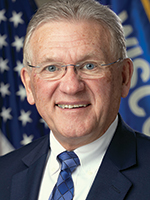
Photo of Jerry O'Connor
R Wisconsin Assembly · District 60

Rep. Jerry O'Connor

Compare
Total votes
420
all sessions
Attendance
99%
6 missed
Near the chamber average
With party
99%
of cast votes
Near the chamber average
Bipartisan score
0%
crosses aisle rarely
Near the chamber average
Sponsored
868
bills & resolutions
Near the chamber average
Committees
6
assignments
868 bills and resolutions

Sponsored bills

Total
868
Primary
868
Co-sponsor
0
This page
868
matching current filters
Primary AB 262
Failed · Wisconsin Assembly · Lead sponsor
Relating to: findings of fact when the court grants less than equal physical placement of a child.

Maddy summaryAB 262 modifies the legal requirements for courts when determining child physical placement in custody cases, directly affecting parents and children involved in these proceedings. The bill changes the threshold for when a court must provide specific findings of fact regarding its placement decisions. Currently, courts must provide these findings if a parent receives less than 25% of physical placement time. AB 262 increases this to 50%, meaning if a court grants one parent less than half of a child's physical placement, it must enter specific findings explaining why a greater allocation is not in the child's best interest.

Failed Mar 23, 2026 0 co-sponsors
Primary AB 159
Failed · Wisconsin Assembly · Lead sponsor
Relating to: creating a rural creative economy development grant program. (FE)

Maddy summaryAB 159 creates a grant program to support rural creative economy development in Wisconsin. It provides competitive grants of up to $50,000 to eligible applicants - including rural cities, tribes, nonprofits, and economic development organizations - for projects like renovating public spaces, supporting public arts, and promoting local creative businesses. Applicants must secure matching funds from nonstate sources (with no more than 25% in-kind), and grants must directly benefit rural areas defined as populations under 10,000 or non-urbanized regions. The Wisconsin Economic Development Corporation must report on the program's effectiveness by May 2027.

Failed Mar 23, 2026 0 co-sponsors
Primary AB 292
Failed · Wisconsin Assembly · Lead sponsor
Relating to: the use of artificial intelligence or other machine assisted translation in court proceedings and of telephone or live audiovisual interpretation in criminal trials. (FE)

Maddy summaryAB 292 allows courts to use artificial intelligence or machine-assisted translation services instead of or alongside human interpreters in both civil and criminal court proceedings. It also updates rules to permit telephone or live audiovisual interpretation in criminal trials (beyond just non-trial stages) and clarifies that using AI translation does not require a waiver that would normally be needed for alternative interpretation methods. This bill directly affects court proceedings involving language barriers, expanding options for language assistance without mandating AI use. The law amends specific statutes to implement these changes, focusing on procedural flexibility for courts.

Failed Mar 23, 2026 0 co-sponsors
Primary AB 40
Failed · Wisconsin Assembly · Lead sponsor
Relating to: school safety grants and making an appropriation. (FE)

Maddy summaryAB 40 establishes a competitive grant program to fund school safety improvements and security training for school personnel. It allocates $30 million for the 2025-26 fiscal year to public, private, and tribal schools, with a maximum grant of $20,000 per school. The program prioritizes schools that have not previously received similar grants under Section 165.88 and requires annual reports to the Joint Committee on Finance. Grants must be awarded by June 30, 2027, after which no new funding will be issued.

Failed Mar 23, 2026 0 co-sponsors
Primary AB 231
Failed · Wisconsin Assembly · Lead sponsor
Relating to: creating a tax credit for expenses related to film production services and for capital investments made by a film production company, granting rule-making authority, and making an appropriation. (FE)

Maddy summaryAB 231 creates a 25% tax credit for film production companies in Wisconsin covering eligible expenses (like wages, equipment, and location costs) and capital investments for accredited productions. It directly affects film production companies operating in Wisconsin that meet minimum spending thresholds ($50,000 or $100,000 depending on production length) and excludes news, sports, or corporate content. The bill establishes a State Film Office to administer the program, requiring accredited productions to include a state acknowledgment in the final film and mandating annual reports on credit allocations. It caps annual tax credits at $10 million statewide and $1 million per company, with strict eligibility rules and third-party audit requirements to ensure compliance.

Failed Mar 23, 2026 0 co-sponsors
Primary AJR 8
Failed · Wisconsin Assembly · Lead sponsor
Relating to: restricting the governor’s partial veto authority to only rejecting entire bill sections of an appropriation bill that are capable of separate enactment and reducing appropriations in a bill (first consideration).

Maddy summaryAJR 8 proposes a constitutional amendment to limit the governor's partial veto power on budget bills. It would prevent the governor from rejecting small parts of a bill (like single words or sentences) and require that any vetoed section must be a complete, standalone law that can function independently. The bill specifically targets appropriation bills, restricting the governor to vetoing entire sections that are capable of separate enactment. This is a proposed constitutional change, not a law, and would need voter approval to take effect. The amendment aims to reduce the governor's ability to alter budget bills through partial vetoes.

Failed Mar 23, 2026 0 co-sponsors
Primary AB 286
Failed · Wisconsin Assembly · Lead sponsor
Relating to: interest earned on coronavirus state and local fiscal recovery funds. (FE)

Maddy summaryAB 286 redirects $172 million in interest earned from unused coronavirus state and local fiscal recovery funds to the general state fund. It applies to funds held under specific state appropriations (section 20.505(1)(mb)) that were not spent by the deadline. The bill transfers this interest directly to the general fund on its effective date, rather than allowing it to remain in the recovery fund. This is a procedural adjustment to reallocate existing interest earnings, not a new funding program.

Failed Mar 23, 2026 0 co-sponsors
Primary AB 71
Failed · Wisconsin Assembly · Lead sponsor
Relating to: school district operating referenda.

Maddy summaryAB 71 changes how school districts in Wisconsin can seek voter approval to exceed their standard operating budget limits. It requires school boards to adopt a resolution specifying whether excess funds are for recurring (ongoing) or nonrecurring (one-time) purposes, and limits such resolutions to four years. Voters must approve these requests via referendum, with ballots clearly stating the amount for nonrecurring uses. Crucially, if approved for recurring purposes, the excess amount becomes part of the next year's budget base; for nonrecurring purposes, it does not affect future budget limits. This bill directly affects school districts seeking to fund additional programs beyond their regular budget without voter approval.

Failed Mar 23, 2026 0 co-sponsors
Primary AB 297
Failed · Wisconsin Assembly · Lead sponsor
Relating to: performance grants based on improving employment rates for individuals on probation, parole, or extended supervision. (FE)

Maddy summaryAB 297 creates performance grants for regional probation and parole offices based on improving employment rates for individuals on supervision (probation, parole, or extended supervision). Offices earn grants by increasing employment rates above a 2021-2024 baseline, with "eligible employment" defined as 130+ wage-earning hours monthly. Funds must be used for employee bonuses, and the department tracks outcomes like employment duration, recidivism rates, and cost savings tied to reduced incarceration. Offices are disqualified from grants if their region saw increased revocations for new crimes in the prior year. Annual reports will detail regional employment trends and program impacts for public transparency.

Failed Mar 23, 2026 0 co-sponsors
Primary AB 27
Failed · Wisconsin Assembly · Lead sponsor
Relating to: expanding veterans benefits to individuals who served in Laos in support of the United States during the Vietnam War.

Maddy summaryAB 27 expands eligibility for state veterans' benefits to include individuals who served in Laos supporting U.S. forces during the Vietnam War and were naturalized under the federal Hmong Veterans Naturalization Act of 2000. The bill updates state statutes to define these veterans as qualifying for property tax exemptions (under 36.27) and other benefit programs (under 38.24 and 45.01). It specifically adds them to eligibility criteria for benefits previously limited to other veteran categories. This change directly affects Hmong veterans residing in the state who meet the federal naturalization requirements. The bill passed committee unanimously and is now pending in the Rules committee.

Failed Mar 23, 2026 0 co-sponsors
Showing 201 to 210 of 868 bills
Previous 1 … 20 21 22 … 87 Next